The ‘Hard Currency’ of Agarwood: Why This Nha Trang Sinking White Kinam (12mm) is a Heritage-Level Investment?
In the world of Agarwood, there is a saying: ‘It takes three lifetimes of merit to smell Kinam.’ In my twenty-plus years in this trade, I have handled mountains of incense, but the one I truly cherish—the one I hesitate to show even to my closest friends—is this 12mm Sinking White Kinam bracelet from Nha Trang’s core old-growth area. It is more than just a piece of jewelry; it is a legend frozen in time. Many friends ask me: ‘Lao Wang, what makes a piece truly graduation-level?’ Today, I will skip the boring textbook theories and share the thrilling story behind these beads, along with the secret identification logic used by insiders. By the end, you will understand why, in today’s asset-scarce market, this remains a ‘hard currency’ that survives economic cycles.
Origins: The 2012 ‘Scent Gambling’ Thrill in the Deep Mountains of Nha Trang
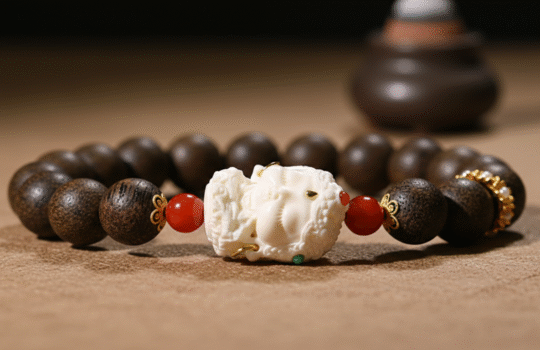
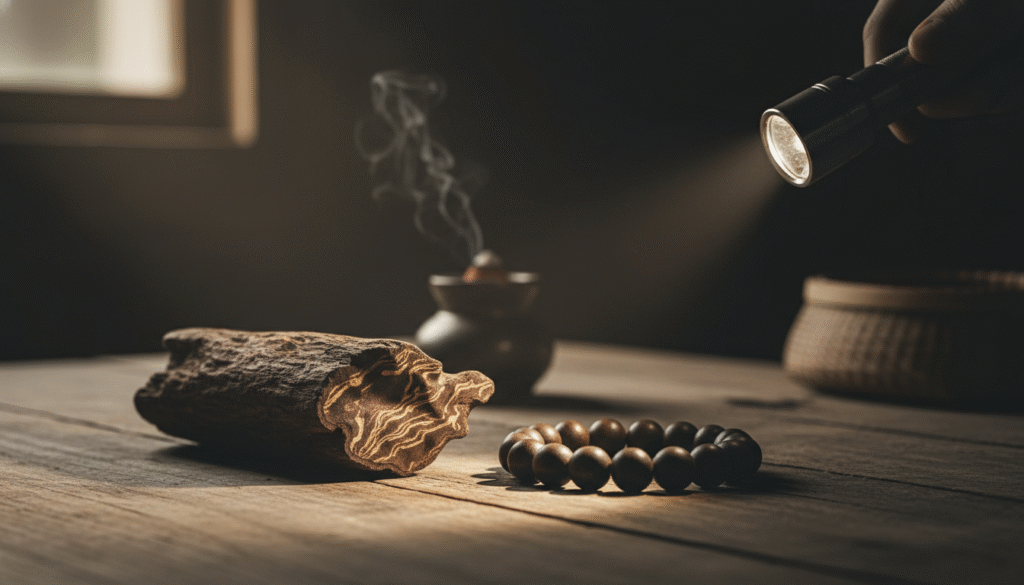
The story dates back to 2012. I traveled alone to a remote village in Khanh Hoa Province, Vietnam. An elderly farmer tremblingly pulled a piece of unsightly black wood, looking like rotten firewood, from a rice jar under his stove. This was the predecessor of this 12mm bracelet—a 300-gram ‘Raw Knot’ (Sheng Jie) old-growth White Kinam from Nha Trang. To acquire it, I staked nearly all my liquid capital at the time; this is what we call ‘Scent Gambling.’ I dared to bet because, under a strong flashlight, the thick patina revealed a breathtaking ‘Soft Silk’ luster—a soulful, haunting glow that cannot be faked. The moment it was cut, the room went silent. Oil seeped out like honey, sticky to the blade and forming threads. It was top-tier ‘White Kinam.’ These beads were carved from the ‘Dragon Spine’—the core area with the highest oil density. To avoid internal cracks, I sacrificed nearly 40% of the premium material to craft these 17 flawless 12mm beads. Every bead is a survivor of that gamble and a masterpiece of nature’s centuries-old creation.
Visual Codes: The ‘Soft Silk’ Universe Under the Microscope
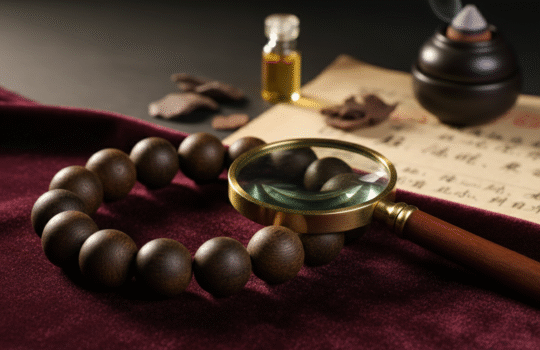
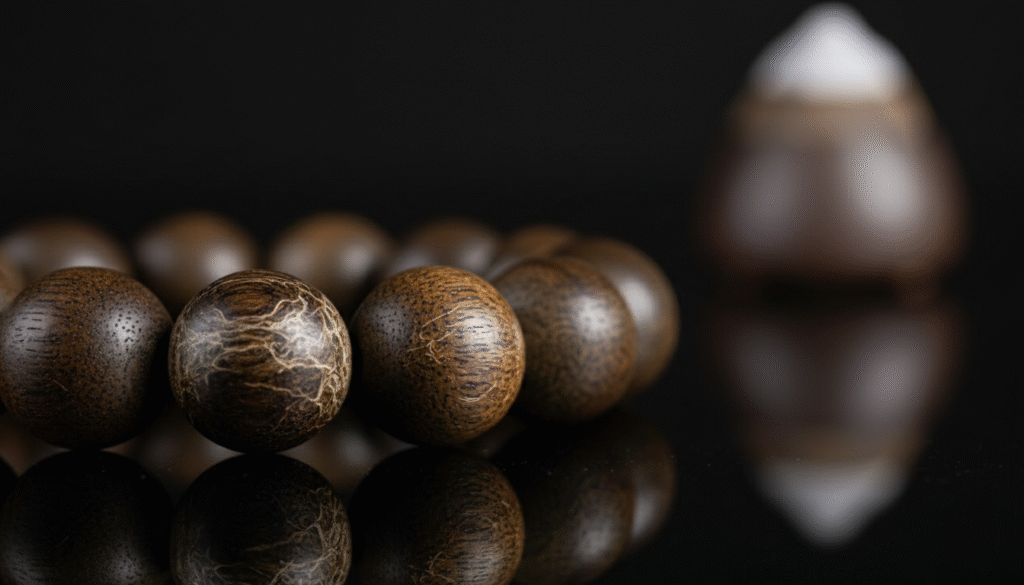
After the story, let’s look at the physical attributes. Many novices only look for ‘blackness’ in Agarwood, but with White Kinam, that is a superficial metric. Under a magnifying glass, these 12mm beads reveal a dynamic ‘oil-wood symbiosis’ rather than a dull, dark surface. The signature ‘Soft Silk’ characteristic of White Kinam is fully displayed: the oil glands are not rigidly aligned with the vessels but permeate the wood fibers in patches and clusters, like an ink wash painting. Ancients described this texture as ‘curling when shaved, kneading into a pill,’ as if the oil itself were alive. When held in the hand, the ‘Sinking Grade’ weight instantly conquers your palm. This is not the weight of wood, but the density of high-saturation active resin. In natural light, it emits a faint silvery-white luster—hence the name ‘White Kinam’—stunningly beautiful.
A Feast for the Senses: A Time Tunnel of Five Shifting Flavors
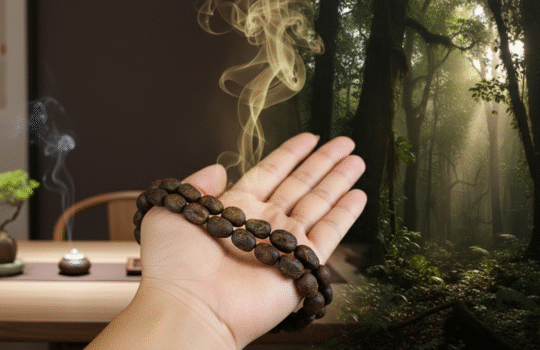
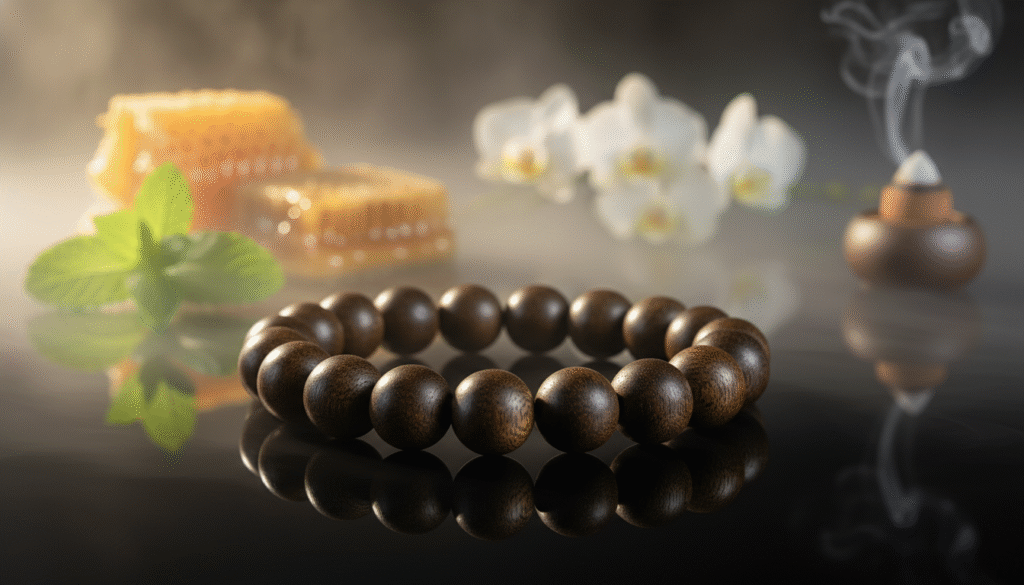
If visuals determine the price, the scent determines the soul. This Nha Trang White Kinam is the ‘King of Kings’ because of its uncopiable ‘Five-Flavor Profile.’ At room temperature, without heating, a gentle sniff begins the sensory journey: First, a powerful coolness, like a burst of mint, hits the crown of the head, instantly refreshing the mind. Then, as the coolness fades, a rich milky sweetness and honey-like aroma surge forward, thick like aged honey—sweet but never cloying. Finally, the most enchanting moment: a lingering, ethereal scent of white orchid that hovers at the tip of the nose. This three-stage scent evolution—from cool to sweet to elegant—is a ‘scent DNA’ that no synthetic fragrance can simulate. Owning this is like carrying a portable fragrance museum.
The Insider’s Guide: Hardcore Identification and Private Invitation
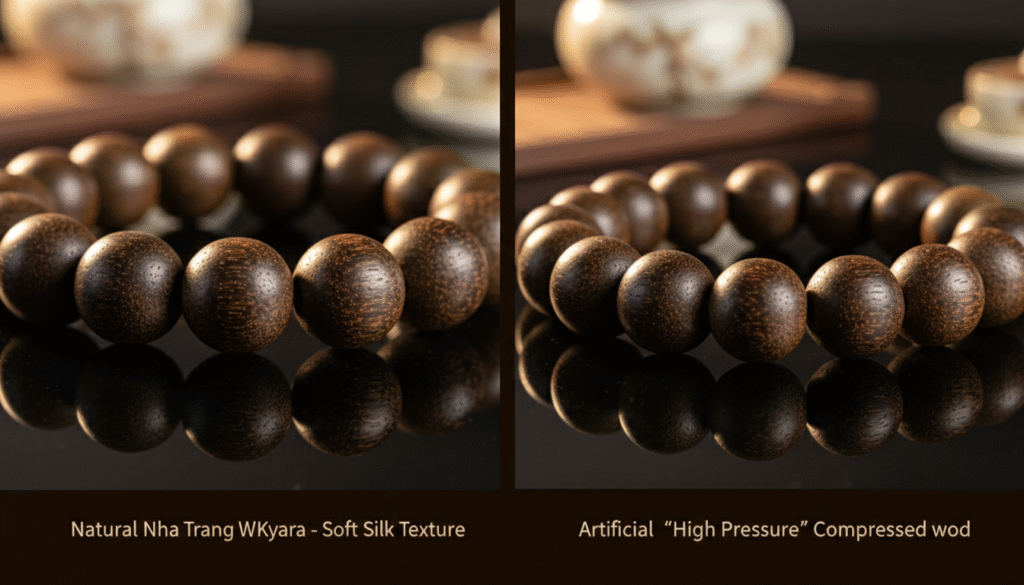
To help collectors understand this ‘Heritage Choice’ and avoid pitfalls, I have summarized this comparison table. These are the hard metrics you can use when searching for authentic pieces: [Oil Structure] Natural: Soft Silk smudge effect, oil in patches, resilient texture. Fake: Rigid black lines, looks unnatural, dry interior (High-pressure injection). [Scent Layers] Natural: Three-stage explosion (Cool/Sweet/Elegant), high penetration. Fake: Single-note chemical sweetness, causes headaches, no evolution. [Taste] Natural: Numbing, spicy, and cool on the tongue. Fake: Bitter or tasteless. [Scarcity] Natural: One-of-a-kind, depleted core origins. Fake: Mass-produced with identical patterns. This 12mm bracelet matches every criterion of a genuine masterpiece. Truth be told, photos cannot capture its true essence. If you have a piece you are unsure about, or want to see high-definition macro videos of this legendary item, click ‘Book a Viewing’ or message ‘Lao Wang’ directly. Even if you don’t buy, we can share our passion for incense—don’t let fakes ruin your spiritual journey.
FAQs
Q. Why is Nha Trang White Kinam considered the ‘hard currency’ of Agarwood?
A. Because resources in its core origin are nearly extinct. White Kinam possesses the ultimate fragrance profile and extreme scarcity. It has high liquidity in auction markets and high-net-worth circles, making it a premier asset for preserving and increasing wealth against inflation.
Q. What is ‘Soft Silk’ and how does it differ from regular Agarwood?
A. ‘Soft Silk’ is a unique oil form found in Kinam where the resin is semi-fluid and soft. Regular Agarwood is usually ‘Hard Silk’ with a solid, woody texture. Soft Silk has far superior fragrance diffusion and explosive power compared to Hard Silk.
Q. What does ‘Sinking Grade’ mean for 12mm beads?
A. It indicates extremely high oil content and density. For a bead of this volume to sink, the oil content usually exceeds 80%. Achieving this in 12mm beads is rare, as they are selected from hundreds of pounds of raw material.
Q. How should this bracelet be maintained daily?
A. White Kinam is rich in oil and soft. Avoid high temperatures and chemicals like soap or perfume. While wearing it, the natural patina will protect it. When not in use, store it in a sealed bag or professional box in a cool place to let the oil self-maintain.