The ‘Black Pearl’ Paradox: Why Chinese Kinam Barrel Beads Are the Collector’s End-Game
Decades ago, inside a private tea room in Dongguan, a veteran collector handed me a rough, charcoal-like nodule and whispered, ‘Do not look with your eyes; look with your breath.’ That piece was legendary ‘Guanxiang’ (Chinese Kinam)—resin so aggressive it had literally consumed the wood. He called it the ‘Black Pearl of the Earth.’
Today, I see many novices chasing the flashy patterns of Vietnamese wood, missing the point entirely. We need to talk about the ‘Silent Giant.’ The Chinese Kinam Barrel Beads we discuss today are the direct spiritual descendants of that nodule. They represent the pinnacle of ‘Sinking Grade’—a biological miracle where wood surrenders to oil. This isn’t just jewelry; it’s a masterclass in nature’s dominance. Let me explain why the barrel shape is the only respectful way to hold this heavy spirituality.
The Visual Truth: ‘Oil Wrapping Wood’ (油包木)
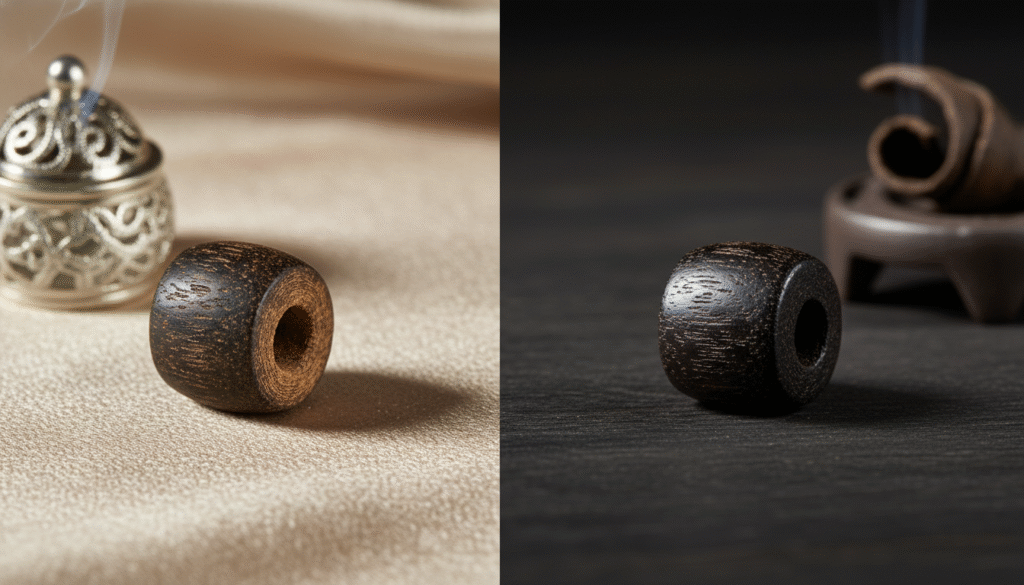
In the trade, we have a saying: ‘Ink frozen in time.’ When you hold these beads, forget what you know about wood grain. You are looking at ‘Oil Wrapping Wood’ (You Bao Mu). Unlike common agarwood where you count the pore lines, here, the surface is a seamless, paste-like fusion. It looks wet, doesn’t it? But touch it—it’s dry, smooth, and waxy. This ‘grease-like’ saturation is the visual signature of the Guanxiang lineage. It suggests that if you were to squeeze the bead, black elixir would drip out. If you find a bead that looks like a solid chunk of dark chocolate, hold onto it. That is the wood submitting to the oil.

The Philosophy of the Barrel Cut: Why Spheres Are a ‘Sin’
I often get asked, ‘Why not perfectly round beads?’ My answer is always the same: reverence. To grind rare Chinese Kinam into a perfect sphere is to commit violence against nature, wasting nearly 40% of this ‘black gold’ as dust. A true master refuses to do that. The Barrel Cut (Tong Zhu) follows the natural ‘vein’ of the resin flow, preserving the ‘meat’ of the agarwood. It mimics the original segment of the fallen branch. When you wear a barrel bead, you are wearing the conservationist’s choice. You are prioritizing the spirit of the material over the geometry of the market.

The Silent Giant: Chinese vs. Vietnamese Kinam
Let’s be honest. Vietnamese Nha Trang Kinam is a rockstar—flashy, high contrast, extroverted. But Chinese Kinam? It is an old soul. It is introverted.
The Distinction:
- The Flash (Vietnamese): Reddish flesh fighting black lines. It screams for attention.
- The Void (Chinese): There is no war, only unity. The oil has won. The bead appears as a uniform block of darkness that absorbs light rather than reflecting it.
To the uninitiated, the Vietnamese bead looks ‘prettier.’ But trust me, to the veteran collector, the Chinese bead looks ‘eternal.’ It doesn’t need to show off.
The Invitation: Are You Ready for the ‘Cool Honey’ Resonance?
The visual is the body, but the scent is the soul. Chinese Kinam breathes at room temperature. The moment this barrel strand warms on your pulse, a piercing ‘coolness’ (Liang) travels up your nose—clean, minty, almost medicinal. It is immediately followed by a thick, creamy honey sweetness that settles in the throat. It’s a scent that lowers your blood pressure.
My Final Advice: These pieces do not stay in the public market long. They are usually whispered from one private collection to another. If you believe your energy aligns with this ‘Silent Giant,’ I invite you to reach out. Don’t ask for a price list; ask for a ‘Compatibility Check.’ Let’s see if this wood is meant for your wrist.

FAQs
Q.Why do experts say the Barrel shape is more ‘valuable’ than the Round shape?
A.It’s about density and respect. The Barrel shape retains more of the original resin-heavy core. A round bead sacrifices the most valuable outer layers to achieve symmetry. In the world of Gram-for-Gram value, the Barrel is the ‘King’s Cut.’
Q.How can I tell if the ‘waxy’ look is real or just polish?
A.Great question. Artificial polish sits *on top* and looks glossy like glass immediately. True ‘Oil Wrapping Wood’ has a ‘Soft Focus’ sheen—it looks like deep, matte wax that glows from within. It shouldn’t look like plastic; it should look like solidified oil.
Q.Does Chinese Kinam really smell different from Vietnamese Kinam?
A.Absolutely. Vietnamese Kinam is floral, fruity, and explosive. Chinese Kinam (Guanxiang) is medicinal, milky, and cooling. It is less about ‘perfume’ and more about ‘Qi’ (Energy). It centers you.