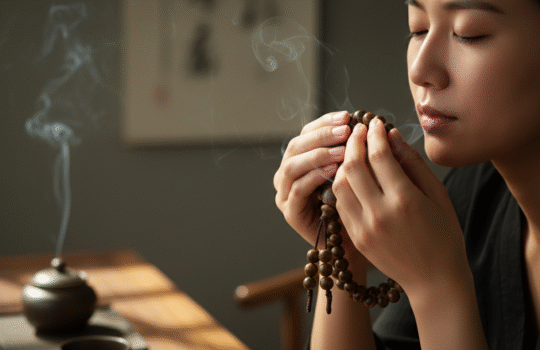
Record of a Rare “National Fragrance”: 108-Bead Wild Chinese Agarwood “Tiger Skin” Mala Through an Exporter’s Eyes
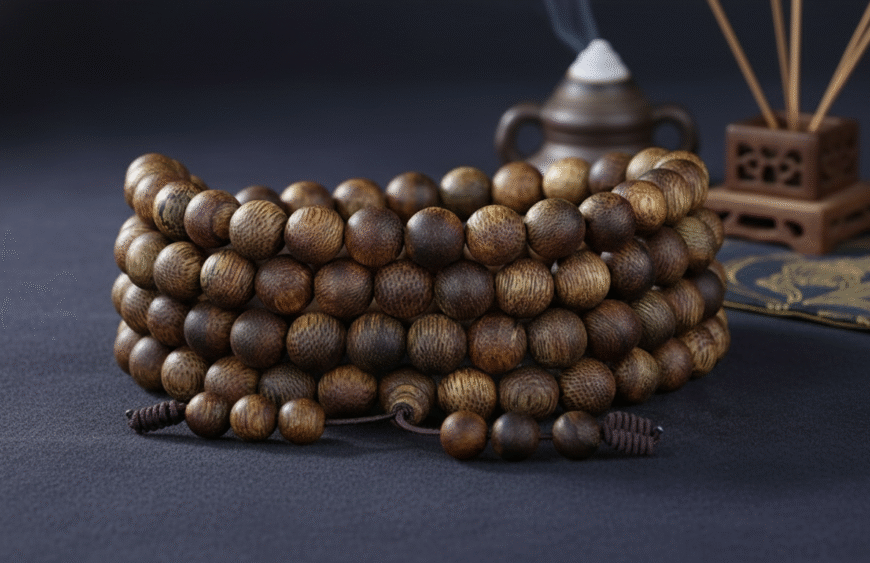
Having spent decades in this trade, I have handled countless pieces of agarwood from Vietnam and Indonesia. However, my deepest memory remains an encounter twenty years ago in the mountains of Dianbai, Guangdong. After a heavy rain, an old farmer pulled a dust-covered piece of wood from the bottom of a rice jar. The first cut revealed the breathtaking “Tiger Skin” pattern. Today, as I hold this 108-bead mala crafted from similar wild old-growth material, my heart still skips a beat. This isn’t just sentiment; it’s an instinctive reverence for a “unique specimen of nature.” Many newcomers ask: what defines “authentic quality at first sight”? Today, I’m setting aside my merchant persona to examine this “Tiger Skin” agarwood through the lens of a craftsman. We won’t discuss vague concepts, only the raw details I’ve witnessed on the trading frontlines and in the deep mountains. For collectors seeking spiritual peace, this is more than an accessory—it’s a non-renewable piece of Chinese fragrance history.
Visual Evidence: Identifying Authenticity at a Glance—What is “Living” Tiger Skin?
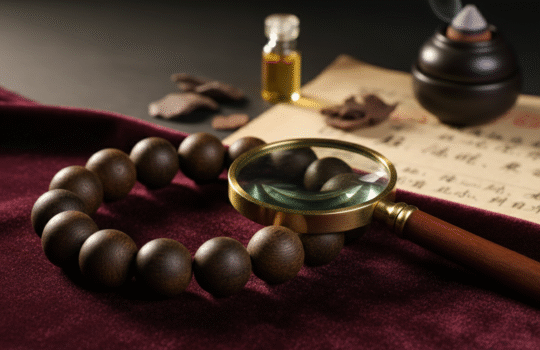
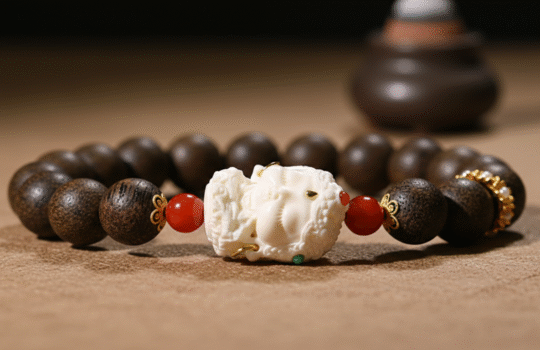
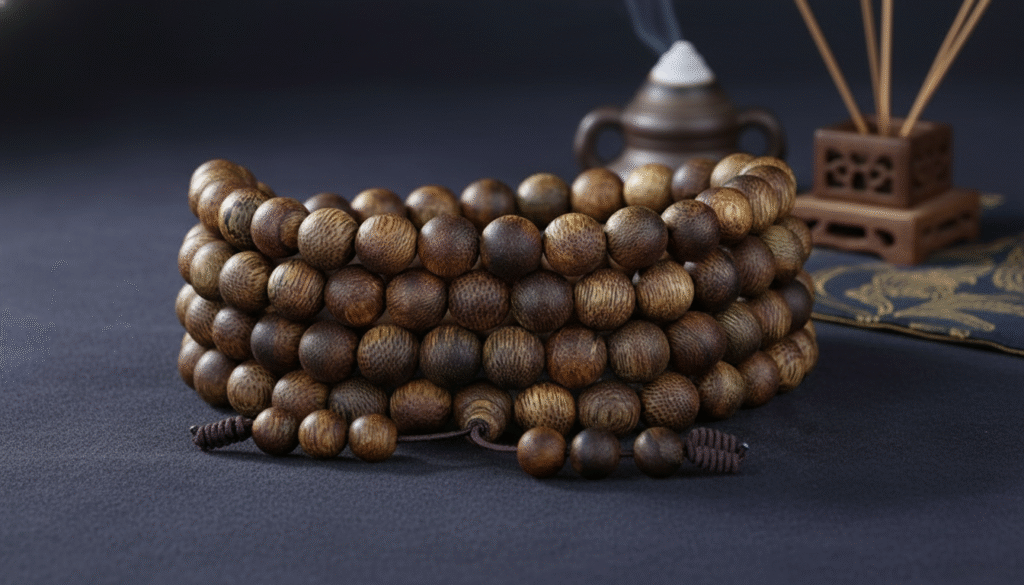
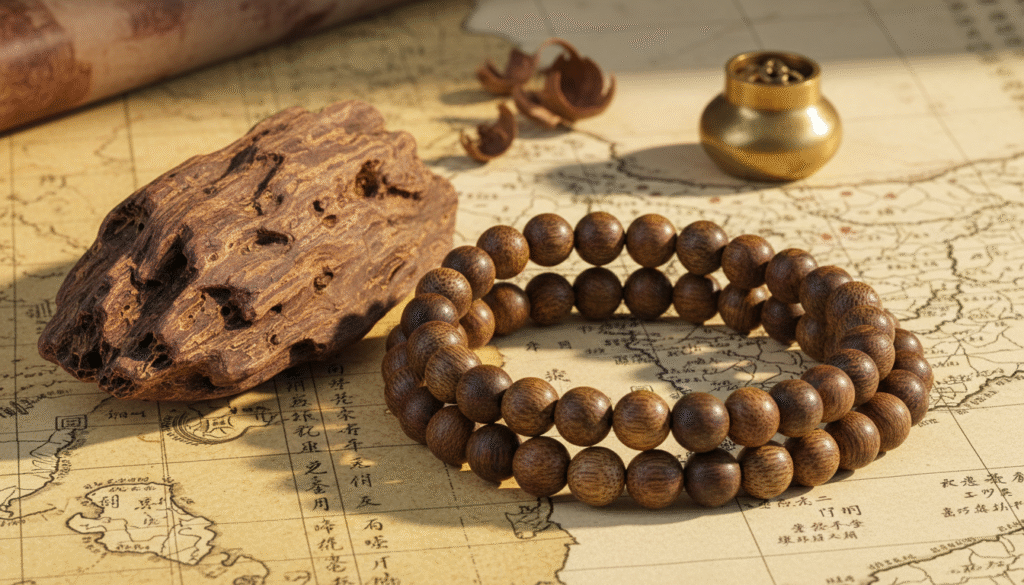
The first thing that will strike you about this mala is the iconic “Tiger Skin” oil lines. Experienced collectors know that the black, unnaturally shiny beads often found on the market are mostly “dead” objects—highly polished or oil-rubbed. This mala, however, is a natural imprint left by the resins of Aquilaria Sinensis, which seeped through the wood layers under the unique subtropical monsoon climate of South China over many years. Observe the surface closely: the color is an antique interlacing of deep brown and golden bronze, with an oiliness so rich it seems to overflow from the wood grain. This black-and-yellow pattern possesses both the majesty of a tiger and the stability of time. Each bead is polished exceptionally round while retaining delicate “pore” textures. This texture tells us the wood is “alive,” originating from resilient wild trees that recorded the rain and sunlight of those ancient forests.
The Soul of Scent: From the Morning Mist of “Wuzhi Mountain” to the Medicinal Aura of “Ancient Temples”
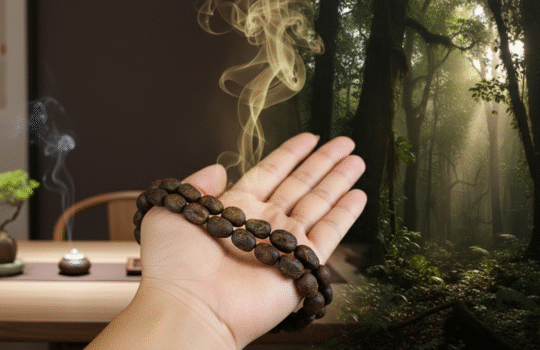
Many international clients ask me about the difference between Chinese Agarwood and the Star-cluster (Hoi-An/Sing-洲) varieties. I tell them the difference lies in its “innate elegance” and “penetrating coolness.” The fragrance of this Tiger Skin mala is never a superficial or cloying scent; it is a crisp clarity unique to the mountains of Hainan or Guangdong. Upon the first whiff, your nasal passages feel a distinct cooling sensation, as if standing deep in the mist-shrouded Wuzhi Mountain at dawn. This is followed by a long-lasting, mellow honey-sweet aroma that is comforting rather than overwhelming. The most remarkable part is the finish—a warm medicinal fragrance unique to indigenous Chinese agarwood. For those accustomed to Zen practice or meditation, this scent quickly settles the mind. It is understated; you don’t need to search for it, but when you sit in silence, the fragrance lingers around you persistently. This is what we call “Noble Air.”
Collection Trends: Why a 108-Bead “National Fragrance” is the Anchor of Asset Allocation
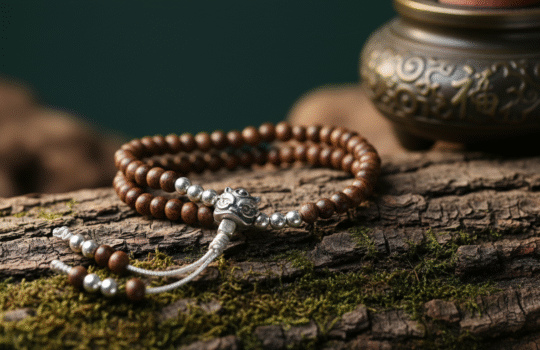
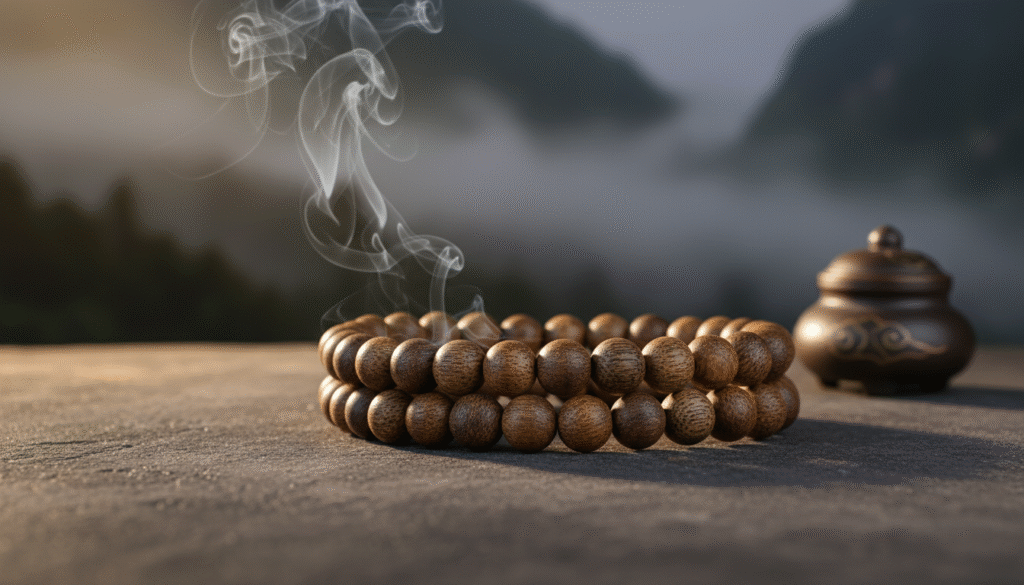
As an exporter, I must candidly reveal a harsh market reality: the depletion of wild Chinese agarwood resources is faster than imagined. In the past, we could occasionally find old material in remote villages of Guangdong and Guangxi. Today, finding 108 beads crafted from large, high-quality “Shu-Jie” (matured) logs with such clear oil lines is rare. Crafting 108 beads involves staggering material waste, requiring a single log to be flawless and crack-free—an ultimate luxury for a scarce resource. In the secondary market, Chinese agarwood with distinct visual features (like Tiger Skin) and pure origin commands high premiums. If you aren’t just looking for a bracelet but want to collect a “hard currency” heirloom, these beads are the definitive choice. If you have questions or want to learn the secrets of identifying old materials, click the consultation button below. I have reserved half an hour for a one-on-one session to discuss the art of fragrance and the “Tao” of agarwood.
FAQs
Q.What is Agarwood “Tiger Skin” and what quality does it represent?
A.”Tiger Skin” is a unique visual trait of Chinese Agarwood (Aquilaria Sinensis species). It refers to the alternating pattern of deep brown resin lines and golden wood fibers, resembling tiger stripes. In wild agarwood, this usually signifies high oil content and long formation periods, where the resin follows the wood vessels to create an ornamental distribution—a vital identity for high-quality domestic agarwood.
Q.Will the scent of this Chinese Agarwood disappear over time?
A.Absolutely not. This is “Shu-Jie” old-growth agarwood, where the resin has stabilized through aging. With proper care (avoiding chemicals and high heat), the body heat from wearing or handling the beads will actually stimulate the deeper medicinal and honey notes. This reflects the industry saying: “The person nurtures the jade, the jade nurtures the person; person and scent nourish each other.” The fragrance becomes mellower and more spiritual with age.
Q.As an investment or collection, why choose a 108-bead long mala?
A.A 108-bead mala is considered a “masterpiece” in the collectible market. Compared to single-loop bracelets, a 108-bead strand demands extreme volume and integrity from the raw material, with a high waste rate. As wild resources dwindle, a log capable of producing a perfect 108-bead set could often produce several single bracelets instead. Therefore, for the same quality, the rarity, cultural significance, and value appreciation potential of a 108-bead mala are significantly higher than standard specifications.