Original Old Stock: Why This ‘Success Upon Arrival’ Carving from the ‘Guang-Hai’ Region is a Hard Currency in the Collection World?
“Discover what authentic domestic agarwood (Hainan/Huizhou) looks like. This 'Success Upon Arrival' carving showcases the honey-knotted texture and black oil lines of the Aquilaria sinensis. Learn the value logic of high-density material from a veteran collector.”
Having spent decades in this industry and handled countless pieces of agarwood, I must tell you from the heart: my pulse still quickens whenever I encounter true ‘domestic old stock.’ In today’s market, where Vietnamese and Indonesian materials are everywhere, finding a solid piece of wild-grade agarwood from the golden production zone of 18-23 degrees north latitude (the Guang-Hai system, characterized by the climate of the Guangdong-Hainan border) is about as rare as winning the lottery! I remember when this material was first recovered; it was pulled from an old incense farmer’s rice vat in Huidong, covered in dust and quite unassuming. But once I applied the Ruyi brush, that ‘black iron luster’—honed by burial in red soil and baptism by subtropical monsoons—emerged instantly. I’ll never forget that feeling of awe. Today, let’s skip the empty theories and use this ‘Success Upon Arrival’ hand-carved piece as an example. Looking at the physical object, we’ll discuss why this domestic incense, grown in red soil and formed in the path of typhoons, is the true inflation-resistant ‘hard currency’ of the collectible circle. If you are a collector pursuing ultimate oiliness and regional lineage, I suggest reading this note carefully.
Identify Authenticity at a Glance: Interweaving Oil and Fibers of the Authentic ‘Guan-Xiang’ Species
Many friends ask me how to distinguish domestic material from Southeast Asian material at a glance. I tell them: don’t just listen to stories, look at the oil lines! Take this horse carving as an example; under natural light, its oil line texture is clear and dense, showing a typical ‘gathering’ effect. This is a unique characteristic of the domestic Guan-Xiang tree (Aquilaria sinensis). Unlike the loose structure of Southeast Asian rainforest material, the Guang-Hai region has distinct seasons and frequent typhoons. The long recovery cycle after a tree is injured results in an extremely tight interweaving of resin and wood fibers. Look at those deep black lines on the side of the horse’s body; those are ‘medals’ left by the tree resisting wind and rain decades ago. This visual sense of ‘entanglement’ is the result of resin mellowing slowly in red soil under specific temperature and humidity over long years. This piece has full resin and a naturally deep color, exuding a restrained matte texture known in the trade as ‘Iron Bone, Tender Heart.’ This is the specific aged character of high-latitude regions, a look that many new materials cannot replicate no matter how they are artificially aged.
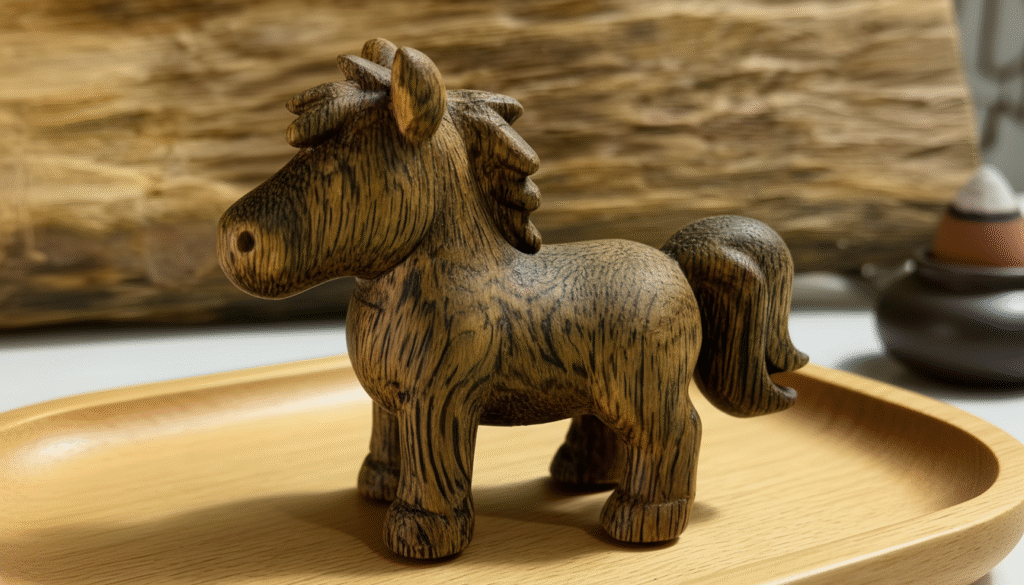
Cherishing Wood Like Gold: Good Material Deserves Fine Craftsmanship
Anyone who plays with agarwood knows that domestic old stock is worth its weight in gold; the biggest fear is it being ‘ruined by carving.’ This piece is a high-quality domestic agarwood solid block, and it is also a typically irregular ‘following-the-form’ material. When I first got it, I saw its shape resembled a powerful horse ready to gallop, but this required the carver to have high intuition. This work is entirely hand-carved with precision. Look at the muscular lines of the horse; the lines are rounded and smooth, and the craftsmanship is exquisite. Especially in the mane and the power in the limbs, the carver followed the unique twisted grain of the Guan-Xiang wood. This not only preserved the maximum weight of the material but also avoided the loose white wood parts, leaving only the high-oil sections. The dark resin knots at the horse’s legs perfectly form the focal points of power during a gallop. This ‘creating based on material’ approach is a sign of respect for scarce geographic resources; this is the kind of artwork worthy of being passed down.
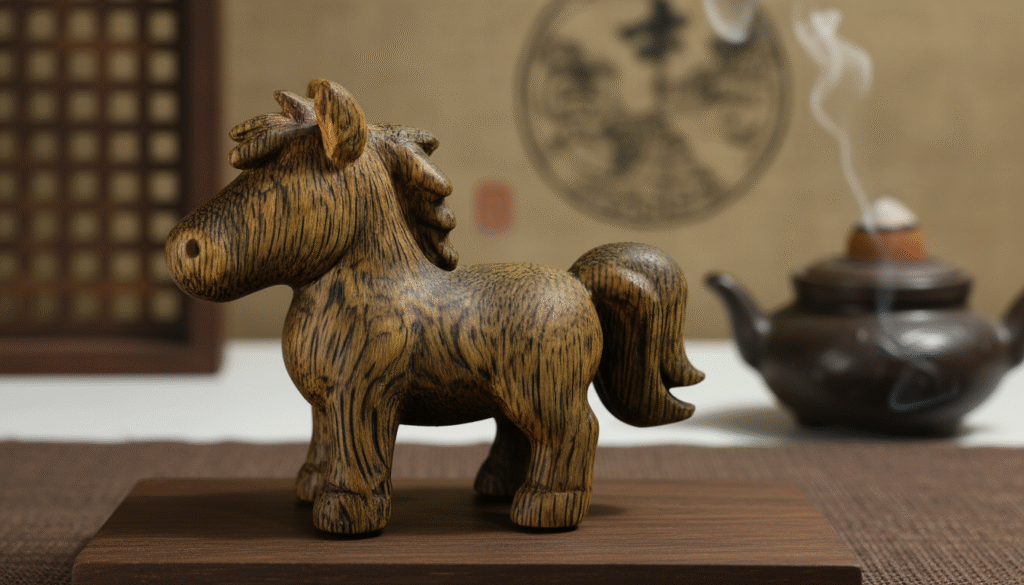
Olfactory Genes: The ‘Pure, Sweet, and Cool’ Fragrance Defined by Red Soil Layers
Why do I say this piece is worth collecting? Besides the auspicious meaning of ‘Success Upon Arrival,’ the most critical factor is its ‘foundation’—its geographical DNA. The wood texture is solid, and the surface shows a natural sense of resin exudation. Just by handling and playing with it, the warmth of your body will trigger the resin to form a beautiful ‘glass-bottom’ patina. More importantly, there is the scent. Although you can’t smell it through the screen, I can responsibly tell you that based on its Guang-Hai (Hainan/Huizhou) lineage, it possesses a signature dual fragrance: an initial pure sweetness followed by a cool trailing note. This sweet-cool sensation is produced by the decomposition of lignin by specific fungal flora unique to the Guangdong and Hainan regions, which Southeast Asian materials cannot mimic. This patina potential, combined with the unique regional fragrance, constitutes the core logic of its value appreciation. [Expert Advice]: Old stock of this level is becoming rarer by the day. If you truly want to collect an ‘authentic domestic scent’ heirloom, or want to compare your own stock against a standard, feel free to DM me with the word ‘Appreciation.’ Let’s not talk about business first; let’s become friends. I will send you high-definition microscopic detail photos of this material to show you what true ‘Black Oil and Iron Bone’ looks like.
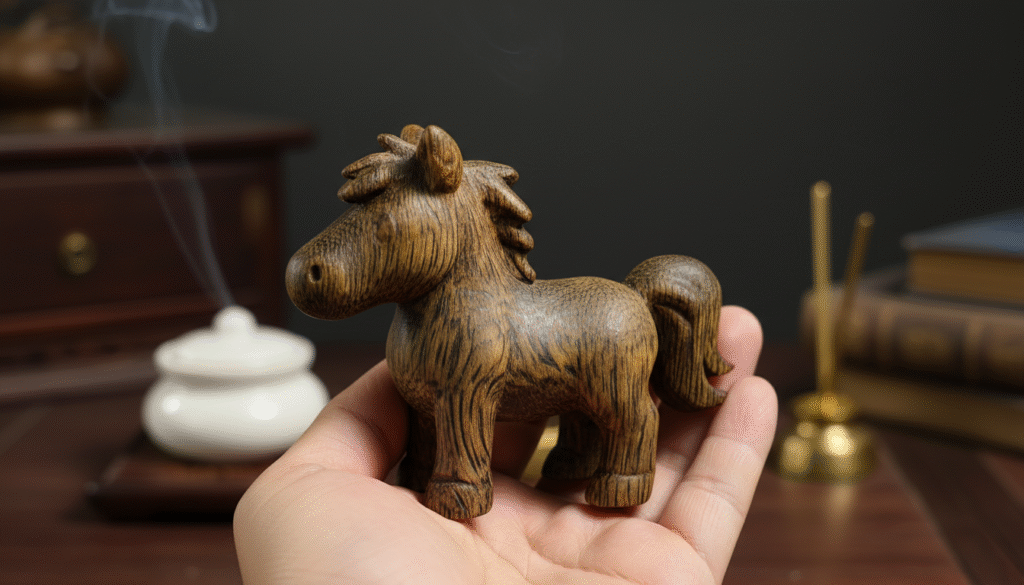
Q&A
Q.Q: What is the difference between this domestic agarwood and the Indonesian ‘water-sinking’ agarwood on the market?
A.A: That’s a great question! The core difference lies in the species and the aromatic aura brought by geography and climate. Indonesian material (mostly large-leaf species) has thick oil but often possesses a strong, fishy, or harsh scent that can be ‘aggressive.’ This domestic old stock belongs to the white incense tree (Guan-Xiang system) from specific Guang-Hai regions. Its resin is honey-knotted, its texture is more like a landscape painting, and its fragrance is the ‘National Scent’ style—elegant, sweet, and cool. This ‘noble aura’ is determined by the specific latitude and fungal species of Southern China, making it an extremely scarce resource.
Q.Q: How should high-density domestic old stock like this be maintained daily?
A.A: Good incense is indeed afraid of high temperatures, odors, and chemicals. However, because this material had a long growth cycle and is full of resin with high wood density, it is actually much ‘tougher’ than loose, fast-growing agarwood. When wearing or handling it, keep your hands clean (avoid direct contact with sweaty hands). When not in use, place it in a sealed bag or a jewelry box. Domestic old stock has strong internal resin activity; you can let it self-maintain using its own resin exudation. Remember, never apply oil! Once you apply oil, you seal off decades of scent, which would be a waste of a heavenly treasure.
Q.Q: Why emphasize the impact of the production area on value appreciation?
A.A: The collection circle values ‘provenance.’ First, resources are depleted; wild solid blocks from traditional domestic areas like Hainan and Huizhou have almost disappeared, with 99% of the market now being plantation-grown. Second is the irreplaceable nature of the fragrance. This work combines physical characteristics like solid wood and high patina potential with non-renewable geographical attributes. In high-end collectible circles, items with authentic origins, sufficient age, and fine craftsmanship have high liquidity and are true ‘hard currencies.’ Those who know the trade can see its weight at a single glance.