Natural Qinan Burl: The “Oil Universe” Under the Microscope—Why Sinking Wild Old Material is the Ultimate Faith for Top Collectors?
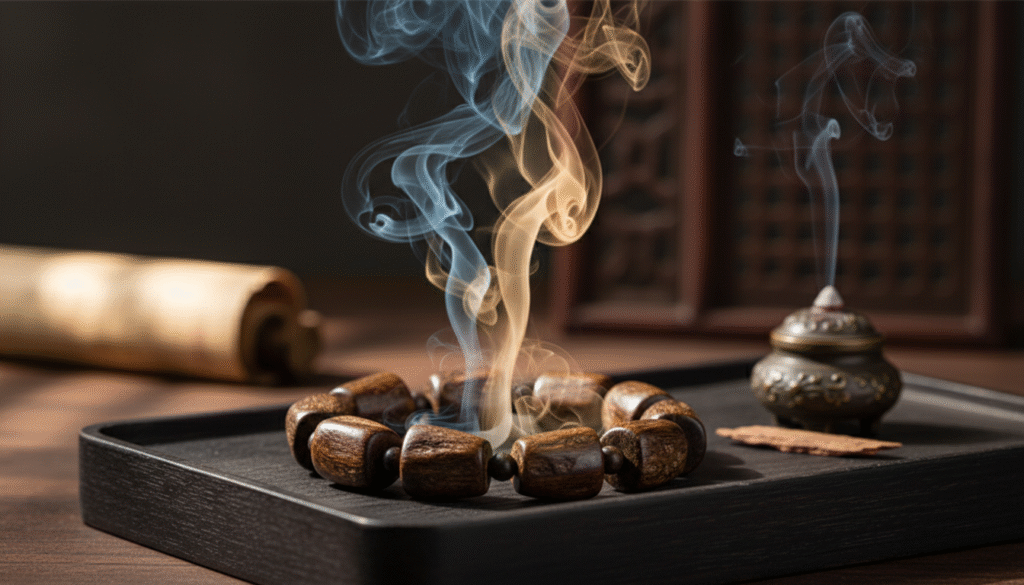
Having been in this business for over twenty years, I often tell newcomers: “Look at the skin with the naked eye, but look at the bones under a microscope.” While common goods are everywhere, a unique piece combining “Qinan + Burl + Sinking” is a “graduation-level” collectible that is truly hard to come by. Today, I don’t just want to sell; I want to place this [Natural Qinan Burl Wild Agarwood Bracelet] under the microscope and in a water tank to show you, through data and evidence, nature’s art born from extreme pain, and why it is true “liquid gold.”
Microscopic Vision: “Soft Silk” Under the Microscope vs. Ordinary Agarwood
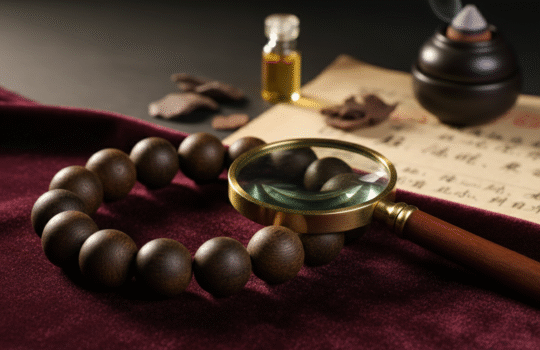
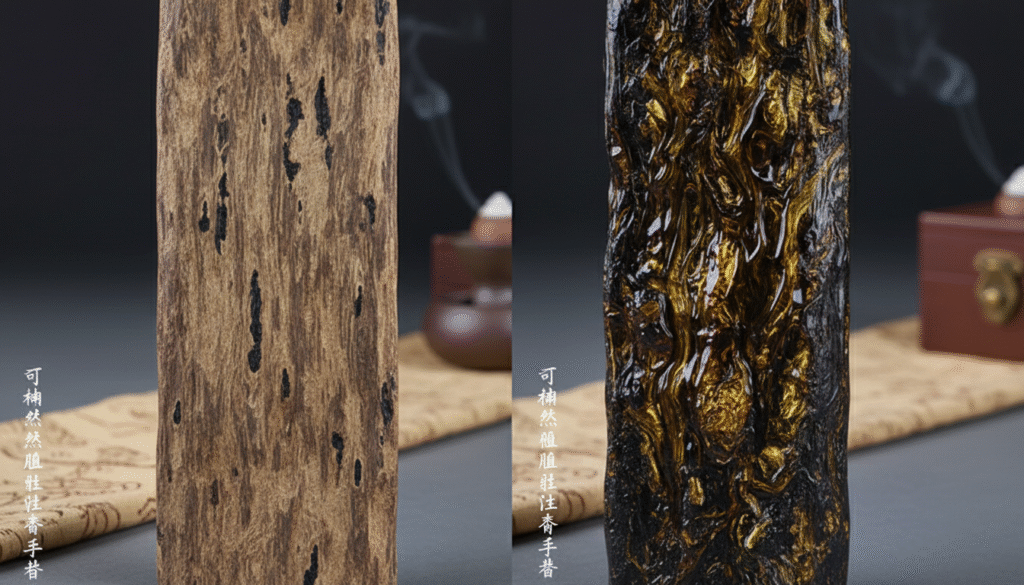
In agarwood collecting, the resin pattern is the soul. To the naked eye, the “Grape Thunder” texture of this piece looks like an ink-wash painting, but that is not enough. To verify its Qinan status, we observed it under a 60x microscope. Honestly, this sight gives me goosebumps every time—ordinary agarwood oil is often dry and dotted, like a parched riverbed. However, the microscopic structure of this Qinan piece is an entire “Oil Universe”! The resin is honey-like and flowing, known to experts as a “soft silk” structure, penetrating aggressively along the wood vessels with an “active” sense of envelopment. This extremely dense oil structure at the microscopic level is the physical basis for its jade-like warmth and complete lack of dry woodiness.
Empirical Evidence: The Immediate “Hand-Weight” and “Fast Sinking”
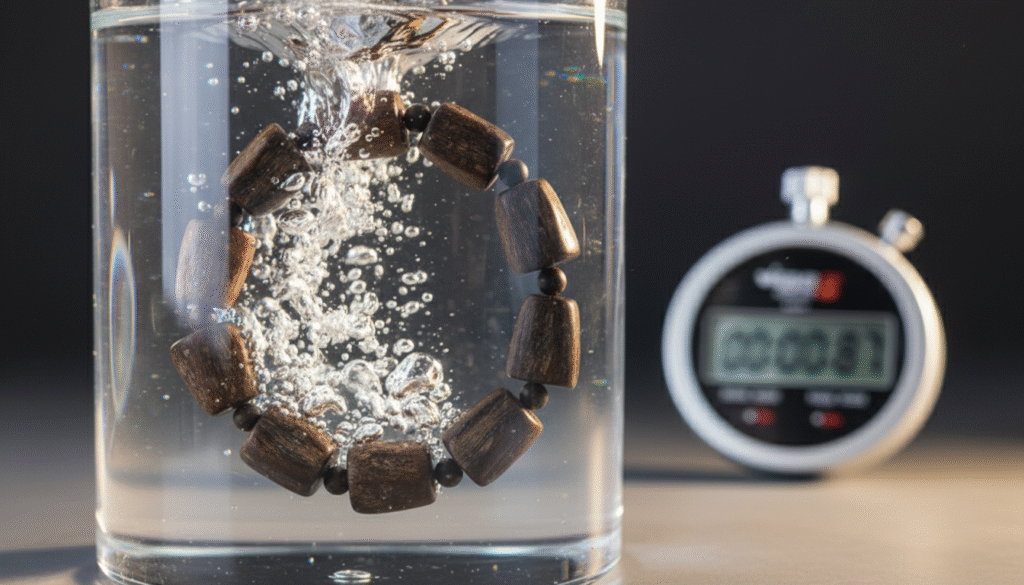
Data does not lie. In the world of agarwood, “sinking grade” is the hard metric for resin saturation and the dividing line between a casual hobbyist and a serious collector. We performed a standard sinking test on this bracelet: the moment the beads touched the water, there was no hesitation or floating; they broke the surface tension and plummeted straight to the bottom. This is not just a victory of physical density (density > 1g/cm³), but ironclad proof of centuries of resin formation. The heavy “hand-weight” of each bead reminds you that this is wild old material condensed over a hundred years, incomparable to the “floating goods” faked with high-pressure oil injection.
The Philosophy of Free-Form Barrel Beads: Utmost Respect for Every Gram of “Priceless” Material
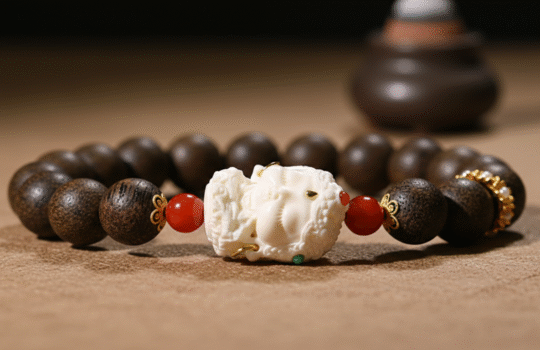
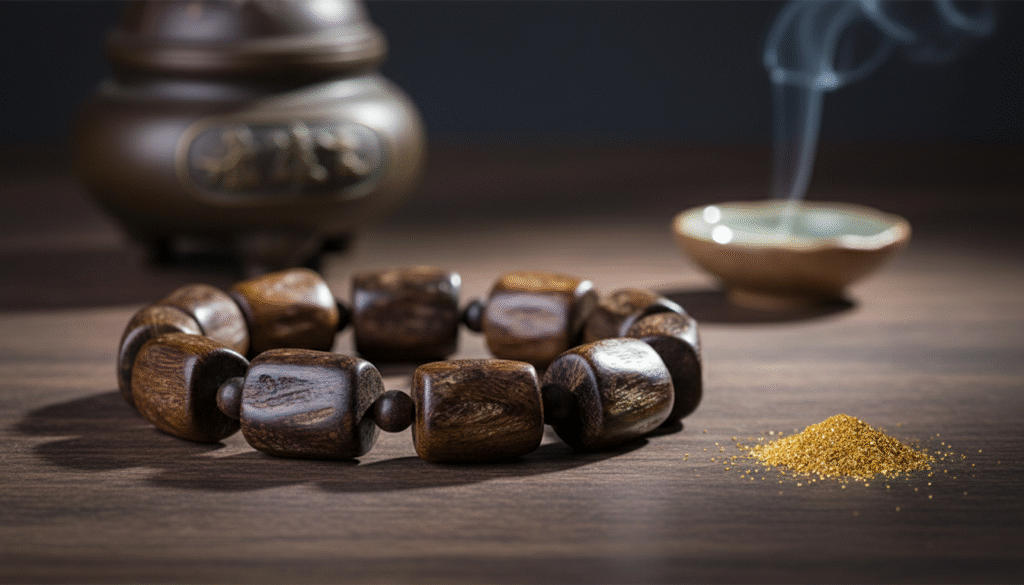
Collectors often ask: “Brother, the material is so good, why not carve them into perfect rounds?” This is actually a misunderstanding of top-tier Qinan raw materials. For wild Qinan old material, where the price per gram far exceeds gold, every cut is like cutting flesh. We use the “free-form barrel bead” craft to maximize the preservation of the original material’s natural shape and weight. This retains a primitive, rustic charm while avoiding the 20%-30% waste that comes with forcing a perfect sphere. The unique shape of each bead serves as a natural anti-counterfeiting mark of its noble status.
Olfactory Symphony & Expert Message: Piercing Coolness and Orchid Sweetness
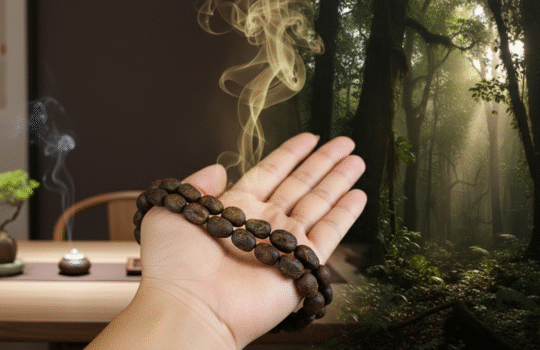
If visual and microscopic data have conquered your logic, the scent will capture your soul. The kingly nature of Qinan lies in its “Qi” (energy/scent). At room temperature, the initial scent is a highly diffusive, “piercing” coolness that hits the crown of the head, instantly clearing the mind. This is followed by a mid-note of rich orchid sweetness and honey nectar. This fragrance is “dominant” and incredibly expansive. Words are pale when describing such a scent. If you want to see the shocking microscopic video or hear the sound of these beads hitting the water, feel free to DM me. The old tea is brewed, waiting for you to taste this ultimate worldly treasure.
FAQs
Q. What is ‘soft silk’ structure, and how does it differ from hard silk?
A. ‘Soft silk’ is the unique resin state of Qinan and a key to identification. Ordinary agarwood (hard silk) has hard resin that turns to powder when scraped. Qinan (soft silk) resin is sticky and waxy; it curls into thin ribbons when scraped and tastes numbing and cooling. Microscopically, the oil appears to be flowing. This is a core basis for identifying genuine Qinan.
Q. Will the sinking test damage the bracelet?
A. A short immersion in clean water (a few seconds) has almost no effect on high-quality sinking-grade agarwood, but it must be dried immediately with a soft cotton cloth and allowed to air dry in the shade. Frequent testing is not recommended to avoid water impurities affecting the surface patina.
Q. Will these natural burls cause the beads to crack?
A. Quite the opposite. In Qinan, burls are usually the areas where resin secretion and repair are most concentrated after the tree is injured. Although the texture is twisted, because the oil filling is so dense (sinking grade), its physical structure is actually denser and more stable than ordinary wood, making it extremely difficult to crack.
Q. How do I maintain this ‘piercing’ scent during daily wear?
A. The best maintenance is ‘human nourishment.’ Body temperature activates the resin, making the scent more vivid. When not wearing it, we recommend placing it in a sealed glass bottle or a dedicated bead box. ‘Sealed nourishment’ is key. Avoid contact with chemicals like shampoo or perfume, which can clog the pores and mask the original fragrance.