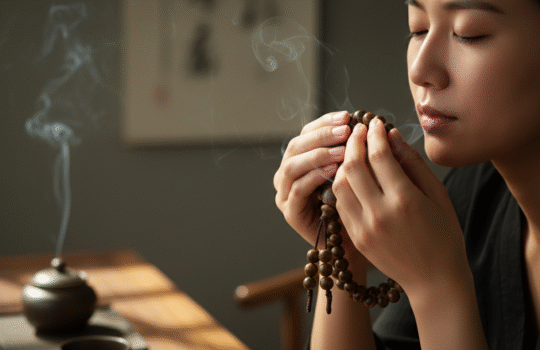
Experts Are Snatching Up These ‘Ugly Pieces’: Revealing the Top Value of Domestic Chinese Agarwood and the Ash Identification Method
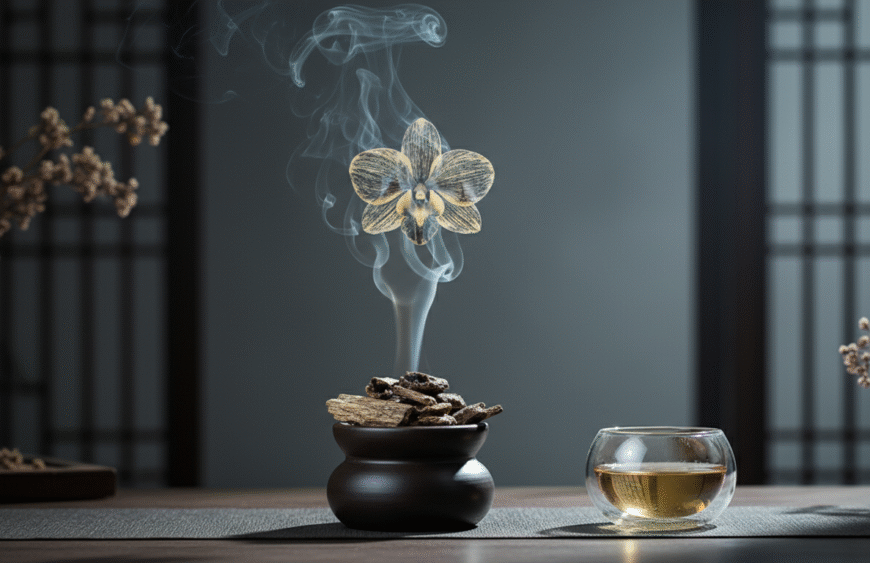
Over a decade ago, I first followed an old harvester deep into the heart of Limu Mountain in Hainan. Beside an ancient tree scarred by lightning and storms, the old man picked up several fragments scattered in the soil. They didn’t have a glamorous appearance; in fact, they looked like withered firewood. He handed the pieces to me and said with a smile: ‘Don’t look at how ugly they are; this is the “Fragrance Bone.” Nature has weathered away the useless wood, leaving only the essence.’
That was the first time I felt a sense of reverence for ‘chips’ and ‘scraps.’ Having been in the agarwood export business for a long time, I’ve grown accustomed to those oil-injected, polished ‘sinking grade’ handicrafts made just to please the market. Instead, I find myself missing that pure, wild scent. To be honest, the batch of domestic Chinese agarwood (Guoxiang) chips I want to discuss today is exactly that kind of ‘Fragrance Bone.’ It doesn’t please the eyes; it only pleases the nose. If you play with incense for that soul-piercing ‘honey-sweetness with a cool trail’ rather than to show off on social media, then these notes on value and ash identification are for you.
Marks of Heaven and Earth: Quality Material Must Be ‘Distinctly Black and Yellow’
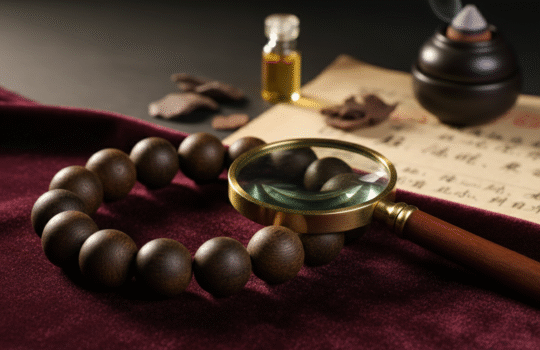
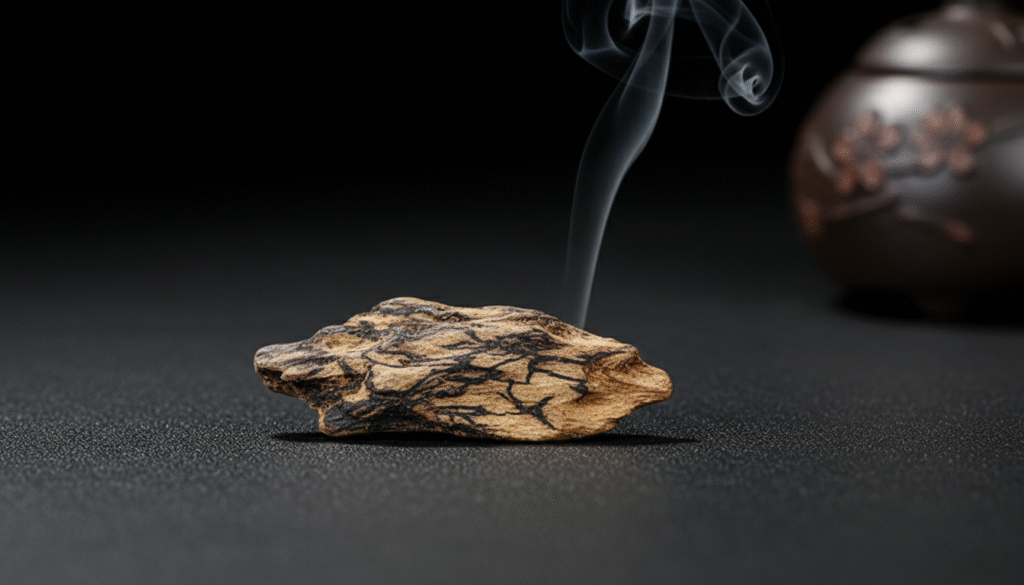
Pick up the piece shown in the image and examine it with the scrutiny of a magnifying glass. This is not just wood; it is a battlefield map of the tree’s struggle against fungi. The fakes on the market that are solid black and oily-bright are soaked in chemical fluids—a dead, stagnant look. True domestic agarwood chips prioritize being ‘distinctly black and yellow.’
Look at the details: The dark brown is the resin (oil), the immune antibodies secreted by the tree; the pale yellow is the original xylem (white wood). The boundary between the two is clear, with oil lines wandering like silk or ribbons, as natural and fluid as an ink-wash landscape painting. This contrast indicates a long, natural resinification process where time has permeated the wood bit by bit, rather than an instant blackening from high-pressure oil injection. Give it a squeeze, and the fragrance lingers on your fingertips; that texture of combined solidity and oiliness is the ‘anti-counterfeit certificate’ issued by nature.
The ‘Integrity’ of Time: Dry Enough to Snap
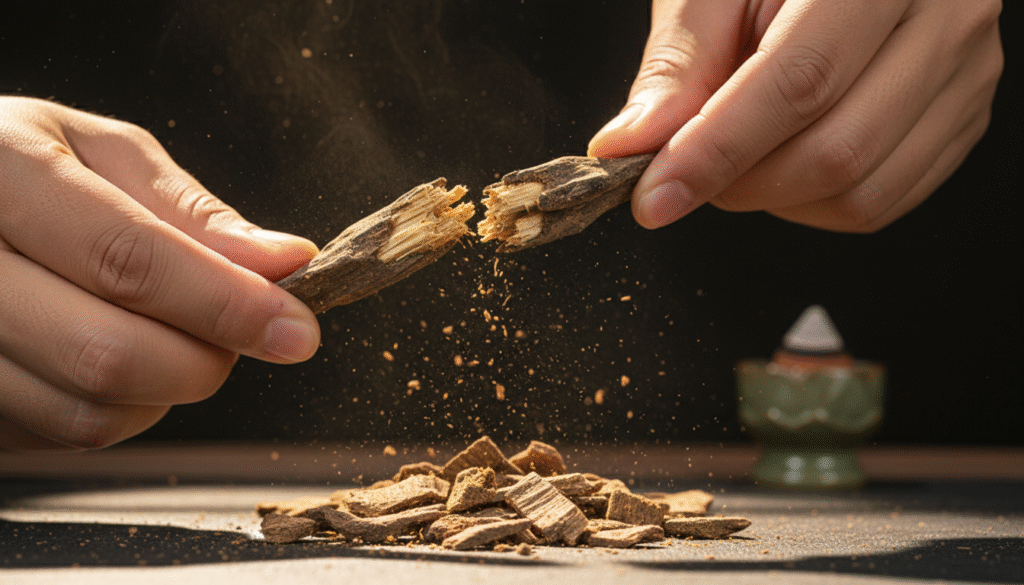
In this industry, we fear ‘wet goods’ the most. Moisture not only adds fake weight but also masks the true quality of the material. But I call this batch of domestic chips material with ‘integrity.’ When you hold it, the texture is hard and brittle. If you snap it with a bit of force, you can hear a crisp ‘crack’ sound.
This sound is incredibly pleasant; it means the moisture has completely evaporated naturally, and every gram you buy is solid aromatic material. This dry state, without manual modification, high-polishing, or oil injection, lacks the flashy patterns of Southeast Asian beads, but it preserves the most even resin distribution. It is the top-tier base material for high-end incense heating. Because there is no excess water vapor interference, the fragrance’s explosive power upon heating is intense—clean, pure, and decisive.
The Soul of Chinese Agarwood: The ‘Coolness’ Within Orchid Honey Notes
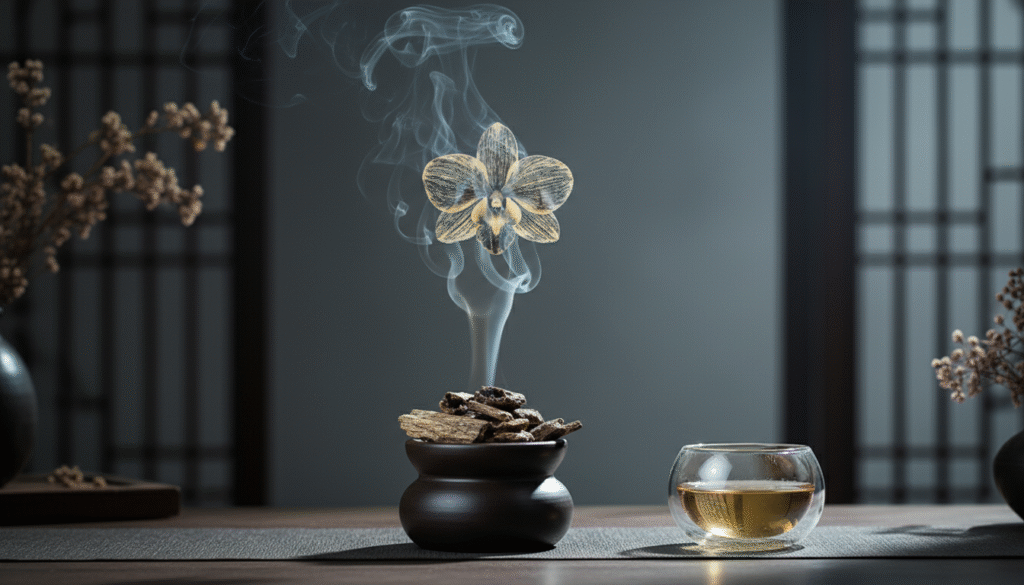
Why do experts insist on ‘Guoxiang’ (Domestic Chinese Agarwood)? Because in the global map of agarwood, the domestic lineage (Hainan, Guangdong, Hong Kong, etc.) possesses an unreplicable gene: ‘an elegant cooling sensation.’ Unlike the heavy, aggressive milky scent of the Irian or Star Island lineages, these chips smell more like a reclusive scholar.
At room temperature, it offers a faint, ethereal orchid fragrance that doesn’t compete for attention. Once heated on a burner or lit, the honey-sweet scent explodes instantly, followed by a clear cooling sensation that shoots straight to the crown of the head, like drinking iced nectar on a sweltering afternoon. This characteristic of sweetness-within-coolness and a long-lasting aftertaste makes it the ceiling-level raw material for making incense powder for seals or handcrafting high-end stick incense. It allows one to settle down instantly; this is the essence of Oriental incense culture.
Rebirth Through Fire: Ash Color Never Lies
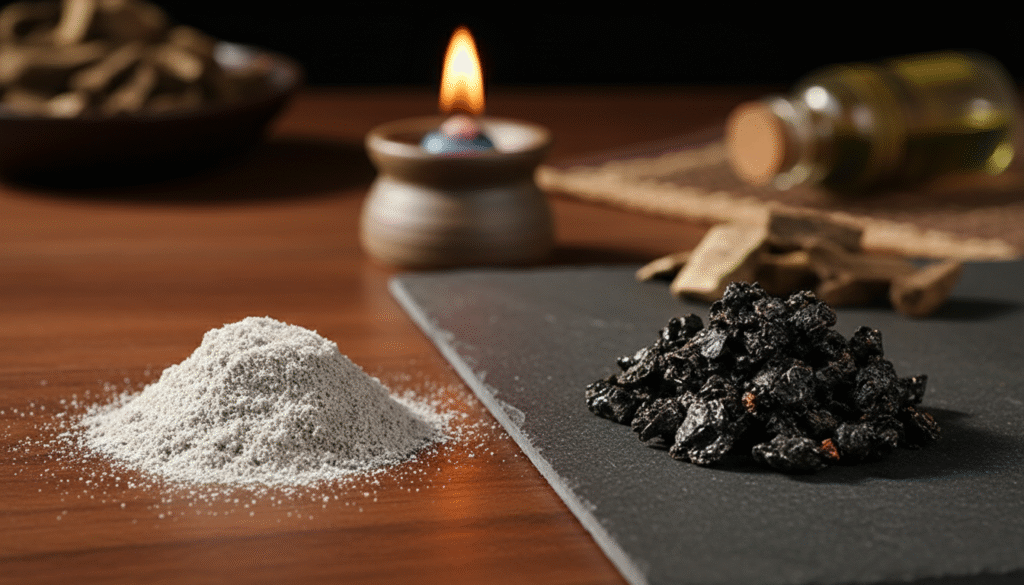
If appearance and raw scent aren’t enough for a verdict, then subject it to the ‘Trial of Fire.’ The ash after burning is the final confession of agarwood. This is the one weakness that counterfeiters cannot overcome.
Take a small piece and light it directly, observing quietly. When natural domestic agarwood burns completely, the ash is usually a natural grey-white or intermingled grey-black (depending on oil content). The most critical factor is the feel—it should be as fine as powder, dispersing at a touch without any graininess. If you find the ash is pitch black, clumps into hard bits, or if the flame is erratic with a pungent plastic smell and a ‘sizzling’ sound, throw it away immediately. That is ‘high-tech’ junk soaked in chemical accelerants or glue.
[Expert Advice]: Real gold fears no fire; real incense fears no ash test. If you have material you’re unsure about or want to experience this ‘textbook-level’ domestic agarwood specimen yourself, feel free to click below for a consultation or DM me directly for ‘Identification.’ I am happy to be your guide to ensure you are playing with a true gift from nature.
FAQs
Q.Q: These chips look like waste; are they ‘exhausted dregs’ after essential oil extraction?
A.This is a massive misconception. ‘Exhausted material’ from oil extraction looks pale and lifeless with no oiliness; when burned, it smells only of wood or even a burnt stench. In contrast, our chips show clear resin accumulation at the breaks and have an orchid scent at room temperature. This is ironclad proof that the natural resinification has preserved rich oils—it is ‘Fragrance Bone,’ not ‘dregs.’
Q.Q: I am a beginner. How else can I use these besides burning them as incense?
A.There are many ways! Besides **electronic incense burners** (highly recommended for a smokeless, pure experience) and **making incense seals**, these chips are of such high purity (no glue or wax) that they can be cleaned and used to **brew agarwood water or tea**. The honey-sweet taste and the returning coolness will open the doors to a new world for you.
Q.Q: Does the ash identification method apply to all types of agarwood?
A.Generally, yes, especially for identifying if inorganic glues or chemical accelerants were used. Natural wood and resin turn into fine powder after combustion. Any ash state that is hard, clumping, or ‘stringy’ is direct evidence of non-natural additives.