Echoes of Rarity and Rebirth: Senior Expert Reveals Why This Chinese Kynam Natural-Shape Pendant is the Hard Currency of the Collecting World
I have spent thirty years in this industry and handled countless pieces of agarwood. To be honest, the term Kynam is used far too loosely in today’s market, making it hard to distinguish truth from fiction. Sometimes, seeing those high-polished white woods labeled as Kynam truly saddens me. But when I placed this batch of natural-shape pendants, recently sourced from the Chinese production region, on my desk and turned on the high-intensity light, I actually held my breath. It felt like reuniting with an old friend—familiar yet shocking. Today, I won’t give you a dry textbook lecture; instead, as an elder who loves and understands incense, I will guide you through the details of this rare find to see what the diamond of wood and nearly extinct wild Chinese Kynam truly look like.
A Glimpse into the Soul: Black Oil and Soft Silk—What Defines the Luxury Feel of Kynam?
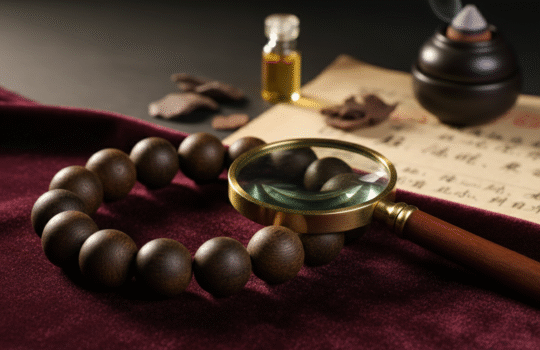
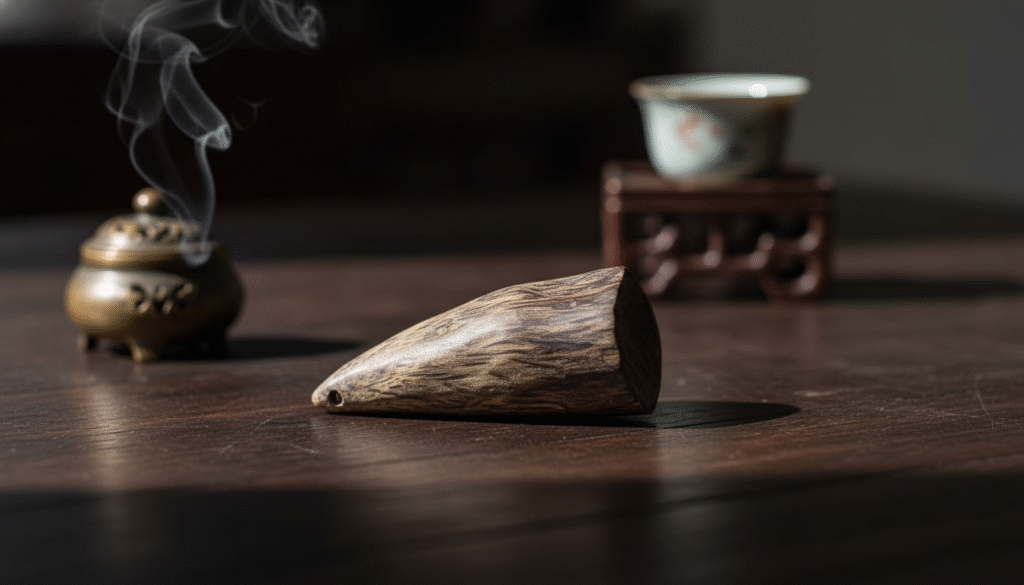
Many people ask me, Old Zhang, what is the real difference between Kynam and ordinary agarwood? I have seen too many confusing online explanations. In reality, true Kynam can be identified at a glance! Look at this pendant; its resin line distribution is incredibly dense, appearing less like wood and more like a piece of solidified dark oil. Under natural light, it exhibits the unique silky luster of Kynam. This glow is not the result of polishing or waxing, but a natural patina formed by resin seeping from within, a luster that feels moist to the heart. Holding it, you will notice its deep color—a typical dark brown tone that directly reflects its high resin saturation. What fascinates me most is the cross-section, where wood fibers and resin are so intertwined they create a visual softness. This is the characteristic of a Mature Knot (Shu-Jie)—where the resin has completely permeated and transformed the wood structure. In the industry, we say it can be shaved into curls and kneaded into pills. It is not dry, hard wood, but a living vessel of sealed fragrance. The heavy feel in the hand is something an expert recognizes instantly.
The Evolution of Three Scents: From Cooling Explosion to Honey-Knot Frankincense
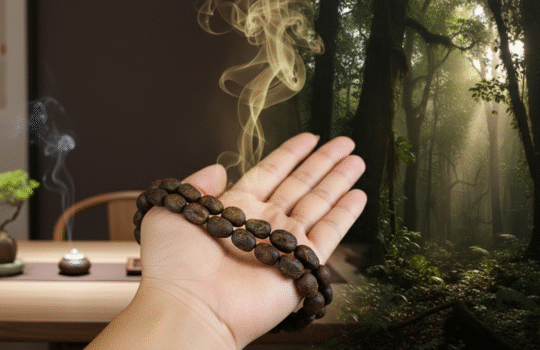
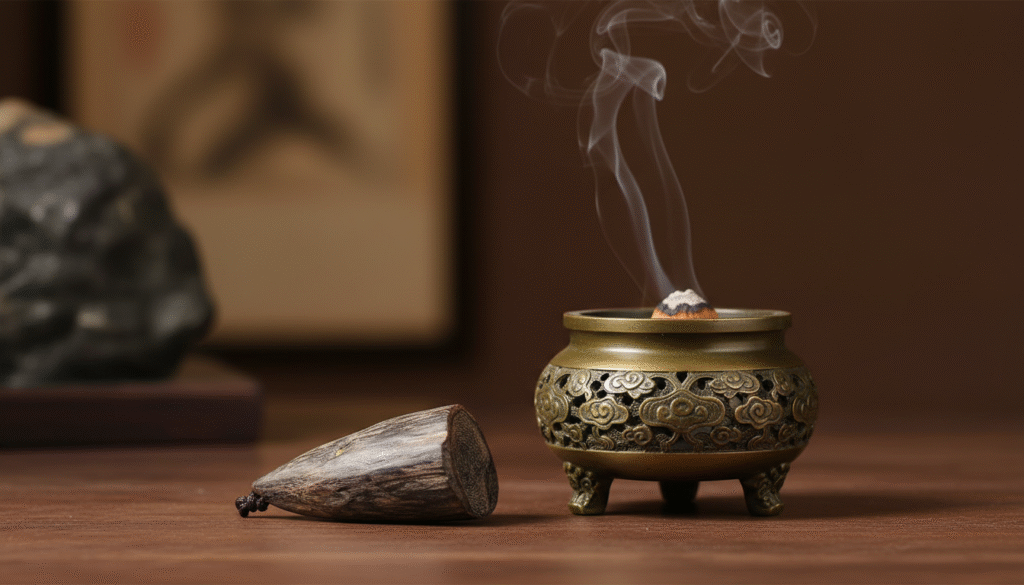
If visual beauty is the first impression, the scent is the resonance of the soul. Kynam from the Chinese production region is honored as the crown because of its powerful penetration. This natural-shape pendant requires no heat; at room temperature, as you bring it close, the initial note is an intense cooling sensation. It feels like mint but is far more sophisticated, rushing straight to the mind and instantly refreshing the spirit, as if standing in an ancient forest at dawn. This coolness then slowly dissolves, transforming into a sweet, rich Honey-Knot fragrance and milky aroma. Please note, this honey sweetness is not synthetic; it is the scent of old honey fermented in nature for centuries—warm and thick. In the base note, it leaves a hint of elegant medicinal fragrance that lingers. This layering is impossible for any synthetic perfume to replicate. For the elite working in this high-pressure society, this is not just an accessory; it is a portable sanctuary for peace and healing at any time.
Collecting in Prosperous Times: Why Now is the Last Window for Chinese Kynam?
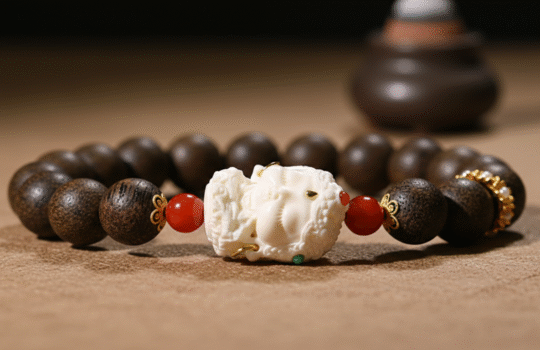
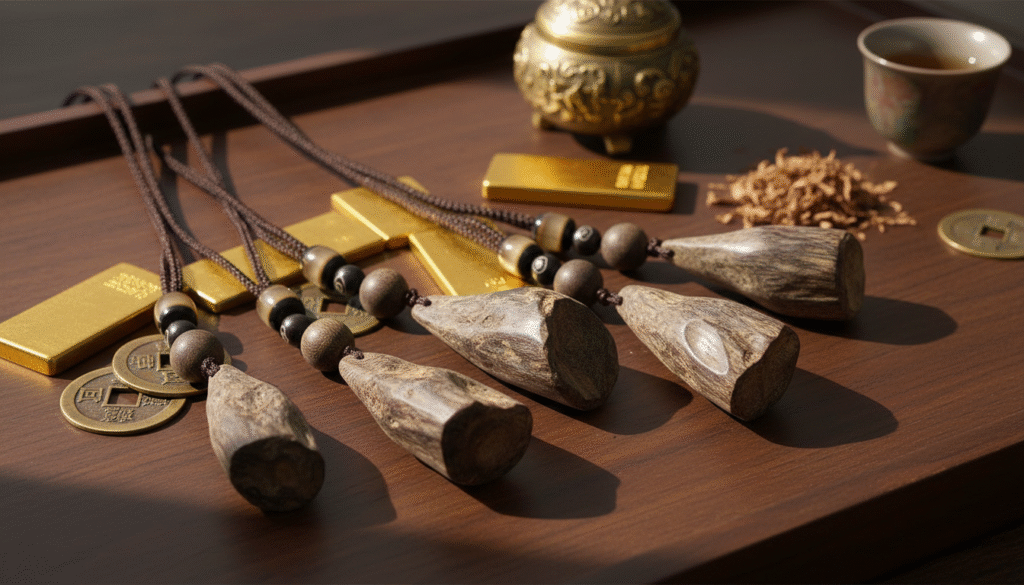
As an exporter, I must share a harsh reality: Kynam resources in the Chinese region are nearly exhausted. The genuine pieces circulating now are mostly returns from early collectors or extremely accidental discoveries in deep mountains. With this batch of pendants, we intentionally preserved the natural form of the Kynam formation, avoiding excessive polishing to maintain the primitive simplicity and high-end wildness of the material. In current auction markets and private collections, Kynam of this grade is a hard currency. Its price per gram is often several or even dozens of times that of gold. This is not just because of its scarcity, but because it is a non-renewable resource. For veteran incense collectors and high-end art investors, owning a piece of genuine Chinese Kynam is not only a symbol of wealth but an identification with cultural heritage. Acquiring it now is preserving a piece of natural legacy that is about to disappear. EXPERT MESSAGE: If you are a seeker of fine incense or wish to leave a priceless family heirloom, please click Expert Consultation below. Fine incense not only chooses its owner but relies on destiny. Items of this grade are often snapped up in private chats. Don’t wait until it’s gone to ask me if there’s more.
FAQs
Q. How do you distinguish Kynam from ordinary agarwood?
A. The core difference lies in resin content and texture. Kynam has extremely high resin levels and a soft, waxy texture known as being able to be shaved into curls. It has a numbing, cooling taste when bitten. Ordinary agarwood is harder, less resinous, and has much weaker scent penetration.
Q. How should a natural-shape pendant be maintained?
A. Kynam is precious and delicate. Avoid contact with chemical detergents like shampoo or soap to prevent damaging the resin. When not wearing it, store it in a sealed bag or a specialized box. Avoid exposure to sun and extreme dryness. Actually, natural oils from human skin are its best maintenance; it becomes more lustrous the more it is worn.
Q. Why is Chinese Kynam more expensive than Southeast Asian varieties?
A. China, particularly Hainan and Guangdong, is a traditional famous region for agarwood. Its scent is known for being elegant, sweet, and layered, fitting high-end Oriental aesthetics. After centuries of harvesting, wild resources are nearly extinct. Scarcity drives value, making its collection worth exceptionally high.
Q. How long will the fragrance of this pendant last?
A. Kynam is a mature knot agarwood, meaning the resin is fully matured. As long as it is not chemically contaminated, its fragrance is permanent. Furthermore, as it is warmed by body temperature during wear, the scent profile will shift and become even more flavorful over time.