Deep Review: Chinese Kynam 108-Bead “Soft Silk” Prayer Beads—A Cross-Regional Fragrance Duel
In the world of incense, there is a saying: “Agarwood is like gold, refined over ages into a soul.” I remember years ago at an old farmer’s house in Dianbai, Maoming, I first witnessed top-tier domestic “Soft Silk” material. The shock remains unforgettable—due to the hot and humid environment, the resin secreted by the tree after injury did not harden into lumps, but remained “active,” like aged floral honey. That warm, waxy, and lingering texture is incomparable to ordinary agarwood.
Recently, controversy surrounding “Chinese Kynam” has been constant. Some are obsessed with overseas origins, unaware that our own “Guan-Xiang” lineage has already achieved a genetic comeback! Today, I won’t talk about boring parameters. I’m putting my personal collection of “Chinese Kynam 108-Bead Soft Silk Prayer Beads” on the table to take you back to those misty, deep mountain origins. Let’s answer one core question through a deep practice of scent and touch: In the arena of fragrance, why does Chinese Kynam, with its millennial heritage, stand toe-to-toe with old Southeast Asian materials?
A Legend at Your Fingertips: Because of “Soft Silk,” Agarwood Has Life
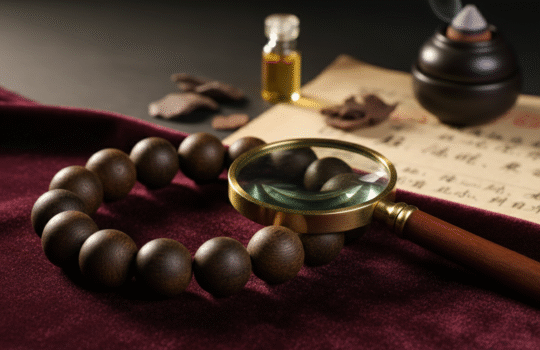
Many friends exclaim at first sight: “The oil veins look like they are about to melt!” This is the most charming feature of “Soft Silk” Kynam—it is not dead wood, but “living”! Under a microscope, the resin of ordinary hard-silk agarwood is a black solid filling the vessels. However, the resin of these beads appears as an amber-colored paste, much like wild honey fresh from the hive, still undergoing subtle oxidation with the air.
Behind this texture lies a story of “Time vs. Fungi.” Only under specific humidity and fungal erosion will the agarwood tree secrete this resilient, viscous resin to protect itself. Handling these beads gives a strange illusion: they seem to possess a natural suction, gently clinging to your fingerprints. This “visibly waxy” quality is a natural patina that no high-polishing process can fake; it is liquid gold condensed by time.
The Peak Scent Showdown: The Hermit’s Integrity vs. The Concubine’s Allure
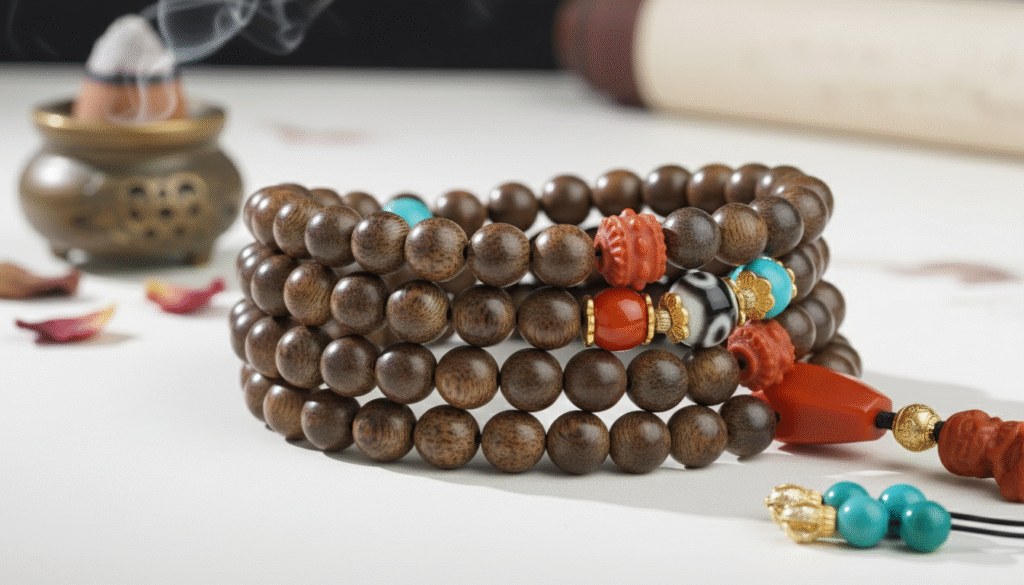
If Vietnamese Nha Trang Kynam is a charming, sweet-scented Tang Dynasty concubine, then this Chinese Kynam is a refined Song Dynasty hermit standing above the clouds. These are two distinct aesthetic philosophies and the core of this “cross-regional duel.”
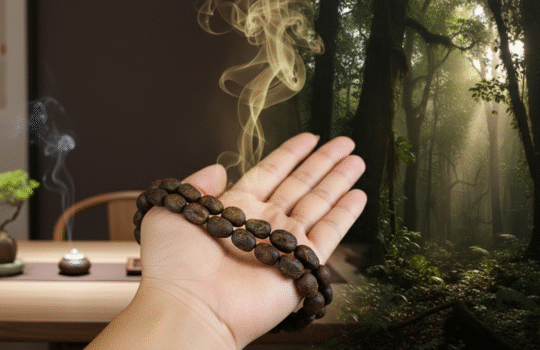
When wearing these 108 beads, as body temperature awakens them, the first sensation isn’t sweetness, but a piercing “polar coolness.” This coolness carries the crispness of mint and the mouth-watering sensation of fresh fruit, rushing straight to the crown of the head, instantly clearing fatigue. This is the “Soul of Guan-Xiang” recorded in ancient texts—it does not please with richness, but nourishes the heart with purity. As time passes, the base notes slowly reveal thick cream and nutty aromas. Compared to the straightforward sweetness of Southeast Asian varieties, the narrative of Chinese Kynam—”cool first, creamy later, unfolding layer by layer”—aligns more with the East Asian literati pursuit of “restraint and depth.”
The Five Elements of Color and the Moment of Connection
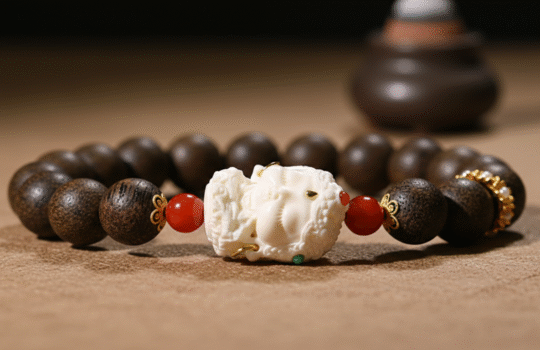
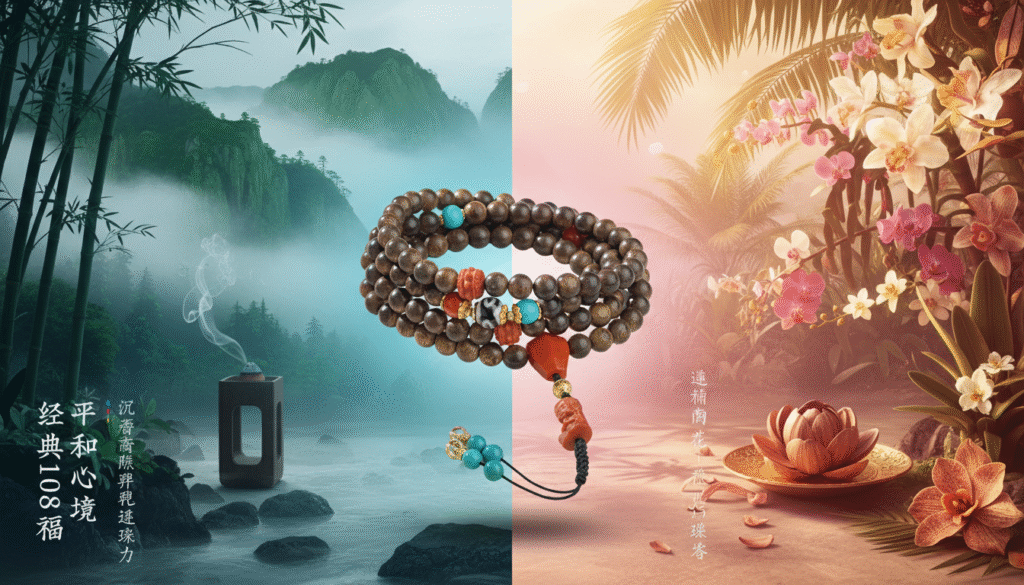
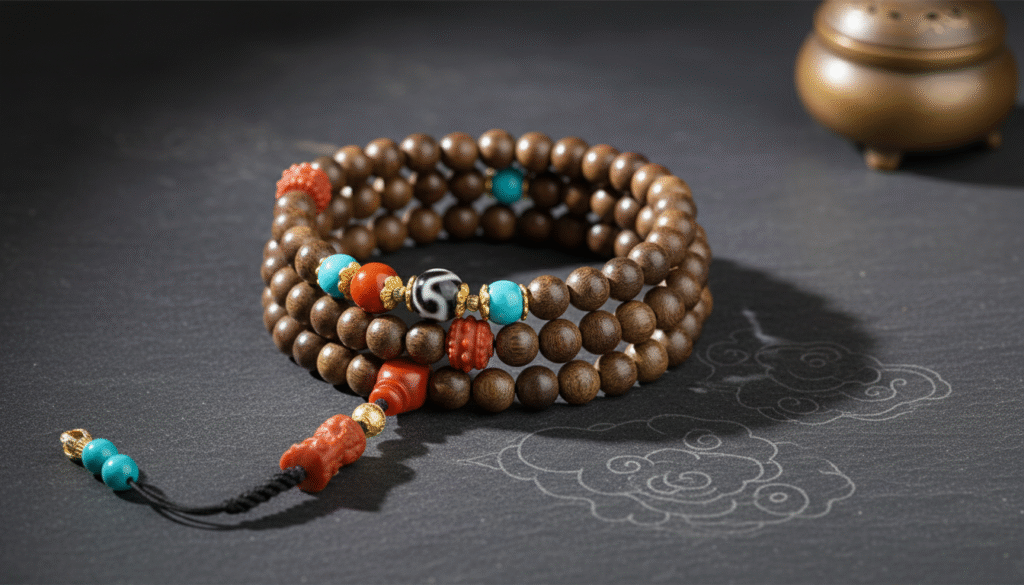
In traditional Chinese culture, prayer beads are more than accessories; they are miniature spiritual sanctuaries. The design of this strand deeply understands Eastern color psychology and the balance of the Five Elements. The dark brown Kynam beads represent “Water/Wood,” symbolizing wisdom and vitality. We specifically chose Sichuan Southern Red Agate as spacers; that mellow “Persimmon Red” belongs to “Fire,” signifying good fortune and passionate life force. The finishing touch is the high-porcelain blue Turquoise, colored like the sky, acting as a visual anchor to “steady the field.”
Each time you move the beads, your fingertips slide over the warm Kynam, delicate Red Agate, and dry Turquoise—different textures mirroring the ups and downs of life. This is not just a collection; it is building a perfect energy cycle on your wrist.
[Expert’s Message]: Seeing once is better than hearing a hundred times; smelling once is better than seeing a hundred times. No matter how flowery the words, they cannot match the “Cool Rhythm” that penetrates the soul. If you are interested in this masterpiece you can “smell,” or wish to challenge it with your own old materials, please click the “Book a Tasting” channel below. I have specially reserved 5 “scrap samples” from the same batch for true connoisseurs on a first-come, first-served basis.
FAQs
Q.I heard Chinese Kynam is “artificially induced.” Do these beads have collection value?
A.This is a typical misunderstanding. While low-quality grafted products exist, we are talking about the top-tier “Soft Silk” state! This resin structure cannot be mass-produced through simple human intervention; it requires a trinity of tree genetics, specific fungal strains, and sufficient maturation time. These beads use “First Generation Kynam” material with a resin structure that has reached a wild-grade “pasted” state. With wild resources depleted, this high-quality, pure-scented Chinese Kynam is currently the “growth stock” with the most potential; insiders are quietly hoarding it.
Q.Since “Soft Silk” is so soft, will it wear down or attract dust easily during wear?
A.”Soft” is industry jargon referring to the waxy feel when cutting and the physical state of the resin, not that the wood is fragile like tofu. On the contrary, because the resin density is extremely high, it resists sweat better than ordinary agarwood. However, as an expert, I must warn you: due to its high resin activity, it absorbs odors easily. Avoid contact with perfume or hotpot smoke. As for dust, normal handling will form a protective patina, making it brighter over time—a process of “the person nourishing the wood, and the wood nourishing the person.”
Q.108 beads are too long; how do I wear them properly for daily use?
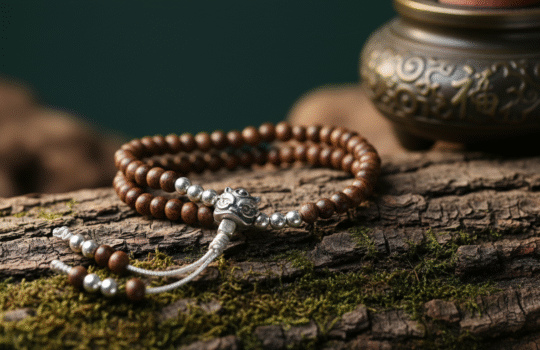
A.The number 108 represents the Buddhist count for eliminating worries; it is the most classic form and highly versatile. Men usually wrap it 3-4 times around the wrist (depending on size) for a capable, Zen look. Women can wear it directly as a long necklace or wrap it around the wrist paired with a thin gold or jade bangle to create a “strength meets softness” Chinese aesthetic. In formal settings like tea ceremonies or meetings, removing them to handle or placing them on a desk is a silent expression of status and state of mind.