[Connoisseur Grade] The Legend of “One Bangle Worth Ten Thousand Pieces of Gold”? Unveiling the “Black Oil” Gene of this Ancient Chinese Kinam Round Bangle
Having been in the agarwood export business for twenty years, I have handled materials by the ton, but to be honest, every time I encounter a “round-bar bangle,” I have to take a closer look and almost instinctively hold my breath. Why? In the agarwood circle, beads are easy to make and plaques allow for some retreat, but this “whole-piece bangle” without splicing or patching is a crazy challenge to nature’s laws of probability. Especially the [Chinese Kinam Agarwood Ancient Material Ladies’ Round Bangle] we are discussing today; it is not just a “survivor” of nature, but a witness to the century-long continuation of Chinese incense culture in the Lingnan mountains. Today, I will not give you hollow chemical formulas. With the physical object in hand, combined with the history of the production area and an expert’s perspective, I will talk about why it is the “ultimate” Qixi gift and why even an old connoisseur like me feels that “every look is one less chance to see it.”
Lineage and History: The Unique “Black Oil” Gene of Chinese Kinam
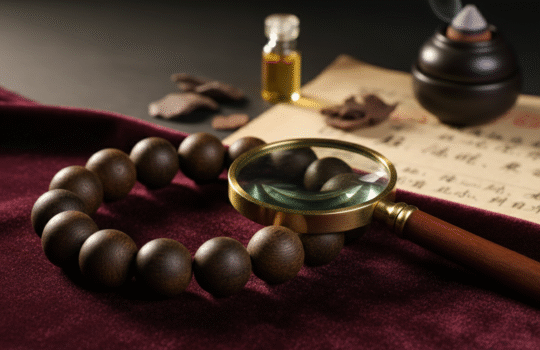
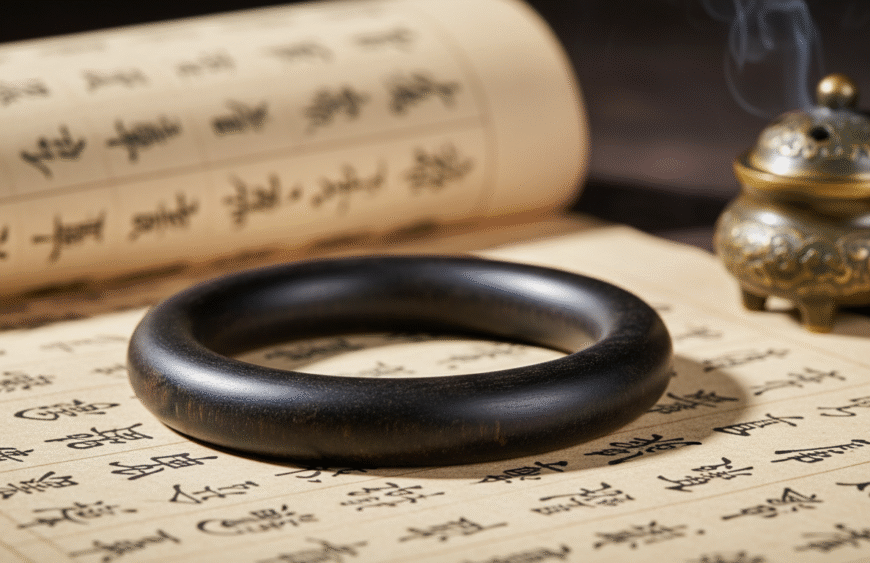
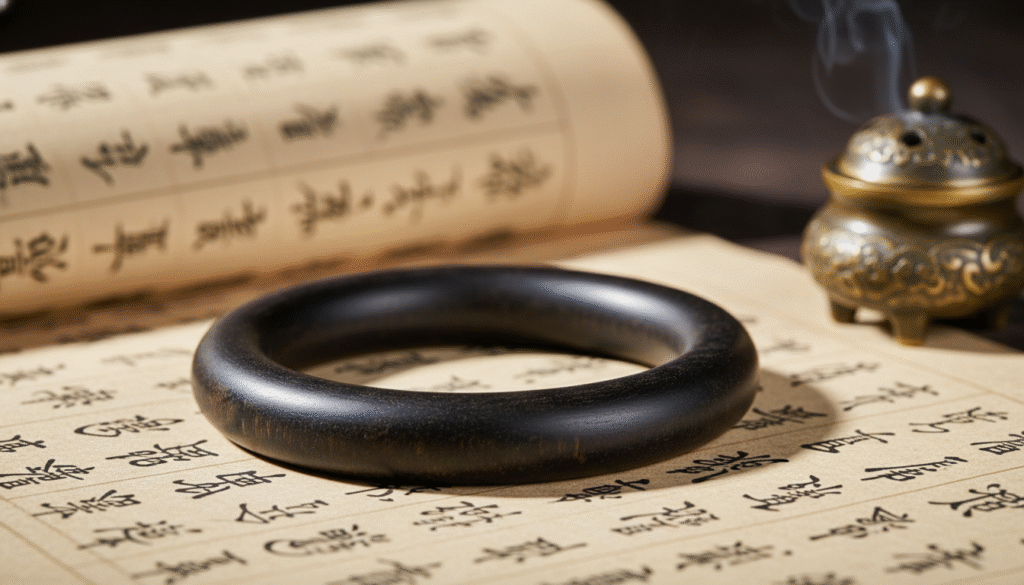
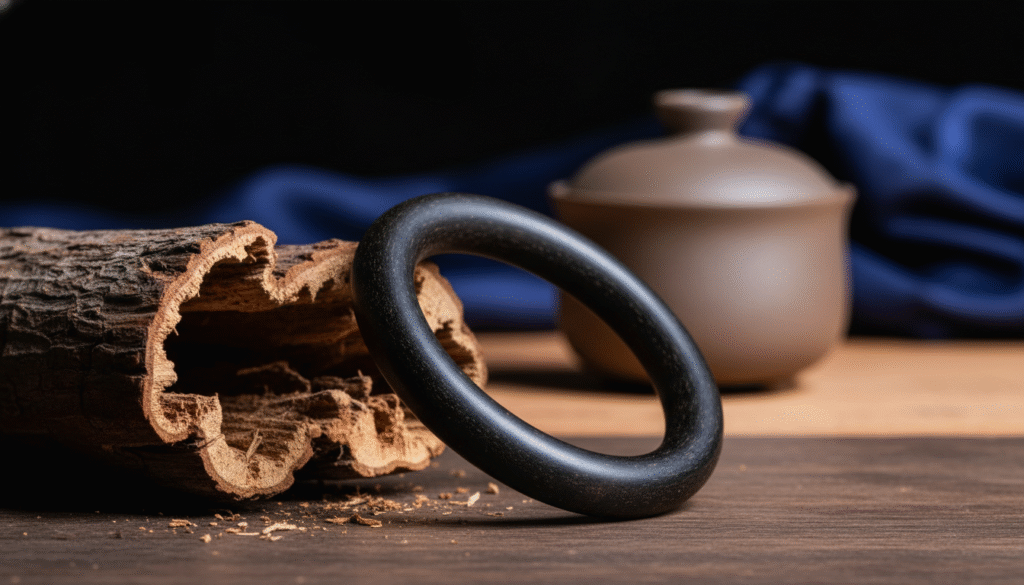
New players often ask why I emphasize “Chinese Kinam.” This starts with history. Since the Tang and Song dynasties, “Tu Chen” (Earth Agarwood) produced in the Guangdong, Guangxi, and Hainan regions of China has been the first choice for tribute. Unlike the continuous humid heat of Southeast Asian rainforests, Chinese production areas have four distinct seasons, which causes the resin to contract more tightly and the mellowing process to be longer. Look closely at this bangle (see image below): the color is deep and jet black, which is a typical feature of high-resin ancient material. This “black oil” is not a surface shine, but a steady depth oozing from within after decades or centuries of high fiber resinification. Even if I do not speak, you can feel the weight of time—a historical product of specific latitudes and microclimates, a “ripe formation” texture that new or artificial materials can never replicate.
Whole Material Cutting: Challenging the Extreme Probability of “Ten Hollows for Every Ten Scents”
Insiders know a bitter saying: “Ten scents, nine are hollow.” During the long resin-forming process, the xylem of the agarwood tree often rots and becomes hollow due to fungal erosion. For beads, we can avoid holes to take small pieces; for plaques, we can slice to avoid cracks. But making a bangle is “hell-level difficulty”! It requires a piece of ancient material large enough, solid enough, and because it is a round-bar design, it has extremely high thickness requirements and must have no hidden cracks. This means that for this one bangle with an inner diameter of 54-57mm, we must ruthlessly “discard” several times the volume of the finished product in top-grade raw materials. This is not just a gamble of craftsmanship, but an extreme appropriation of scarce resources. This is why, at the same quality, the price per gram of a bangle far exceeds that of prayer beads—because you are not just buying this bangle, but the 90% of the essence wasted to achieve it.
Touch and Vision: The “Patina-Ready State” Under Ancient Polishing Methods
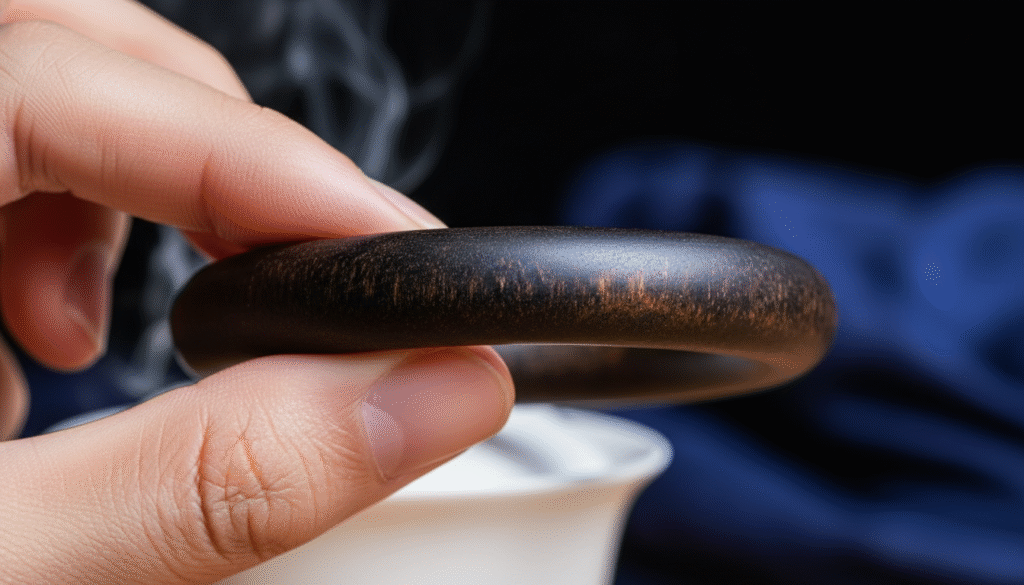
Pick up this bangle; please do not rush to wear it. First, rotate it against the light. You will see dense oil lines: fine resin patterns visible to the naked eye, perfectly integrated with the wood, feeling as warm and smooth as jade. To preserve this natural “spirit,” I specifically instructed the master to reject industrial high polishing and insist on ancient manual polishing. This process leaves a luster called “patina-ready state”—at first glance, it is restrained and steady, not glaring, like moonlight on a deep pool. With every wear, the skin’s oils and temperature will have a subtle physical reaction with it, making it more moisturized over time. Trust me, that process of mutual nourishment between person and object, watching it become as smooth as jade day by day, is the greatest joy of cultural play.
Fragrance Philosophy: A Time Journey from “Coolness” to “Milky Notes”
As ancient Chinese Kinam material, its most charming soul is its scent. Ordinary agarwood often only has a single woody scent, but this one possesses the typical “five layers of flavor.” At room temperature, the initial scent is a refreshing coolness—the unique “Cool Rhyme” of Kinam that instantly calms the mind. As wearing time increases, body temperature warms the internal oils, and a rich honey sweetness and orchid fragrance begin to explode—this is the highlight of the middle notes. In the end note, it is a long-lasting, deep milky scent. This is not just a piece of jewelry, but a portable “fragrance field.” Gifting it for Qixi is not just about value, but a peace that smooths impetuousness and lasts a century. [Expert’s Message & Inquiry]: Every agarwood bangle is unique, and the size is a matter of fate. If you are unsure of your wrist size or want to see a raw, unedited video of this material’s “water-sinking test,” feel free to contact me. Let’s not talk business first; let’s talk about the “connection” with this material. After all, encountering such ancient material is a rare destiny in itself.
FAQs
Q.Why is the price of an agarwood bangle much higher than a bracelet of the same quality?
A.This is an “inverted cost” phenomenon in the industry. The core lies in the extremely high waste rate of “whole material cutting.” Natural agarwood often has many hollows (ten scents, nine are hollow). Bracelets can use fragments or avoid flaws, while bangles require a whole large, solid, crack-free piece. Making one bangle often consumes several times the weight of top-grade raw materials. This low yield and strict requirement for raw materials determine its high value as a “heavyweight treasure.”
Q.What is “Chinese Kinam”? How is it different from ordinary agarwood?
A.”Chinese Kinam” specifically refers to top-grade Kinam agarwood produced in Chinese production areas (historically Guangdong, Guangxi, Hainan, etc.). Compared to ordinary agarwood, it has extremely high resin content, a soft waxy texture (shavings curl up), and its fragrance features unique variations of cool, sweet, milky, floral, and fruity notes. Due to the long history of development in Chinese production areas, very few ancient materials remain, making it more culturally and collection-valuable than general Southeast Asian agarwood.
Q.How should this ancient material bangle be maintained?
A.This is “ancient material ripe formation” with stable resin, so maintenance is simpler than imagined. The core principles are “avoid chemicals, avoid extreme sun, wear often.” Avoid contact with detergents, perfumes, and other chemicals to prevent resin corrosion; avoid prolonged direct sunlight to prevent drying and cracking. The best maintenance is regular wearing, as body oils and temperature accelerate the formation of patina, making the fragrance more vivid. For specific stain issues, I suggest sending photos for consultation rather than blind operation.