Collector’s Secrets: Why I Locked This ‘Full Kalimantan Agarwood Fan’ in the Vault? — On the Supreme Aesthetics of the Finest Oudh
“An Agarwood exporter's tale: Why are full Agarwood fans the 'pinnacle' of collecting? Analysis of 'Tiger Stripes,' medicinal honey scent, and royal patterns. One fan encapsulates centuries of elegance.”
I have been in the Agarwood export business for twenty years and have handled tons of material, but in the gatherings of top collectors, I always say: ‘Burning a piece means losing it; collecting it means eternalizing it.’ The full Agarwood fan is the piece that stirs contradictory feelings in me; I love its supreme elegance, yet I fear wasting its precious raw materials! Do you know how much fine raw Agarwood is consumed to make a single fan? We often have to cut through vast amounts of old Kalimantan wood just to select those few thin slices that match perfectly in grain and color. Today, I don’t want to talk about boring industrial figures; instead, I will take you on a tour to explore this piece that I refused to sell and deposited in my vault. It is not just wood; it is frozen time and a living embodiment of the concept of ‘cool breeze and fragrant aroma.’
The Mystery of Origin: Why Are Kalimantan or Tarakan Irreplaceable?
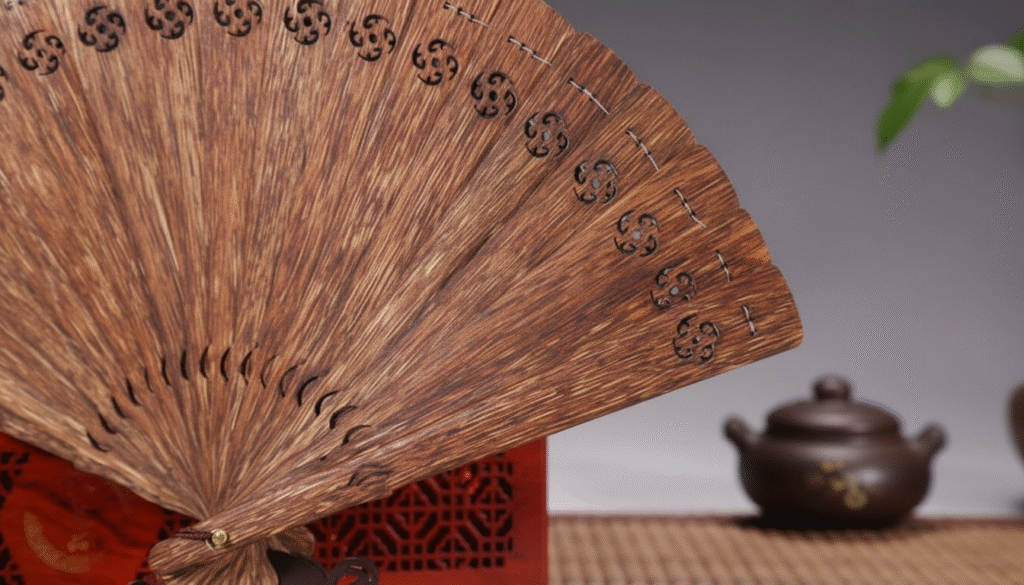
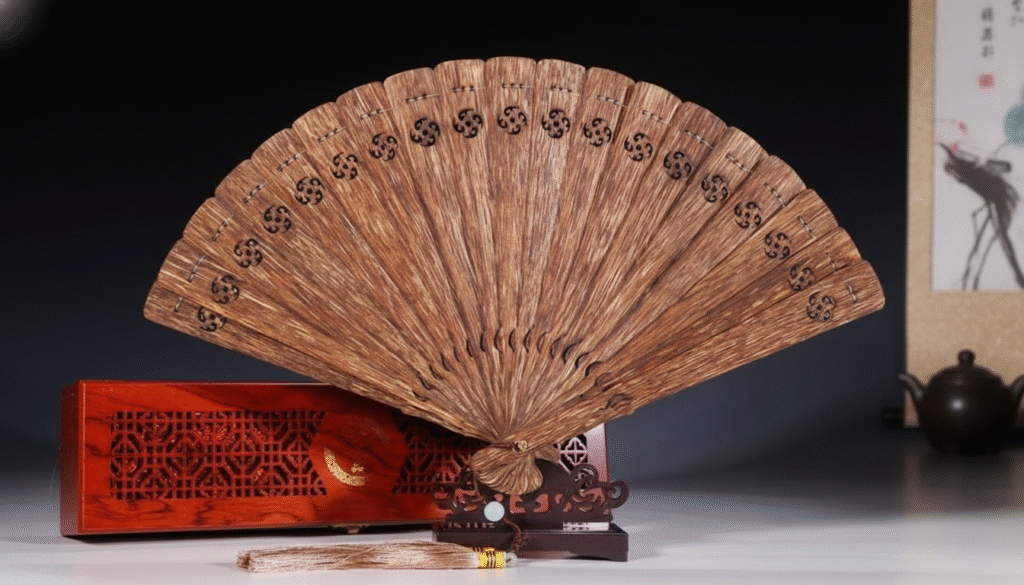
Agarwood experts know that making beads is easy, but making a fan is the ultimate challenge. Beads can bypass defects, but a fan requires a large, stable, and solid material. For this fan, I carefully selected old Agarwood from the Kalimantan or Tarakan regions of Indonesia. The reason? Absolute hardness. Look at the surface of the fan: its color ranges from deep bronze to black-brown, with an intense oily luster. This shine is not the result of industrial polishing but the overflow of internal oils that appear naturally after delicate sanding. If we used modern wood or wood from soft-timbered regions, the fan would warp or lose its luster over time. It can be said that half the value of this fan lies in the strength and heritage of the raw material.
Visual Wonder: ‘Tiger Stripes’ as Fine as Hair
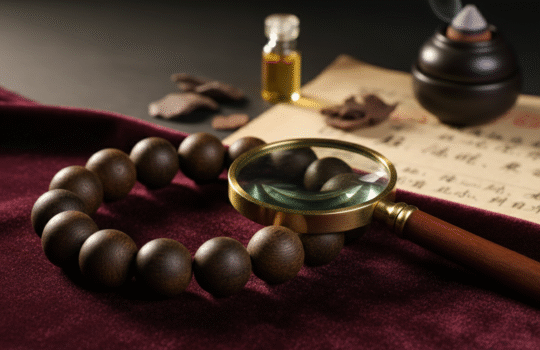
The reaction of most clients upon seeing it is: ‘Give me a magnifying glass!’ and I encourage them to do so. The essence of this fan lies in the fine resin lines, distributed with amazing regularity. In our profession, we call this pattern ‘Tiger Stripes.’ These lines were not drawn by an artist’s brush; they are the result of oil accumulation inside the Agarwood tree over decades or even centuries. When you open the fan, you find each slice is independent yet shares a single harmonious soul. These natural textures are the fingerprints of time, and each piece is a unique version in the world that cannot be repeated. I advise you to rotate the fan handle under natural light to watch the flow of golden lines; it is an addictive visual experience.
A Touch of Creativity: Not Just a Fan, but an Icon of Blessing and Serenity
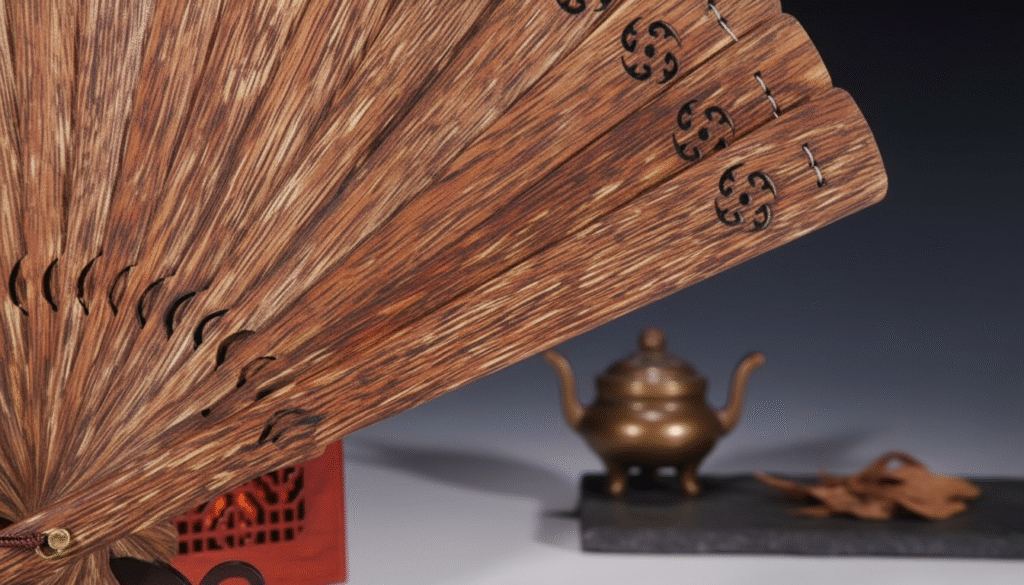
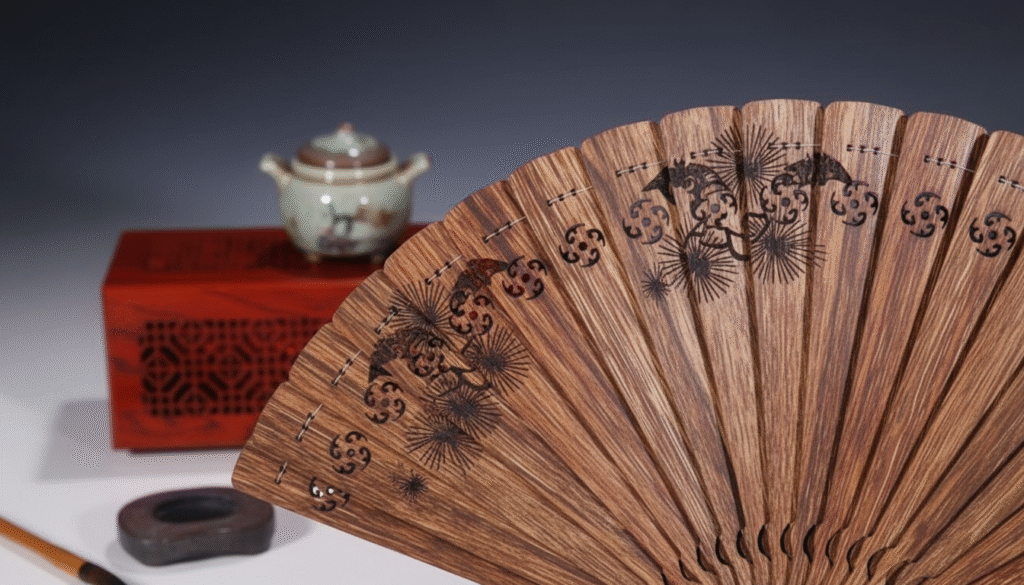
Amateur collectors look at the material, but professionals look at the soul. This fan utilizes the extremely difficult hollow carving technique. Look closely at the ‘Clouds and Bats’ (Yunfu) engraving. We did not choose random patterns; we revived classical motifs that symbolize ‘Universal Blessing’ and transcendence in traditional culture. When you wave this fan, you are not just bringing cool air; you are holding a symbol of serenity and nobility in your hand. This design, which blends ancient culture with the finest types of Oudh, ensures both visual and spiritual pleasure at once.
The Peak of Craftsmanship: Thin Slicing and Perfect Harmony
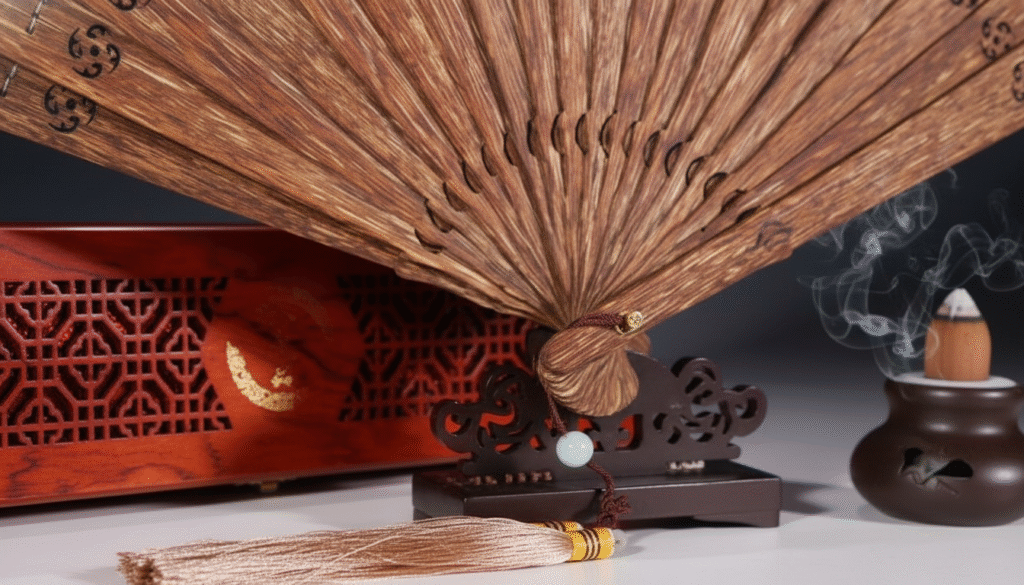
When you hold this fan, you will be surprised by its weight; it is not annoyingly heavy, but it carries a specific gravity that suggests luxury. This is thanks to the traditional full-slice Agarwood cutting technique. Slicing Oudh into equally thin sheets without breaking them is a true test of a craftsman’s skill and patience. What is also amazing is that the fan ribs and the structure are made entirely of Oudh, without using bamboo as a support. This ensures a smooth feel when opening and closing, and ensures the scent remains pure without any other woody impurities. That delicate chime when the Oudh ribs strike each other is a luxury that plastic or ordinary wood fans cannot replicate.
The Olfactory Experience: A Banquet of ‘Medicinal Honey’ at Room Temperature
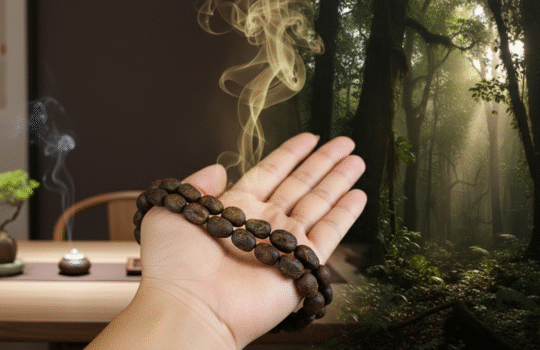
Many types of Oudh need heat to release their scent, but this fan is different; it is the queen of raw natural scents. The characteristics of Kalimantan and Tarakan Oudh appear here clearly: a strong coolness, a distinct herbal scent, and a warm honeyed flavor. You don’t need to light a fire; just open the fan on a summer afternoon or during a business meeting and wave it twice. Those cool, refreshing breezes mixed with the aroma of frankincense and honey are enough to calm the surrounding atmosphere immediately. Finally, the Oudh market is full of secrets; if you have old pieces you’re unsure about, or want to see the details of this fan on video, I would be happy to connect with you to share expertise and protect our shared passion from forgery.
Export Market Research Q&A
Q.Why is a pure agarwood fan much more expensive than an agarwood bracelet of the same weight?
A.The secret lies in the yield rate and material selection difficulty. Making bracelets can use smaller scrap pieces, but a fan requires large, flat, and uniform resin-distributed whole pieces. To cut perfect thin slices, a massive amount of expensive raw material is wasted, coupled with the risk of breakage during the carving process, which significantly drives up the cost.
开始 →
Q.How should an agarwood fan be maintained? Will the scent disappear?
A.Agarwood resin is very stable. Unless exposed to direct sunlight or chemical detergents, the scent is permanent. Maintenance is simple: store it in the included mahogany box at room temperature. Frequent use actually enhances its beauty, as body heat stimulates the resin, making the surface oilier and brighter.
开始 →
Q.Does hollow carving affect the structural strength of the fan?
A.Not at all. When designing the patterns, we precisely calculated the direction of the agarwood fibers and the stress points. The selected raw materials are high-density old stock (sinking or near-sinking grade), where the resin has permeated the fibers making them extremely tough, with hardness exceeding ordinary wood. It is very durable for normal use.
开始 →
Q.Is this fan suitable as a gift or for personal collection?
A.It serves both purposes. As a gift, it expresses high taste and deep respect for the recipient (in Eastern culture, fans symbolize “goodness” and auspicious connections); for an individual, it is a piece of art that adds a sense of luxury to an office or reception room, combining visual and olfactory enjoyment.
开始 →