Collector’s Journal: Why This “One Thought” Guanxiang Agarwood Pendant is Worthy of Your Family Heirloom Collection?
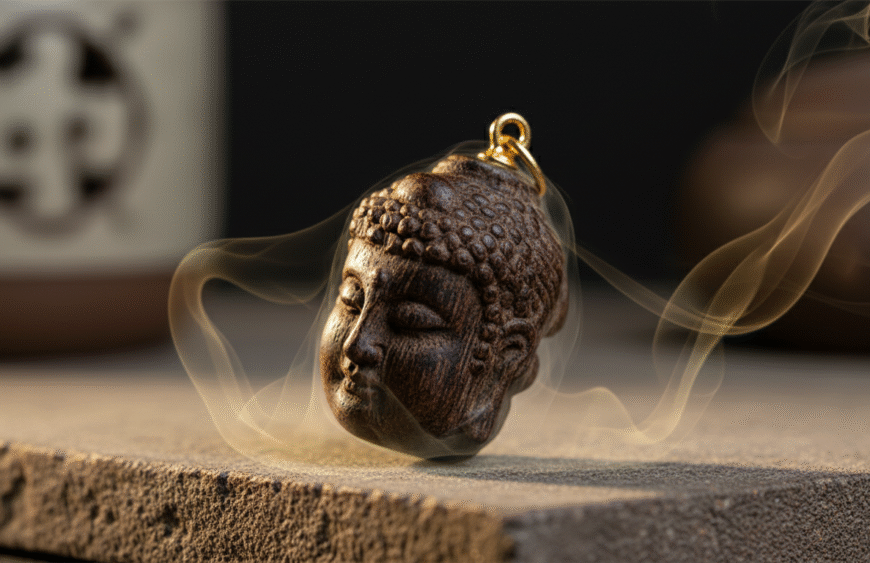
Having spent many years in the Agarwood export industry, handling tens of thousands of pieces, I must admit it is rare for anything to truly leave me in awe. Yet, whenever I encounter “domestic old material” like this, my heart still skips a beat. I remember discovering this piece by chance among a batch of old Dongguan “Iron Head” materials I collected years ago. At the time, it looked dusty and unremarkable in a pile of bulk stock, but the moment a corner was cut, that rich, honey-sweet fragrance instantly conquered everyone present. In this industry, we are used to looking at parameters—does it sink? Is the resin full? But true collector-grade treasures have a soul. Today, I want to have a heart-to-heart about this “One Thought” pendant. It is more than just high-resin wood; it is a luxurious artistic silhouette captured against the backdrop of depleting domestic Agarwood resources. When you hold it in your palm, that heavy, substantial feel and the rushing wave of honey-sweet coolness will make you understand why our ancestors called Agarwood a spiritual bridge between the three realms.
Soul at First Sight: The “Black Oil” Legend Condensed by Time
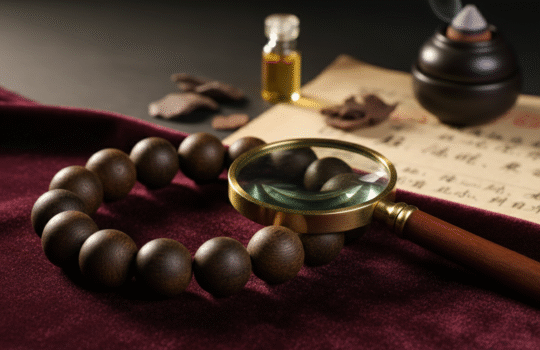
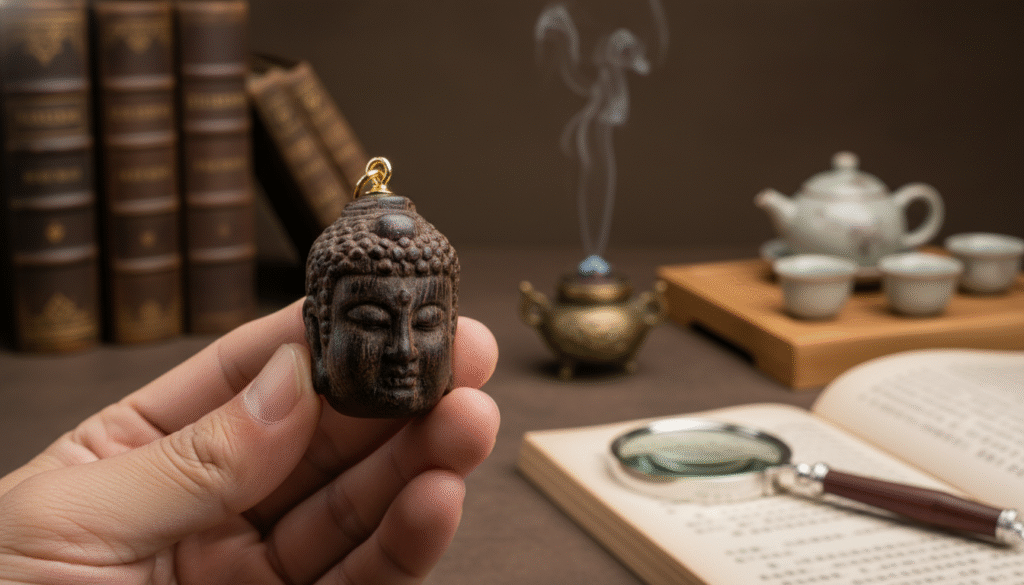
Insiders often talk about “oil quality,” but it’s not just about how black it is. What fascinates me most about this pendant is its “overflowing” quality. This stems from its origin—typical domestic Guanxiang old material. Unlike the coarse oil lines of Irian or Marauke, the resin in this piece is as delicate as ink soaking into Xuan paper. Under natural light, it presents a deep dark-brown wood, with the surface seemingly wrapped in a translucent amber luster. I must remind everyone: this is by no means the “fake shine” achieved with polishing wax found on the market, but the natural secretion of resin after years of precipitation! Every grain is a medal of self-healing left by this Guanxiang tree through decades of wind and rain. Only this level of resin density can carry the title of “Sinking Grade.”
Practice at the Fingertips: Oriental Philosophy and the Harmony of Gold and Wood
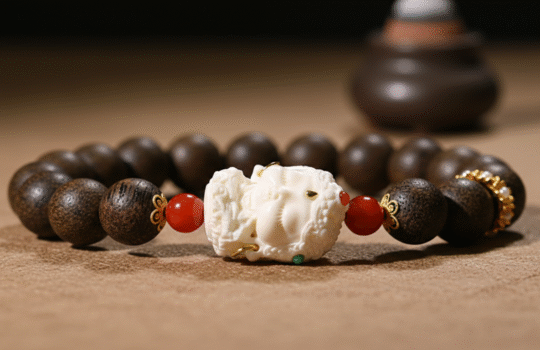
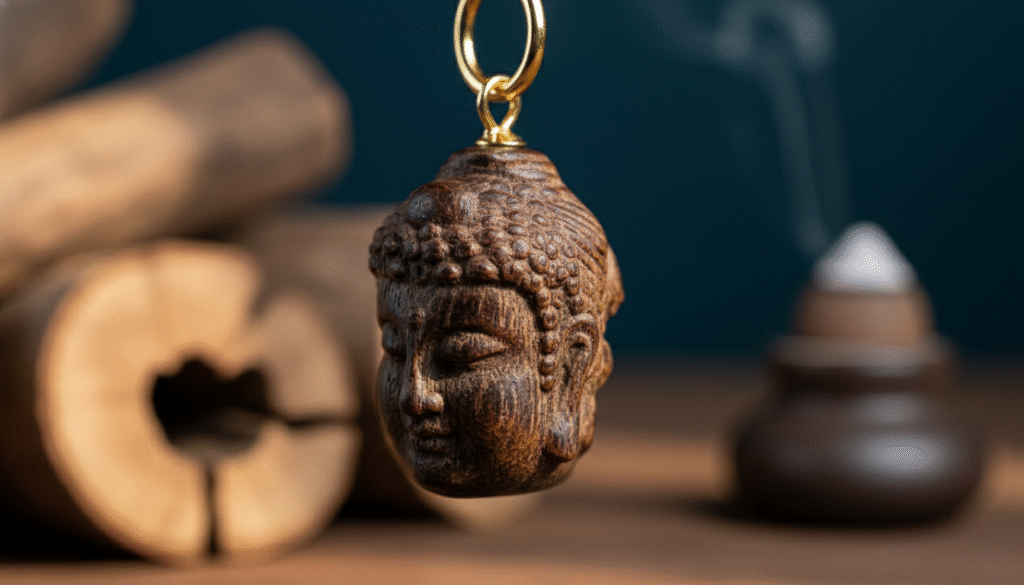
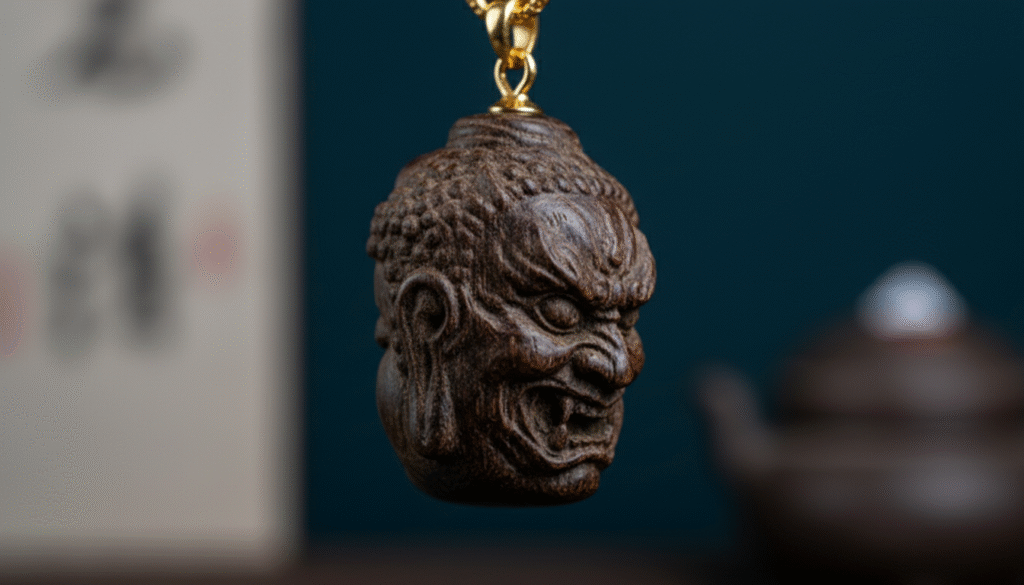
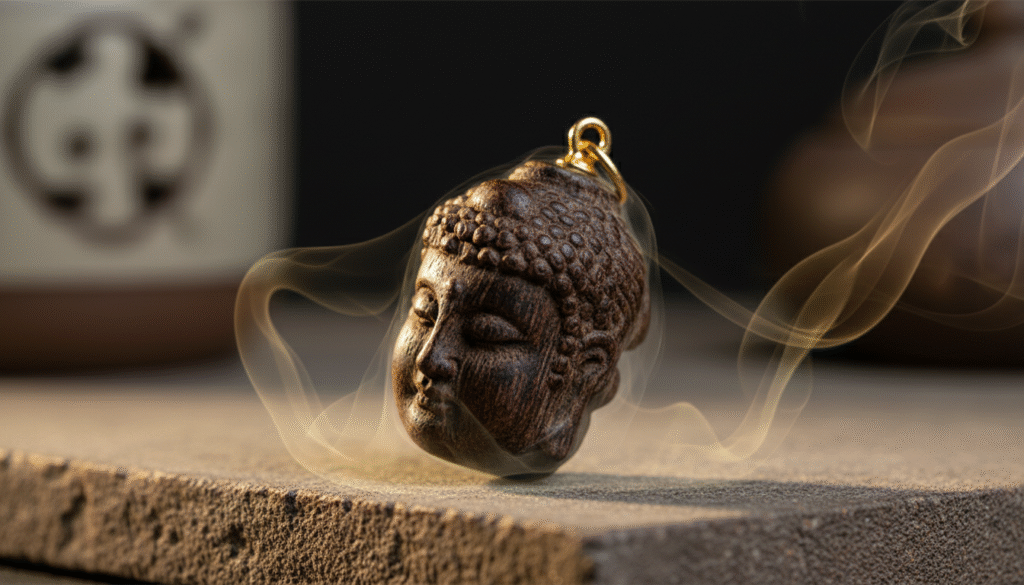
Good material deserves good craftsmanship; this is the rule and a sign of respect for nature. Facing such scarce sinking-grade old material, we did not simply turn it into beads. Instead, we invited a famous Suzhou carving master to bestow upon it the double-sided theme of “One Thought.” One side is the compassionate, downcast face of the Buddha, while the other is the wide-eyed, fierce countenance of a Demon. This echoes the formation process of Agarwood itself—the damage the tree suffers is the “Demon,” while the self-healing through resin is the “Buddha.” Pain and fragrance are two sides of the same coin. To honor this Zen spirit, I specifically chose 18K frosted gold (Au750) for the bail. This low-profile, sandy gold texture ensures both secure wearing and long-lasting luxury without overshadowing the Agarwood itself. Gold and wood give birth to each other, merging strength with softness. Wearing it is not just decoration, but a reminder: good and evil exist within a single thought; afflictions are themselves Bodhi.
An Olfactory Feast: The Irreplaceable “Guanxiang Like Honey”
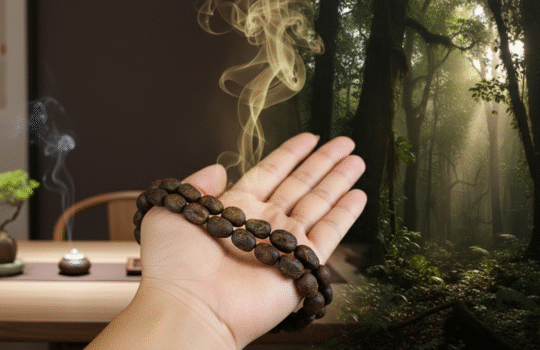
If appearance conquers the eyes, then the scent profile conquers the soul. As a masterpiece of domestic Guanxiang, its aroma is highly recognizable. The ancients said “Guanxiang is like honey,” and they did not lie. It doesn’t need to be burned; when worn on the body, your 37-degree body temperature is the best catalyst. The initial scent is a clear sweetness with a thick fruit-honey feel, not as sharp or piercingly cool as Vietnam Nha Trang, nor as aggressive as the Xingzhou series. Taking a deep breath, you will feel an elegant milky fragrance, with a lingering finish that carries a hint of coolness reaching straight to the crown of the head. This complexity is incomparable to chemical fragrances or ordinary cultivated Agarwood. It is like a hidden hermit—silent, yet possessing a natural aura.
Collection Trends: Value Logic Under Scarcity
Many new friends ask me privately why the price of domestic Agarwood keeps rising. The reason is simple: for every piece dug up, there is one less in the world. Especially for a piece like this—sinking grade, full of resin, and featuring deep cultural significance through hand-carving—its artistic value has long surpassed the material itself. The “domestic old material” behind this pendant is already a hard currency priced by the gram in the market. For veteran collectors and high-net-worth individuals, this is not just an accessory, but a wearable asset. In the future, owning an authentic Guanxiang carving will be a ticket into China’s top-tier cultural circles. If you are still hesitating about your “affinity” with this piece, or want to see a 360-degree detail video in natural light, feel free to private message me for an “Agarwood Appreciation.” After all, forming a bond with fine incense often happens within that “One Thought.”
FAQs
Q.What does “Sinking Grade” mean for this pendant?
A.”Sinking” is the highest standard for measuring Agarwood quality. It means the resin content of this Guanxiang is so high and the density so great that it will immediately sink when placed in water rather than float. In the world of Agarwood collection, sinking grade represents extremely high medicinal value and investment value; it is an incredibly scarce resource.
Q.Is there a specific reason for pairing 18K gold with Agarwood?
A.Agarwood has a warm, gentle texture, and as an heirloom, it needs to be worn long-term. Ordinary alloys or sterling silver oxidize and turn black easily, affecting the aesthetics. We chose 18K gold (Au750) because of its high hardness, wear resistance, and color retention, providing the most stable support for precious Agarwood. The frosted finish particularly complements the ancient charm of old-growth Agarwood, achieving a visual “Destiny of Gold and Wood.”
Q.How should I maintain it during daily wear?
A.Agarwood is “alive”; it is sensitive to heat and chemicals. We recommend removing it when bathing or applying perfume to avoid damaging the resin structure. Usually, simply wiping it gently with a clean cotton cloth is enough. When worn, the natural oils secreted by the human body are actually the best maintenance, allowing the patina to become more beautiful over time—as the saying goes, “The person nurtures the wood, and the wood nurtures the person.”