Collector’s Journal: ‘Black Lacquer’ Old Material from Wuzhi Mountain — Appreciating the Timeless Aesthetics of a 27g Chinese Kynam 18 Arhats Carving
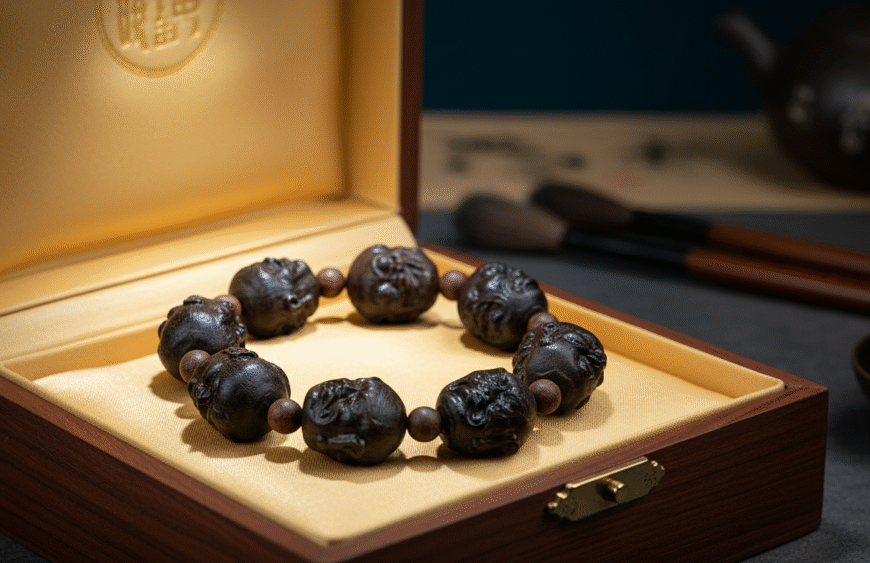
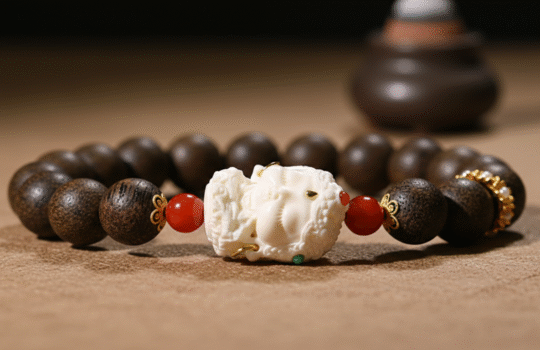
After decades in this industry and handling countless pieces, my heart still skips a beat when my fingertips touch authentic Chinese Kynam old material. The market is flooded with ‘fast-grown’ agarwood, leading many new collectors to believe a thin layer of oil is all there is. I recall the early 90s deep in Hainan’s Wuzhi Mountains when a Li ethnic hunter pulled a charcoal-like piece from under a stove; once cut, its domineering coolness eclipsed the room’s smoke. Such wild old material is now nearly impossible to find. Today, I want to share a treasure from my private vault: a 27g, 18*19mm Chinese Kynam Eighteen Arhats bracelet. It is more than jewelry; it is a textbook specimen of wood fiber completely ‘resinized,’ a century of rainforest essence, and a ‘graduation-level’ piece that ruins ordinary agarwood for you forever.
Tactile Mastery: When Wood Becomes ‘Black Lacquer’ Resin
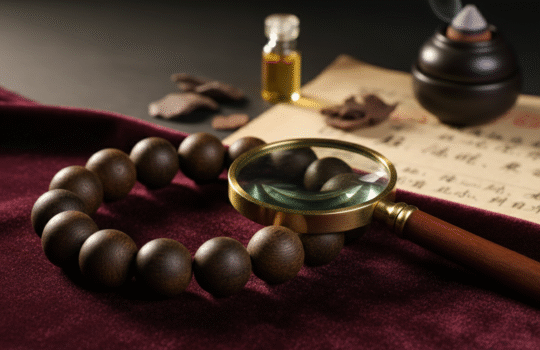
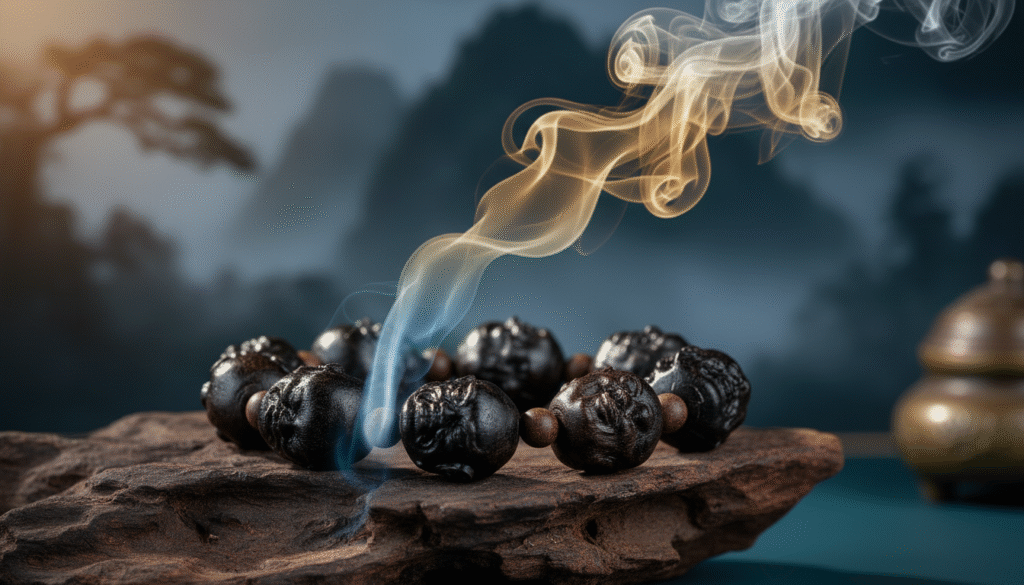
Many friends ask about the legendary ‘Soft Silk’ Kynam. Words are pale; you must feel it. Holding this bracelet, the first sensation is ‘heaviness’—27 grams concentrated into 18*19mm beads creates a dense, pressing weight known as ‘hand-pressure.’ Under natural light, the wood fiber structure is nearly invisible, replaced by a deep, shimmering ‘Black Lacquer’ finish. This luster isn’t a surface polish but resin ‘surging’ from within. A light touch reveals a subtle ‘stickiness,’ as if your finger is sinking into solidified honey. This ‘Soft Silk’ texture, which can be shaved into curls or pinched into balls, occurs when resin completely consumes the wood over centuries. This visual ‘overflow’ and tactile ‘resin drag’ are the definitive methods for identifying top-tier Chinese Kynam.
The Sculptor’s Gamble: The Micro-Carving of Eighteen Arhats
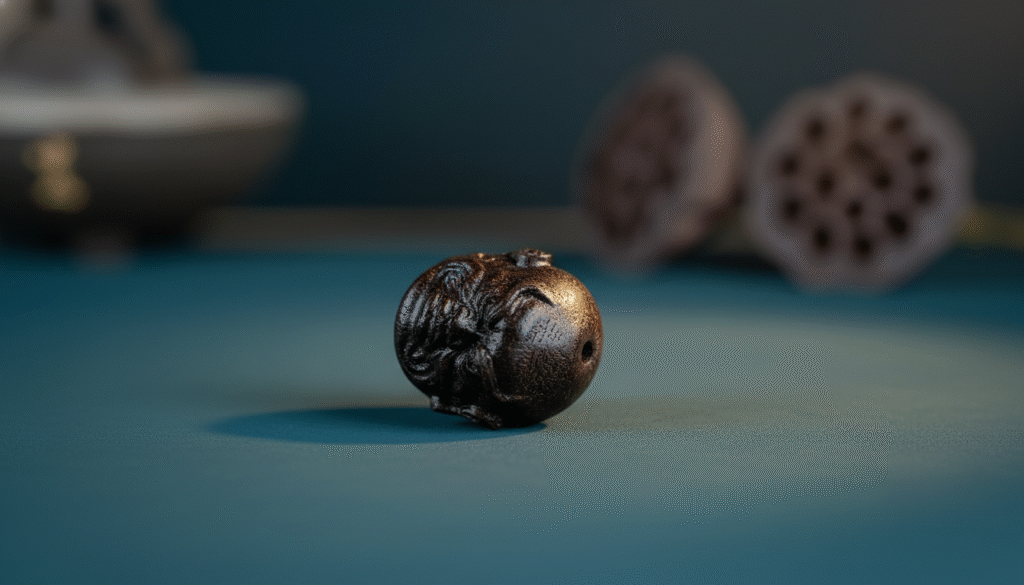
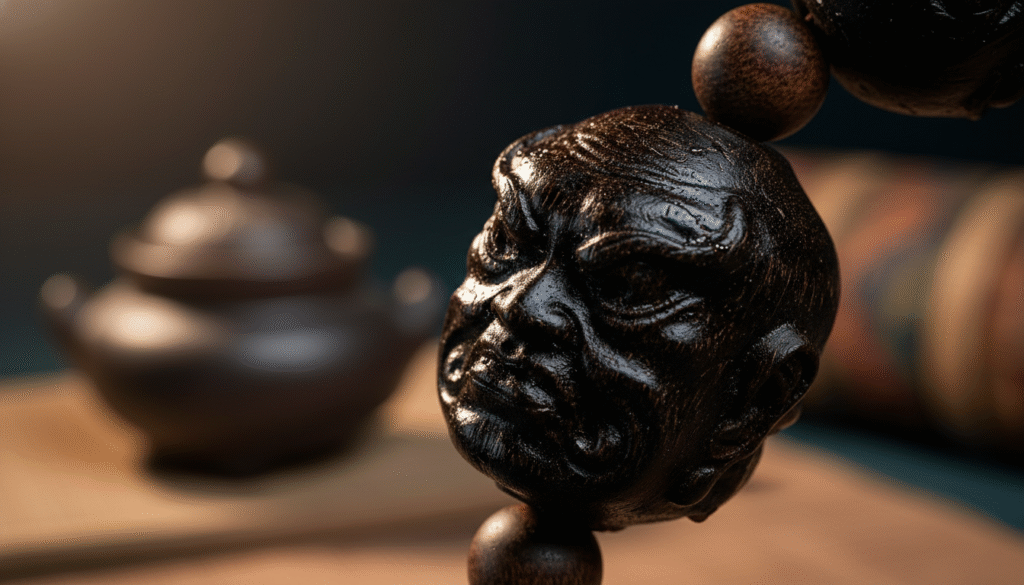
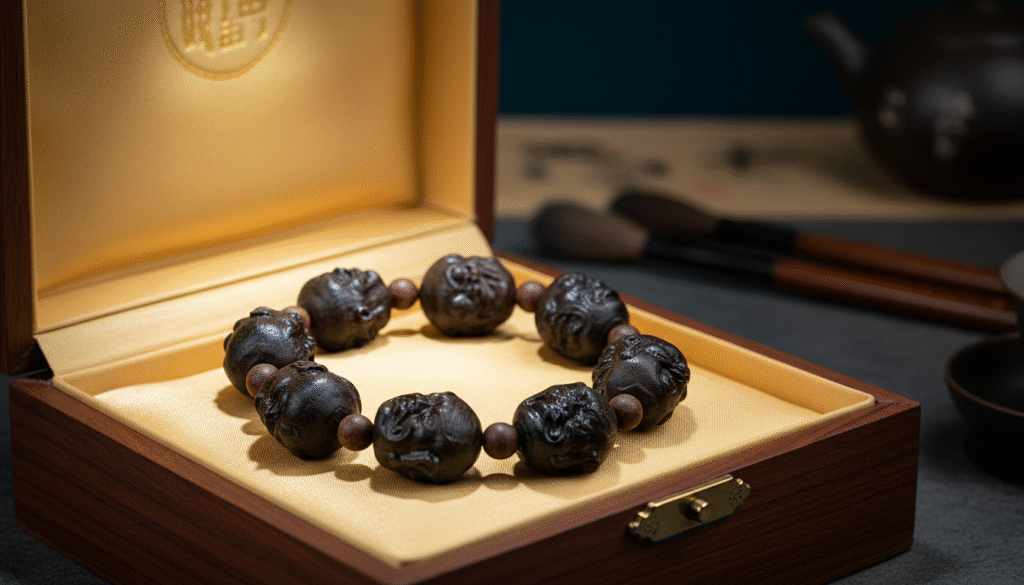
Carving Kynam is a massive gamble. The material is soft and sticky, frequently ‘clogging’ the blades and potentially ruining a piece worth more than a hundred times its weight in gold. Yet, this piece dares to feature hand-carved Eighteen Arhats, showing incredible courage and skill. Under a magnifying glass, the ‘facial opening’ of each Arhat is a miracle. The carver had to follow the chaotic resin lines to avoid tearing the soft silk texture. Whether showing fierce wrath or compassionate gaze, the expressions are majestic without being artificial. This is not just a religious theme; it is a limit-pushing fusion of nature’s craftsmanship and top-tier human micro-carving. Every cut is a dialogue with thousand-year-old resin, creating a unique masterpiece that mass production can never replicate.
Transcendent Scent: A Baptism from Nose to Soul
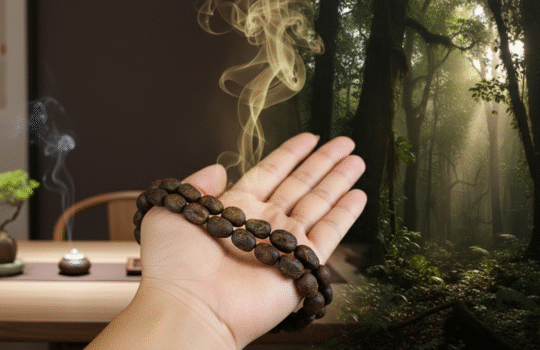
If the ‘Black Lacquer’ look is the body, the scent is the soul of Chinese Kynam. It stands at the pyramid’s peak because of its explosive and penetrating aroma. Wearing this bracelet, you don’t even need to bring it close. The initial note is a ‘coolness’ that strikes the crown of the head, carrying the crispness of the Wuzhi Mountain rainforest. As body heat warms the beads, a middle note of rich honeyed nectar explodes—sweet but not cloying, with hints of ripe fruit. The base note is a blend of thick medicinal incense and creaminess, bringing a meditative Zen peace. This multi-layered and incredibly persistent fragrance is a natural miracle no perfume can mimic, allowing you to build your own quiet sanctuary in a noisy city.
The Weight of Legacy: Why It Is the Ultimate Collection
As a senior collector, I must be honest: wild old-growth Chinese Kynam, especially from Wuzhi Mountain, is a non-renewable resource that is disappearing bead by bead. A piece like this, with a high weight of 27g and exquisite carving, is a ‘pinnacle asset’ in the market. Its value lies not in consumption but in asset allocation and cultural heritage. For high-end investors, it offers strong anti-inflation properties and elite liquidity; for fragrance lovers, it is a tool for self-cultivation. To own it is to safeguard a thousand-year history of incense culture. If you wish to feel the weight of this 27g ‘Black Lacquer’ piece or have questions about your own agarwood, feel free to contact my private WeChat or visit my tea room. Rare incense is hard to find, but a true connoisseur is rarer; I only wish to share this Kynam with those who truly understand it.
FAQs
Q.How should ‘Soft Silk’ Kynam be maintained?
A.Kynam, especially the ‘Soft Silk’ variety, is most sensitive to chemical detergents and high temperatures. Avoid contact with water during daily wear, and store it in a sealed box or with agarwood powder when not in use. The best maintenance is ‘human nourishment’—the constant temperature and natural oils of the skin will make it moister and deepen the patina over time. However, avoid wearing it against the skin during heavy sweating to prevent acidity from damaging the scent.
Q.How can I distinguish this from ordinary agarwood?
A.The key lies in ‘stickiness’ and ‘scent profile.’ Ordinary agarwood is harder and rarely achieves this ‘Black Lacquer’ resinous look, nor does it have the sticky, waxy rebound when touched with a fingernail. Second is the scent’s explosiveness; ordinary agarwood often needs heat to release its aroma, whereas top-tier Chinese Kynam is highly penetrating at room temperature and possesses shifting layers of cool, sweet, milky, and medicinal notes that counterfeits cannot simulate.
Q.Is 27 grams considered heavy for a bracelet?
A.Extremely heavy. For an 18*19mm size, ordinary agarwood with lower resin content usually weighs between 15-20 grams. Reaching 27 grams indicates that the internal wood fibers have been fully converted into resin, resulting in high density. This ‘sinking grade’ or ‘near-sinking grade’ density is a critical metric for old-growth quality, representing an exceptionally high resin saturation.
Q.Does carving the Eighteen Arhats damage the resin lines?
A.Poor carving can indeed cut through resin lines and ruin the aesthetics, but master-level hand-carving follows the grain. This piece cleverly utilizes the flow of the resin lines during carving. Not only does it preserve the visual beauty of the dense, tangled oil lines, but the three-dimensional carving also increases the surface area, which actually helps the fragrance disperse more effectively, achieving a perfect harmony between craft and material.