[Appreciation] A Legacy of Fragrance: Why 108 Top-Tier Chinese Kinam Barrel Beads are Deemed the “King of Incense” by Collectors?
Having navigated the agarwood industry for half my life, I thought I had seen it all, becoming somewhat numb to the so-called “sky-high prices” on the market. That was until a typhoon-swept afternoon when an elderly collector living in the mountains of Guangdong tremblingly produced these 108 top-tier Chinese Kinam barrel beads from a cloth pouch. At that moment, the dim tea room seemed illuminated by a ghostly glow. To be honest, I held my breath—this wasn’t just wood; it was the “sarira” of domestic Kinam, condensed through centuries of erosion and healing. The old gentleman told me this material was a “house treasure” buried by his ancestors during wartime to protect the family’s fortune. Now crafted into 108 beads to symbolize the severing of 108 worldly troubles, I am not just showcasing a product today, but telling a true story of celestial energy and family heritage. Let us set aside dry parameters and touch the fragrance sealed by time.
A Legend at Your Fingertips: The “Soft-Silk” Resin That Enchants at First Sight
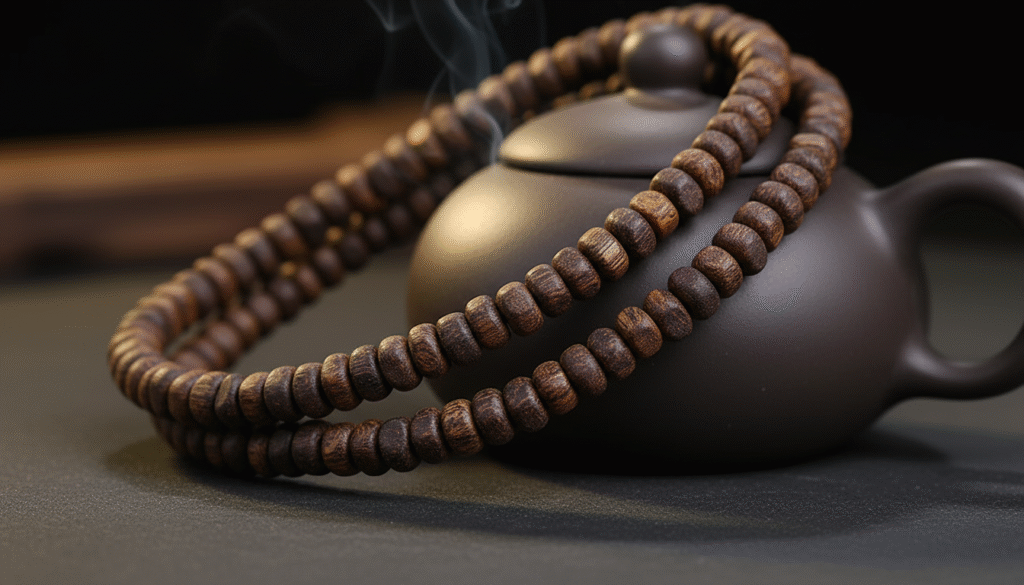
The highest realm of appreciating incense lies in the “touch.” What makes this string of beads most moving is its “Soft-Silk” texture, unique to indigenous Chinese Kinam. I remember the old collector taking out a loose bead; a light scratch with a fingernail left a mark like condensed fat, which slowly recovered under body temperature. This is the legendary quality: “shaves into curls and kneads into a ball.”
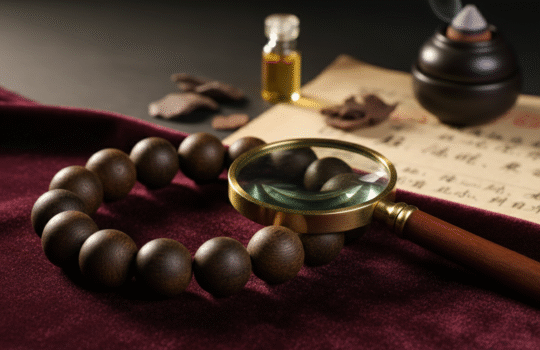
Through a macro lens, you no longer see wood grain, but an ink-wash landscape painting. The high-density resin permeates every wood fiber like spilled ink, presenting a deep black-brown hue. This “black” is not the dead black of withered wood, but a lustrous, breathing color of life. Each barrel bead is a miniature energy field; held between the fingers, that jade-smooth yet slightly waxy feel makes you instantly realize why the ancients said, “An ounce of Kinam is worth an ounce of gold.”
Baptism of the Soul: From “Piercing Coolness” to “Honey-Milk Sweetness”
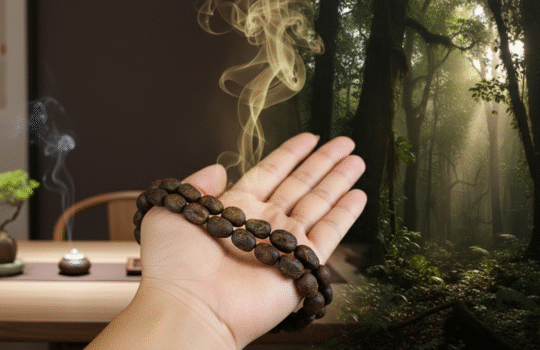
The reason Chinese Kinam stands at the top of the hierarchy is entirely due to its domineering and charming fragrance. The scent of these 108 barrel beads is a symphony with distinct movements. When you first approach, a highly penetrating coolness rushes straight to your brow—what we call “piercing coolness.” This chill is clean and biting, like being in the mist-shrouded ancient mountains at dawn, instantly clearing internal heat and distractions.
But this is only the overture. As it is warmed by body temperature during wear, the initial coolness dissolves into a rich, mellow honey-sweet and milky fragrance. This sweetness has distinct “National Fragrance” characteristics, resembling a blend of ripe fruit and wildflower honey, long-lasting and profound. In the base notes, it transforms into an elegant, ethereal floral scent that lingers. In ancient times, such a fragrance often accompanied emperors, serving not only as a status symbol but also as a spiritual medicine to open the senses and cultivate the body.

A Timeless Asset: The Rose of Time, a Family’s Watch
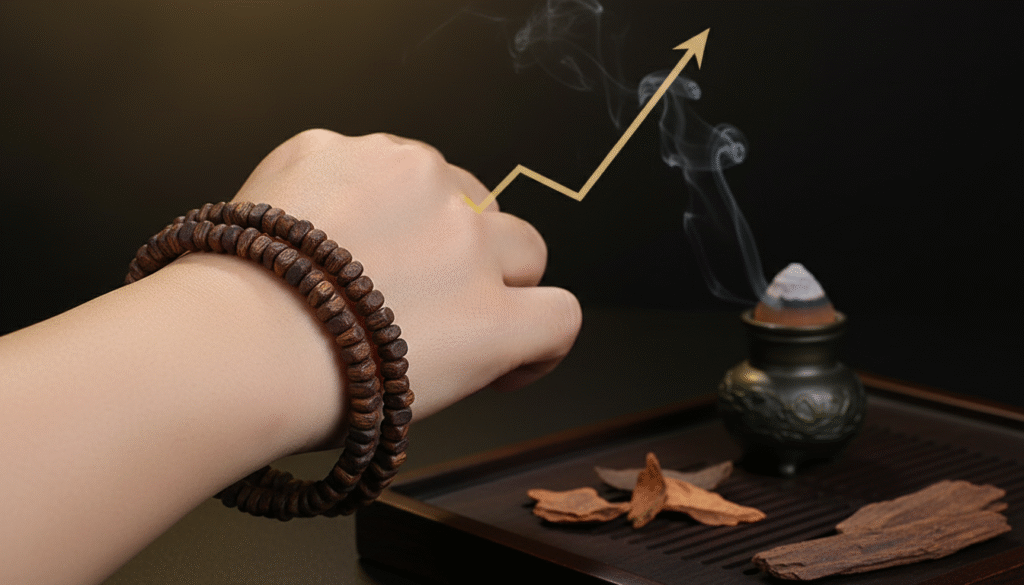
As an exporter, I have seen countless capital games in the agarwood market. But truly top-tier Chinese Kinam is never for “speculation”; it is for “collection.” Looking back over the past fifteen years, ordinary agarwood may fluctuate, but the price curve of top-tier Soft-Silk Kinam has risen like a soaring dragon. What was considered affordable luxury in 2010 is now a luxury priced by the gram at major auctions, with growth rates that put gold to shame.
Yet, the value of this string goes far beyond that. It is a family asset with extremely strong inflation resistance. In today’s uncertain times, owning a string of non-renewable, top-grade Chinese Kinam not only locks in the scarcity of wealth but also leaves a piece of “wearable real estate” for future generations. As years pass, its patina will become more transparent, and its fragrance more mellow.
[Expert’s Word]
To be perfectly honest, 99% of this level of “National Fragrance” Soft-Silk Kinam is hidden away as “bottom-drawer stock,” rarely seen through ordinary channels. If you truly wish to acquire an heirloom piece or are unsure about your current collection, feel free to click my profile or send a private message. Even if you don’t buy, I’m happy to help you appraise it. In this circle, connecting with a fine piece of incense depends not just on money, but on destiny.
FAQs
Q. What is the core advantage of Chinese Kinam compared to Southeast Asian Kinam?
A. Chinese Kinam (commonly known as National Fragrance) is the crown jewel of Kinam. Compared to Southeast Asian regions, Chinese Kinam has a stronger waxy resin feel (more pronounced Soft-Silk characteristics), and its fragrance has a more thorough coolness and a more elegant sweetness. Culturally, Chinese Kinam is the orthodox lineage used by royalty historically, with the most detailed medicinal records, giving it an irreplaceable status in high-end collection circles.
Q. Are there any taboos in the daily maintenance of this “Soft-Silk” Kinam?
A. Because Soft-Silk has extremely active resin and a soft texture, it is as delicate as it is precious. Avoid contact with any chemical detergents (such as hand soap or perfume), as these will dissolve the natural oils. Also, avoid wearing it with sharp metal objects to prevent scratches. The best maintenance is “human nourishment”; the body’s natural oils and temperature are the best polishing agents—the more it is worn, the more lustrous it becomes.
Q. What is the cultural significance of the 108 barrel bead format?
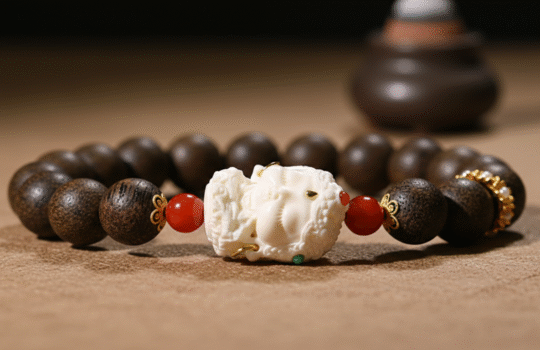
A. 108 beads represent the severing of 108 types of afflictions, the most classic Buddhist format. The “barrel bead” shape is ancient and substantial, with flat ends symbolizing “stability and stored wealth.” This format can be worn as a long chain on the chest to show refined temperament, or wrapped multiple times around the wrist as a daily amulet, making it a perfect carrier of both aesthetics and faith.
Q. How can one visually distinguish that this Kinam is not artificially injected with oil?
A. The charm of real Kinam lies in its “naturalness.” Under light, you can see the resin lines following the natural growth of the wood grain, with natural transitions in depth and a three-dimensional layered feel. Artificially injected oil is often “dead black,” accumulating on the surface, and smells of pungent chemicals, completely lacking the three-stage fragrance transition of “cool-sweet-floral” found in genuine Kinam.