Appraisal Record: “Chinese Black Oil Kynam” Under the Microscope—Why “Live Knot” Golden Threads and Ink Lines are the Hard Currency of the Collection World?
“Senior agarwood expert takes you deep into the microscopic world to decode the ultimate mysteries of Chinese Black Oil Kynam. Compare "Live Knot" and "Ripe Knot" oil morphologies under a microscope to reveal the causes of golden threads and ink lines. Experience cool air penetration and honeyed sweetness—this is a profound guide to olfaction and assets.”
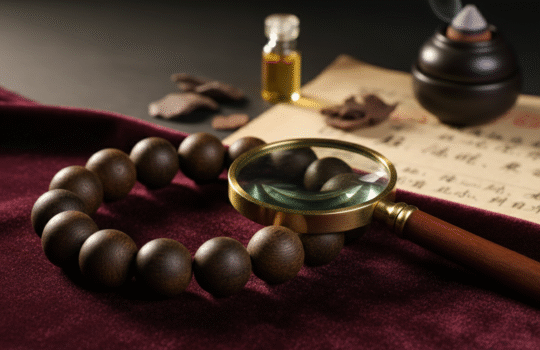
With decades in agarwood export, I have seen countless “fake at first sight” stories and handled many fine pieces. But today, the Chinese Black Oil Kynam bracelet on my desk forces me to take out my 60x magnifying glass to discuss a crucial but often ignored topic: the microscopic battle between “Live Knots” and “Ripe Knots.” In this industry, many only talk about “sinking,” but do not understand oil activity. This bracelet is more than a sealed fragment of time; it is a medal of the tree’s fierce struggle against fungi at the peak of its vitality. Today, I will not share ethereal legends, only visual evidence and olfactory experiences to show you this “active black oil masterpiece” that may soon vanish.
Truth Under the Microscope: Live Knot “Active Oil” VS Ripe Knot “Crystals”
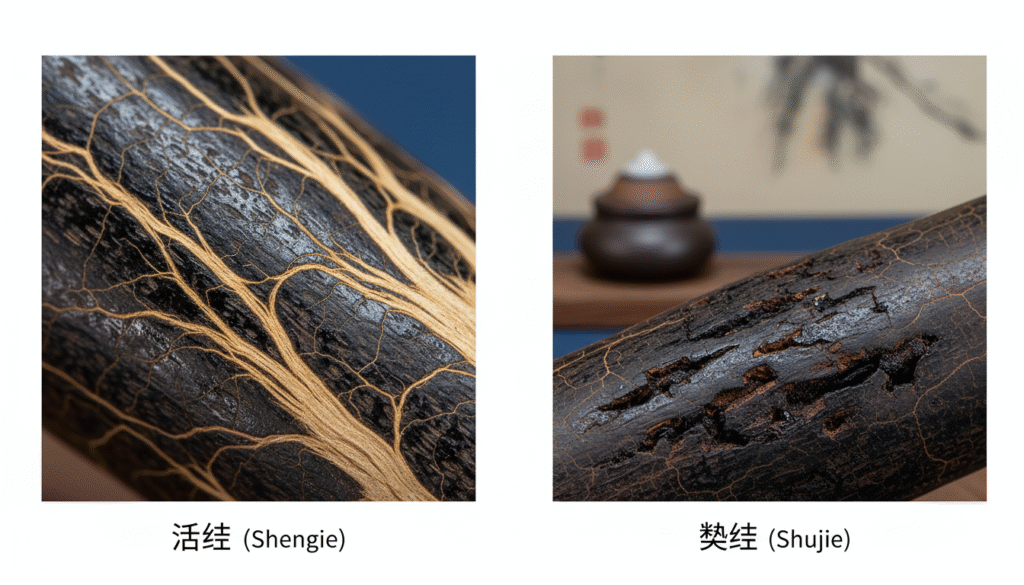
Many collectors ask why the “Golden Thread and Ink Lines” of these beads look so dynamic. The secret lies in it being a “Live Knot” (Shengjie). Under a 60x microscope, we can clearly see that the oil lines of a “Live Knot” look like flowing ink, aggressively penetrating along the original nutrient-conducting vessels, presenting an expanding, smudged morphology—direct evidence of the tree resisting external trauma while alive. In contrast, “Ripe Knots” (fallen or soil-buried) often show shrunken or even dried crystalline oil states under the microscope; while elegant, they lack a sense of “moistness” and “life.” This black oil Kynam, with its intertwined black oil and golden wood fibers, has clear yet fluid lines, as if the oil is breathing beneath the skin. This is the true form of top-tier “Golden Thread and Ink Lines.”
Olfactory Explosiveness: The Layers of Cool Penetration and Honey Sweetness
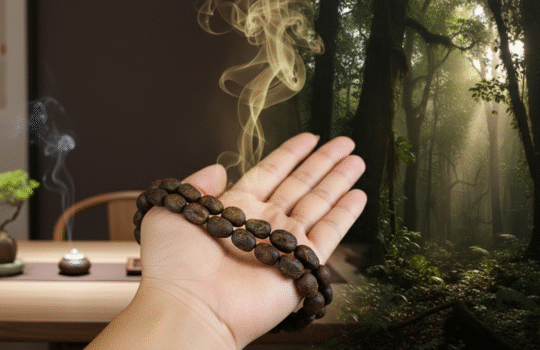
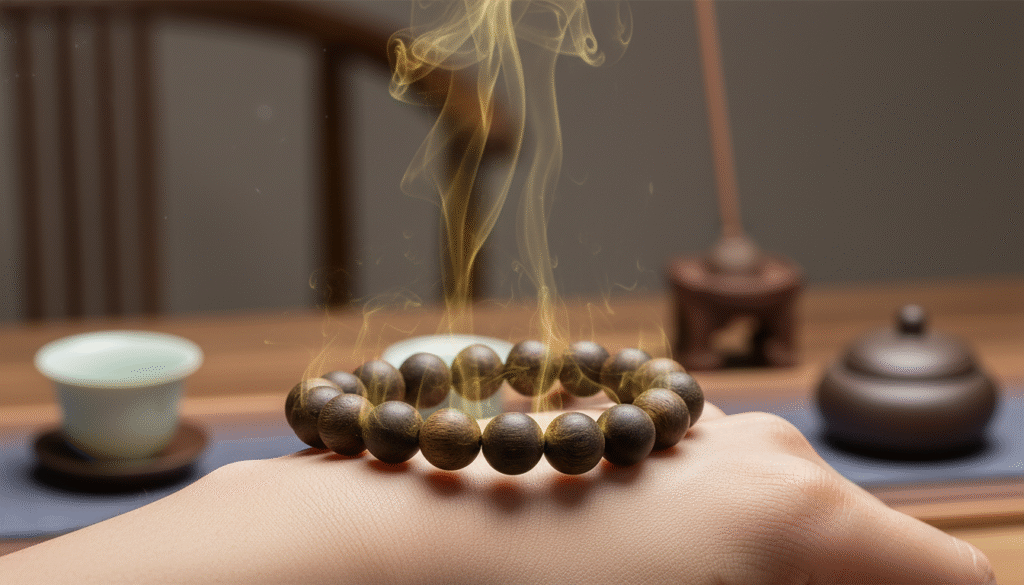
Beyond visual “life,” the biggest advantage of Live Knot Kynam is its scent explosiveness. Because it retains the tree’s active oil, this bracelet—note, without any hand-warmth heating—releases a highly penetrative cool air. This coolness is not the pungency of mint, but a crispness that hits the crown of the head. Following closely is a rich honeyed sweetness and a unique floral fragrance; this layering is incomparable to many soil-buried Ripe Knots, which often require heating to release subtle aromas. When wearing it, you feel the scent is “projected” rather than “wafted.” This is why domestic Chinese Kynam (especially from Guangdong and Hainan) is world-class: dominant, direct, and with a long-lasting sweet aftertaste.
Collection Moat: Why “Live Knots” Have Higher Financial Attributes?
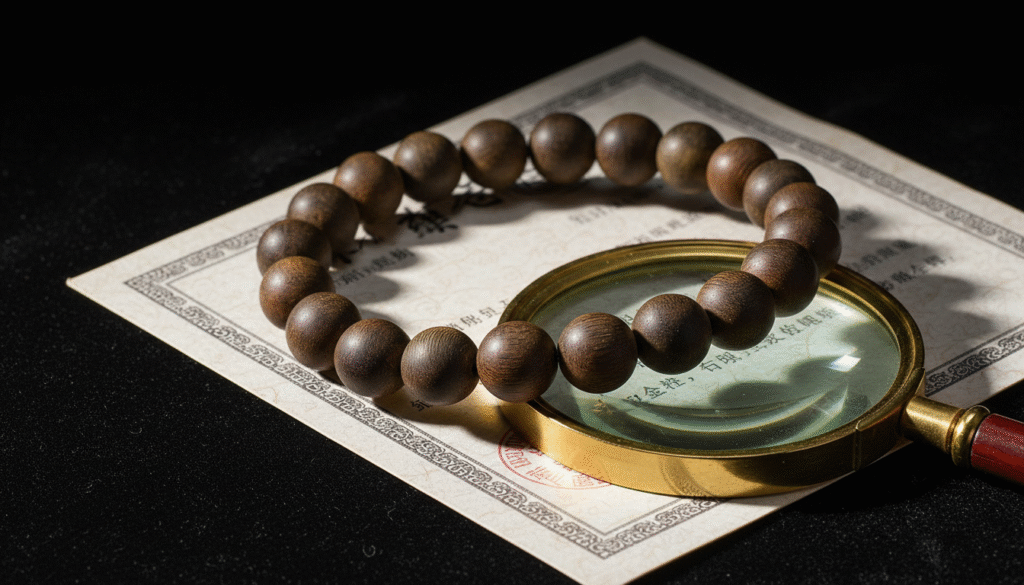
In the current collection market, Ripe Knots are precious due to scarcity, but high-quality “Live Knot Black Oil” is becoming a new asset safe haven. The reason is simple: counterfeiters find it extremely difficult to imitate the natural oil bleeding and vessel activity of a “Live Knot” seen under a microscope. High-pressure oil-injected fakes on the market appear as a dead black mass under magnification, devoid of texture. Each bead of this Live Knot Kynam with clear “Golden Thread and Ink Lines” is an uncopyable anti-counterfeiting certificate. With wild agarwood resources in China nearly exhausted, acquiring a Live Knot old-growth piece with a density reaching semi-sinking levels and a complete scent profile is not just a hobby—it’s seizing the last window of rare resources.
Q&A
Q. What is the most intuitive difference between “Live Knot” and “Ripe Knot” under a microscope?
A. This is a core identification point. Under the microscope, the oil of a “Live Knot” (Shengjie) usually appears “smudged” or “flowing” because the oil formed while the tree’s transport system was active, bonding tightly with wood fibers with naturally blurred edges. “Ripe Knots” (Shujie), having undergone tree death and long-term weathering/soil burial, show oil that is “shrunken,” “crystalline,” or “granular,” and wood fibers may show signs of carbonization or decay. For beginners, Live Knot textures are usually clearer and glossier.
Q. Since it is black oil, why can we still see “Golden Threads”?
A. So-called “black oil” refers to areas of extremely high oil concentration, appearing black or dark brown. “Golden threads” refer to the wood fiber parts not fully filled with oil or containing lighter oil, appearing golden or yellowish-brown. This is a vital feature of authentic pieces—natural agarwood is a mixture of oil and wood; it cannot be solid dead black (unless it is extremely rare full-sinking or artificially soaked). The interplay of black and gold is the “Golden Thread and Ink Line,” representing the natural path of oil formation.
Q. Will the scent of Live Knot Kynam fade after wearing it for a long time?
A. As long as it is genuine Kynam, the scent will never disappear. Because Live Knot Kynam has strong oil activity, body temperature accelerates surface oil evaporation when first worn, making the scent very intense. While theoretically the scent becomes more restrained after surface evaporation, Kynam oil permeates from the inside out. With proper care (avoiding sun and chemicals) and regular sealed maintenance, its aroma will become more mellow and rounded over time, transitioning from a dominant cool note to a deep milky and medicinal fragrance.