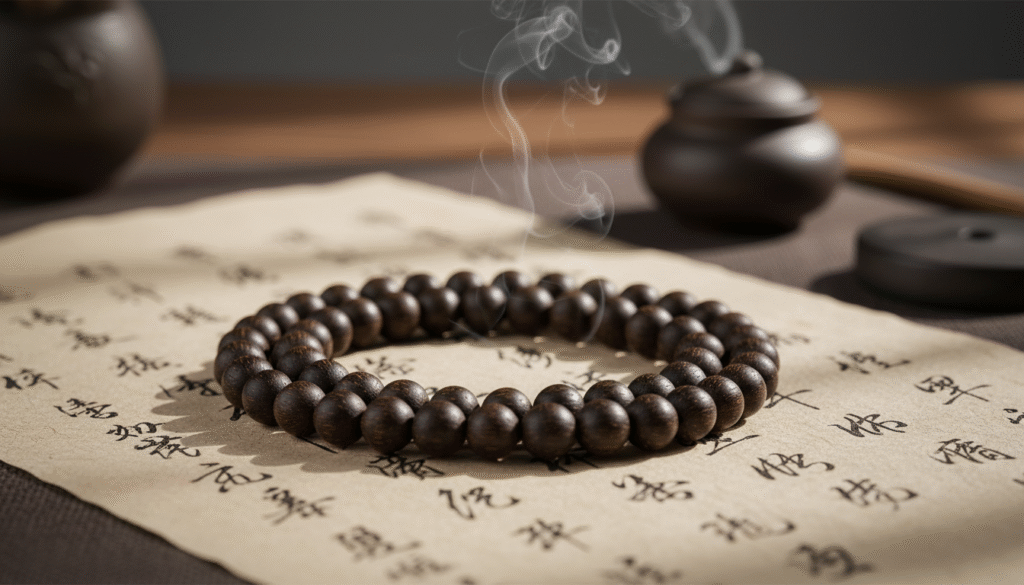
[Appraisal Notes] Why is this string of Sinking-Grade 108 Chinese Kynam Prayer Beads considered ‘Hard Currency’ in the collection world?
I remember collecting raw materials over a decade ago at the home of a reclusive old farmer in Dianbai, Western Guangdong. It was a sweltering afternoon after a heavy rain. The old man dragged a moldy fertilizer bag from under his bed and pulled out a dark, muddy piece of ‘rotten wood.’ Without a word, he lightly scratched the wood with his fingernail. In an instant, a cooling honey aroma suppressed the room’s humidity. That domineering yet gentle scent gave me goosebumps on the spot—it was the legendary ‘Scent that Lingers on the Hand’ top-tier Chinese indigenous Kynam. Today, the 108 sinking-grade prayer beads you see are derived from the same scarce genetic old-stock material. In the agarwood circle, we say ‘one piece of wood is hard to find,’ but to craft 108 beads of uniform color where every single bead sinks is as difficult as reaching the heavens. This is not just a bracelet; it is a ‘fragrance culture fossil’ rescued from time buried deep underground. It remains silent, yet that majestic aroma originating from the Chinese soil is enough to make it the focus of breathless attention for collectors at any top-tier auction.
Visual & Tactile: Solidified Honey and the Mellow Texture of ‘Soft Silk’
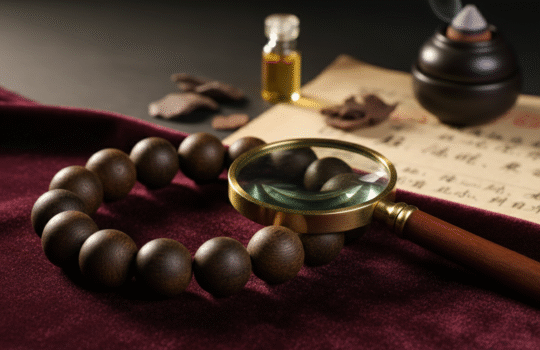
Experts appraising Kynam believe ‘the hand knows before the eye sees.’ Ordinary agarwood beads feel like wood, but the moment your fingertips touch this Chinese Kynam, you feel a strange ‘viscous creaminess.’ This is because its oil content is extremely high and active, exhibiting the top-tier ‘Soft Silk’ characteristic. Under a 40x magnifying glass, the surface of these 8mm beads is a microscopic universe: the wood fibers are almost invisible, replaced by paste-like, amber-colored oil lines that fill every vessel like flowing honey. This visual wonder of ‘appearing black to the eye, purple under light, and golden under macro’ can only be found in premium materials from specific Chinese regions that have undergone over a century of maturation, specifically those that formed resin while living and then weathered underground as ‘fallen earth’ (Tu Chen) or ‘collapsed frame’ (Dao Jia). Every bead is a crystallization of the perfect dance between resin and time.

The Soul of National Scent: A ‘Scent Symphony’ of Three-Stage Rhyme
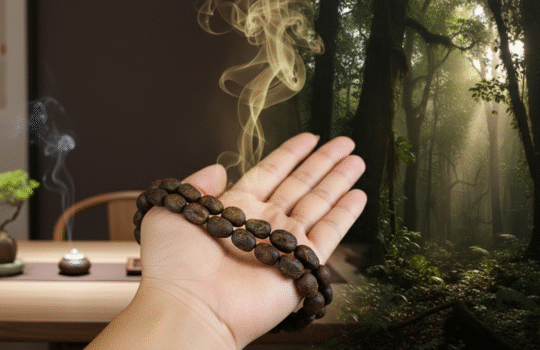
Why is Kynam from Chinese regions revered as the pinnacle of ‘National Scent’? The answer lies entirely in its ‘Qi’ (aromatic rhyme). The fragrance of these beads is never static; it is a fluctuating olfactory symphony. At first sniff, there is a ‘coolness’ like high-mountain snow water that hits the nasal cavity, instantly clearing distracting thoughts—this is the unique ‘orifice-opening’ power of Kynam. Then, as body temperature catalyzes the resin, a rich ‘orchid fragrance’ and ‘cantaloupe-like sweet cooling’ gush forth. This elegant, upright sweetness is a ‘righteous spirit’ that even Vietnamese Nha Trang material can hardly match. The finish is a deep frankincense intertwined with a faint herbal TCM scent, lingering and profound. The ancients said, ‘Sit in silence and burn incense, and the heart will have no obstructions.’ Wearing this Kynam, even in the noisy secular world, a single sniff provides an immediate sanctuary of personal tranquility.
Collection Logic: The ‘Paradox’ of Soft Wood Sinking and Scarcity Value
In physics, wood floats; in agarwood studies, only extremely high oil content (usually exceeding 25%) allows it to sink. Kynam is a ‘paradox’—its texture becomes soft due to excessive oil (it curls when shaved and leaves a mark when pinched). Crafting round beads from such a soft, waxy texture that are dense enough to sink instantly involves a material loss rate ten times higher than ordinary agarwood. Every gram of this 108-bead mala is the essence ‘carved out’ from hollow, irregular wild old-growth timber. Today, as wild Kynam resources are nearly exhausted, assembling a set of sinking Kynam with uniform color and perfect appearance is no less difficult than collecting a set of top-tier Imperial Green Jadeite. It is not only wearable luxury but also a ‘hard currency’ with strong downside protection in asset allocation. If you are looking for your own ‘orifice-opening’ scent or are interested in this unique piece, feel free to private message ‘Kynam’—I will personally guide you.

FAQs
Q. Q: What is the fundamental difference between ‘Chinese Kynam’ and ‘Vietnamese Nha Trang Kynam’ on the market?
A. Both are top-tier agarwood, but their aromatic temperaments differ. Vietnamese Nha Trang Kynam tends to be flamboyant with extreme sweet-cooling notes. Chinese regional Kynam (especially old stock from Guangdong and Hainan) emphasizes ‘elegance’ and ‘uprightness.’ Its coolness is more piercing, its sweetness is more honey-like, and it carries a unique ‘scholarly’ or ‘refined’ aura. From a cultural perspective, Chinese Kynam better fits the traditional aesthetic of ‘restraint and balance,’ and due to lower surviving stocks, the collection value of old material often commands a higher scarcity premium.
Q. Q: What should I do if ‘Soft Silk’ Kynam accidentally touches water or sweat?
A. True Kynam is rich in oil and actually has strong self-protection capabilities. A small amount of fresh water or sweat is not terrifying; simply wipe it gently with a clean cotton cloth after wearing. In fact, body temperature and natural oils from handling (patina development) can ‘nourish’ the beads, making the patina mellower. However, remember the ‘Three Fears’: fear of high temperatures (which dries the oil), fear of chemicals (detergents or perfumes destroy the scent structure), and fear of external odors. If it accidentally picks up a stray smell, seal it in a container with Kynam bead powder for a few days, and the fragrance will return to its original purity.