A Masterpiece Revealed: Why This Aged Kynam Burl Agarwood Bracelet is the Ultimate Dream for Elite Collectors
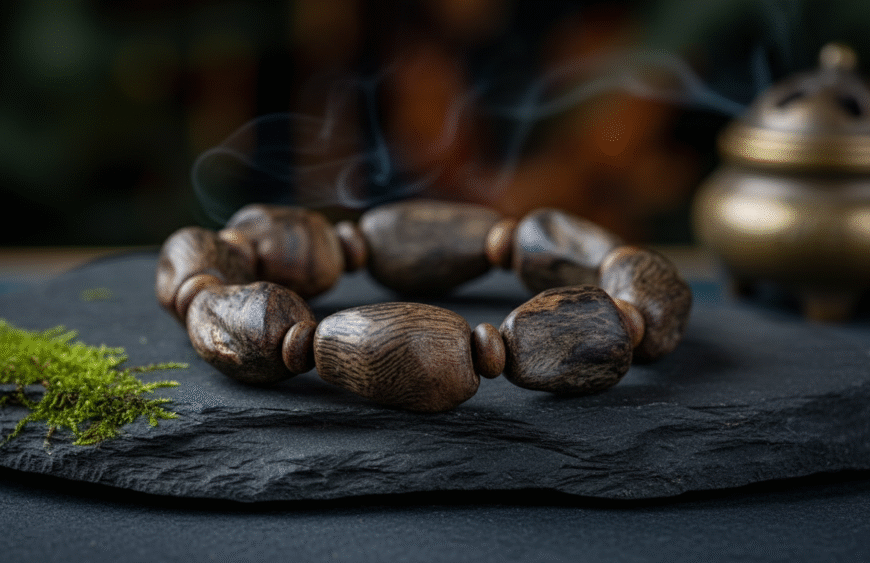
I remember a rainy evening in the Guanxi agarwood region of Guangdong when I visited an elderly farmer who had lived in seclusion for half a century. When he tremblingly pulled this piece from a coarse cloth bag kept close to his body, the air in the room seemed to freeze. This is not a mere commodity; it is a sealed history of suffering. This agarwood originated from a century-old tree that survived a lightning strike fifty years ago, creating burls as it frantically secreted resin to heal its wounds. It is both a scar of the tree and a medal of nature. Holding it, the characteristic soft, waxy stickiness of Kynam made me feel the residual warmth of that decades-old storm. Today, I won’t talk about dry parameters; I want you to understand this art of nature’s scars and why it takes the breath away from even the most seasoned collectors. If you are looking for a true heirloom, please read on.
Visual Impact: The Morbid Aesthetics of a Thunderbolt’s Mark
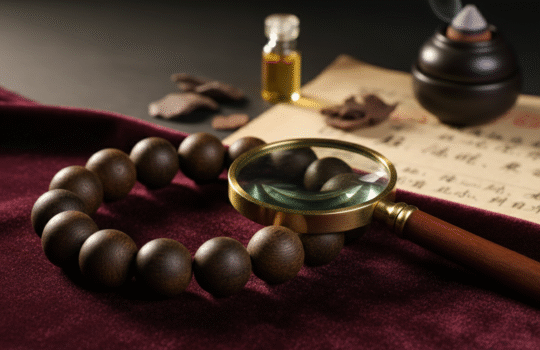
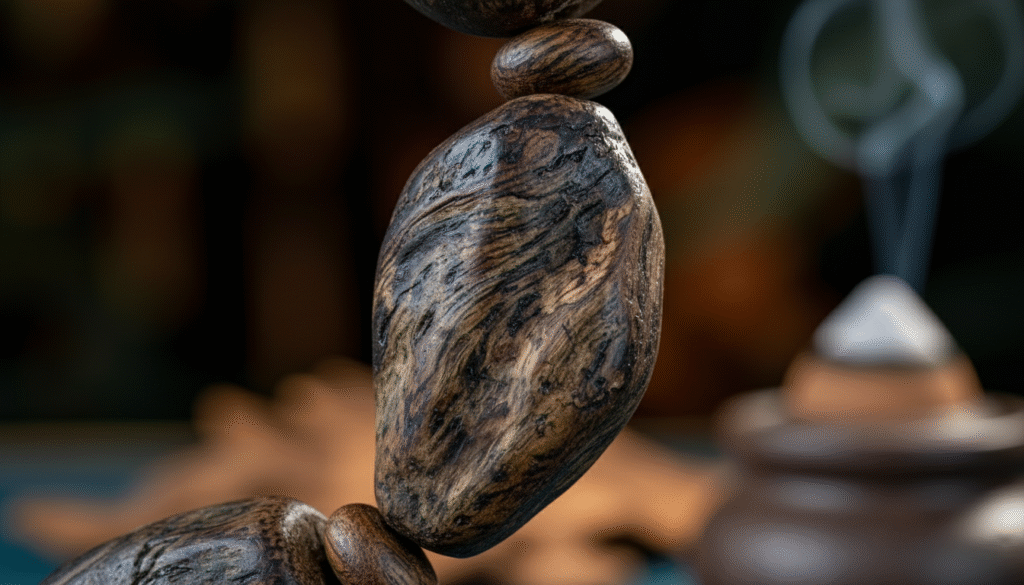
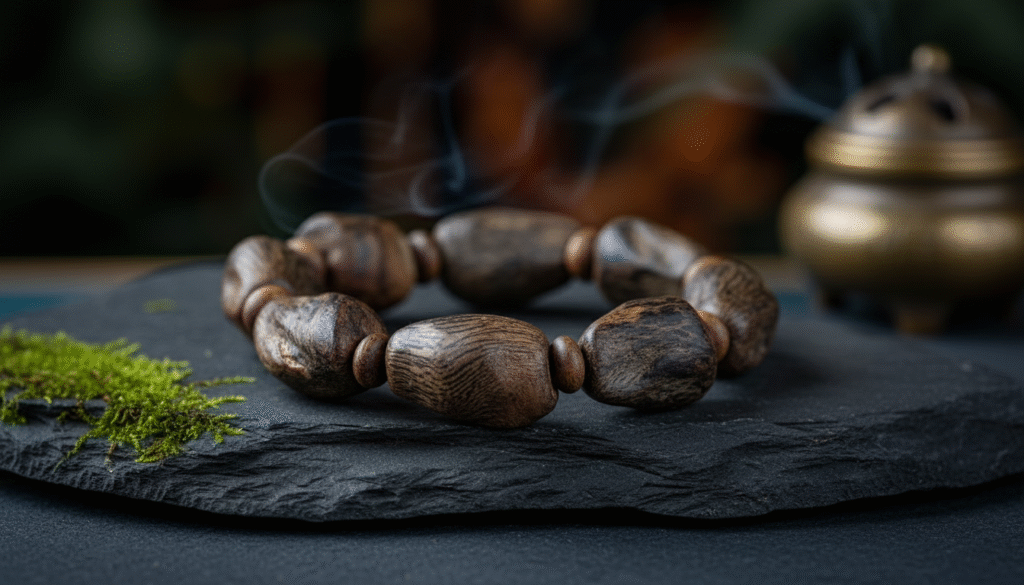
Look closely at your screen; this is no joke. While ordinary agarwood has straight, silk-like grain, this bracelet showcases extremely rare gall or burl formations. This is not man-made; it is the result of an old tree mobilizing its life essence for self-repair after fatal trauma from lightning or insects. The wood grain no longer follows a linear path but twists and entangles like wild ink-wash landscape paintings. In the industry, these patterns are called Demon Faces or Celestial Eyes. Every bead is a unique edition; these intricate lines are a totem of life struggling to survive in extreme environments, transforming pain into art. Owning it means owning a piece of biological nirvana.
Tactile Decoding: The Soft and Waxy Aura of Kynam Species
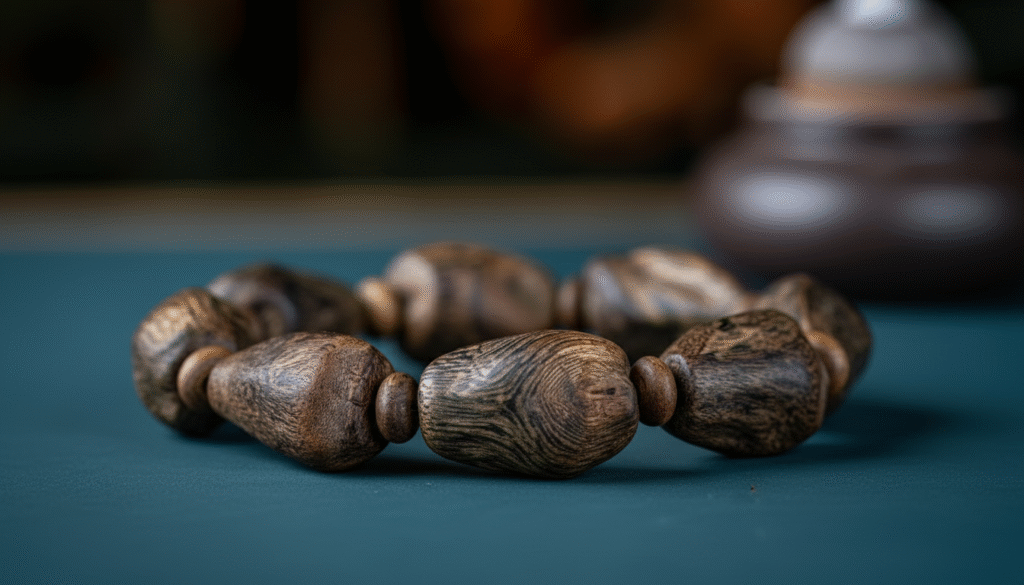
Experts judge resin not just by its darkness, but by its luster. This material is classic black and moist. When you rub it gently with your fingers, you’ll be surprised to find it lacks the dryness of old wood, offering instead a soft, waxy, and slightly tacky sensation similar to cutting through a block of wax. This is ironclad proof that the resin has completely permeated the wood fibers, reaching a state of wood-oil symbiosis. Under a microscope, the oil lines appear in a molten state as if about to overflow. Having spent years in this industry, I must tell you: this Kynam-grade oiliness unique to Chinese regions means it has evolved beyond mere wood into a high-energy polymer. The jade-like warmth and slight resistance when handled is the silent boast of top-tier aged material.
Design Philosophy: Homage to the Natural Form
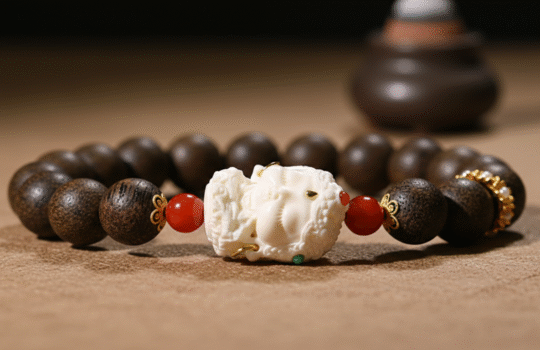
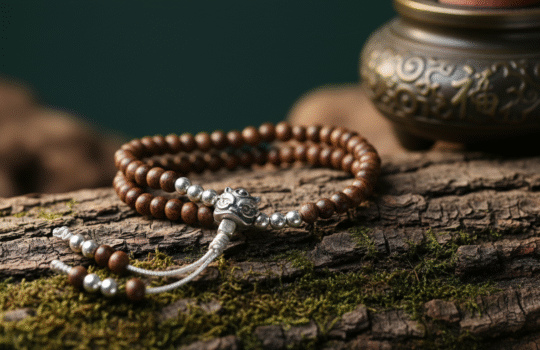
A billionaire once wanted to machine these into perfectly round large beads, and I flatly refused. For aged Kynam burl material of this caliber, every gram is worth several times more than gold. To grind away the most precious resin layers for the sake of industrial geometric perfection is a desecration of nature’s gift. We insist on natural free-form shaping, polishing according to the direction of the grain to preserve the original weight and morphology. These irregular contours retain the wild spirit of a natural creation. On the wrist, it is not a factory product but fragments of mountains, rivers, the sun, and the moon—an expression of the Oriental philosophy where great craft appears simple. This imperfection is the true definition of high-end.
Olfactory Feast and Heritage Value: An Irreproducible One-of-a-Kind
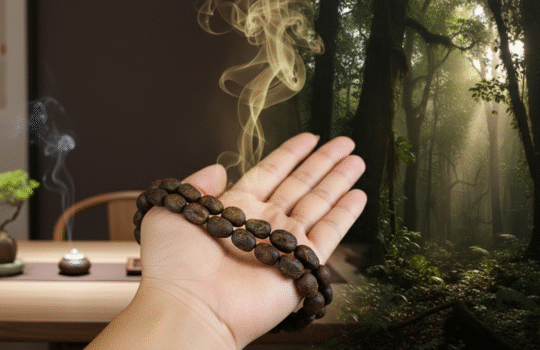
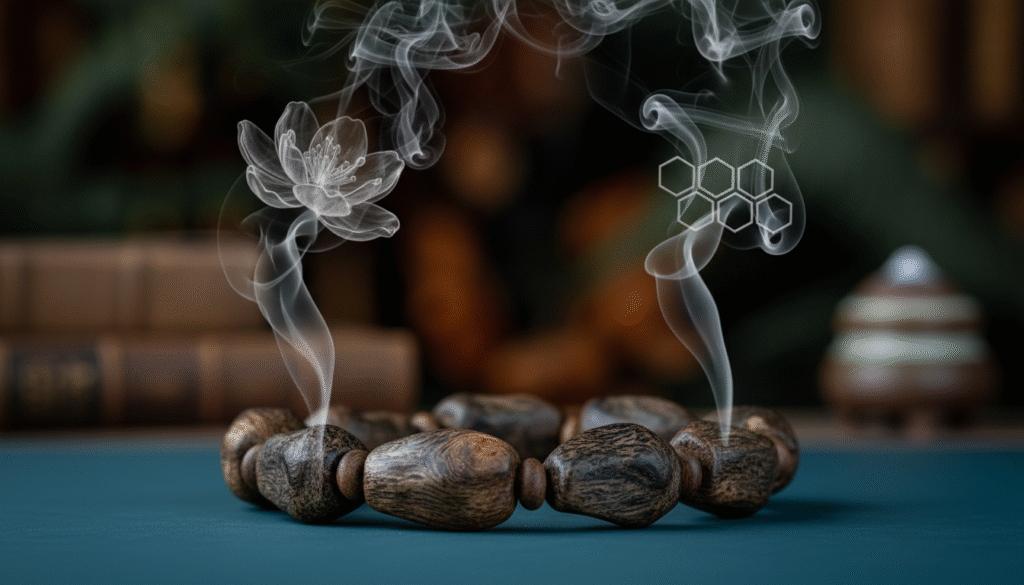
Finally, we come to its soul: the scent. This is a fragrance that pierces through time. The initial note is the explosive power unique to aged domestic Chinese material—a potent, cooling medicinal aroma that instantly clears the nasal passages as if standing in a deep forest after rain. The middle notes transition into a rich almond milk sweetness, a gift from half a century of resin aging. The finish carries a faint fruit-honey fragrance that lingers indefinitely. With aged Chinese agarwood nearly extinct, a collectible combining low-yield burls with Kynam quality is not just the pinnacle of aesthetic wear but a hard currency for family heritage and a hedge against inflation. It is a living artifact; once missed, there will never be another.
FAQs
Q.Why is Chinese agarwood more collectible than Southeast Asian varieties?
A.It is a dual triumph of culture and rarity. 1. Scent Profile: Chinese agarwood (Guanxi lineage) is famous for its elegant, sweet, and clear notes, offering a ‘National Style’ charm with a cooling top note and a honey-sweet finish, whereas Southeast Asian varieties, though intense, often carry a muskier or coarser profile. 2. Depletion of Resources: Wild aged Chinese agarwood has been harvested for millennia and is now virtually extinct. It is a fixed-supply market, making it a rare resource with appreciation potential far exceeding Southeast Asian regions that are still in production.
Q.Why does the price of agarwood with burls increase exponentially?
A.Rarity is valued, but uniqueness is revered. Burls are healing tissues formed under lightning strikes, wind damage, or insect infestations, with an occurrence rate of less than one in ten thousand. It breaks the standard straight grain of agarwood to provide irreproducible artistic textures. Furthermore, because these areas are where the tree’s defense mechanisms are most concentrated, the resin density is exceptionally high. Every burl bead is a miracle of natural chance and a unique item that cannot be mass-produced.
Q.How can I identify Kynam species traits through sight and touch?
A.Remember three words: Sticky, Soft, and Curling. Ordinary agarwood is hard, but aged material with Kynam traits has such high resin content that the wood fibers soften. Visually, the surface has a waxy appearance where resin seems to seep out. Tactilely, it has a slight elasticity when pressed and a noticeable ‘sticky resistance’ during handling. If shaved with a blade (though not recommended), it will produce curling resin rolls rather than wood chips. This is the ultimate expression of resin maturation.