Masterpiece Appreciation: Sarira Reborn from Broken Branches—Why Natural ‘Tree Nail’ Burls are the Ultimate Collection Form of Domestic Agarwood?
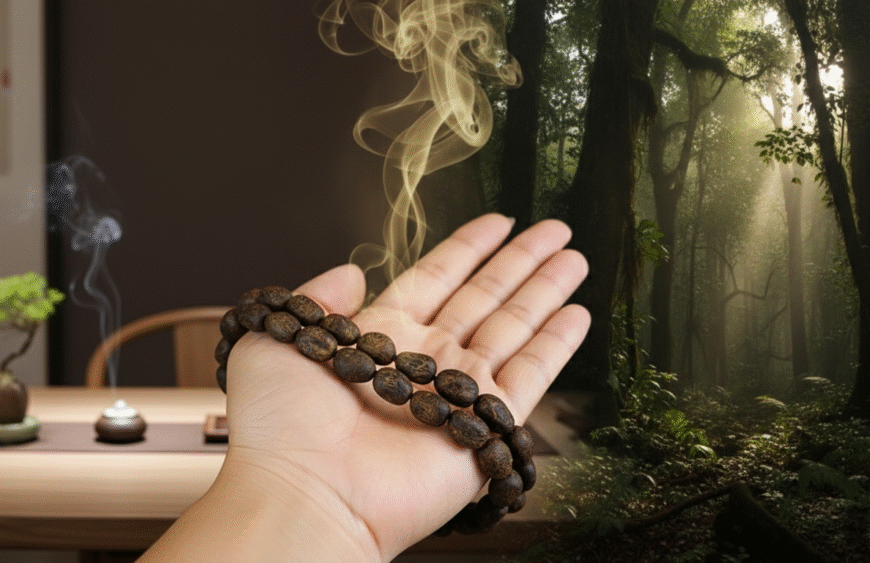
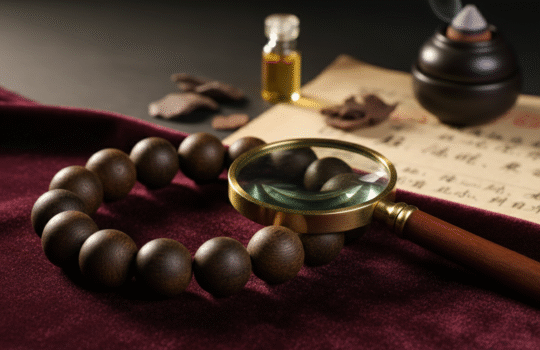
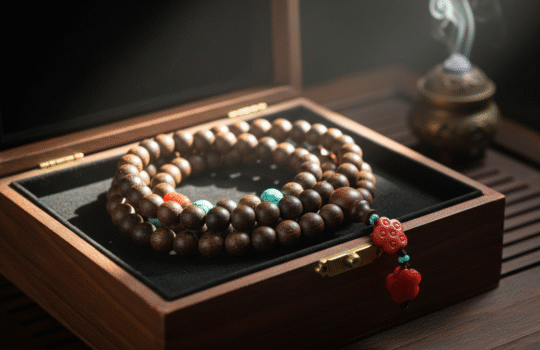
(Caressing the beads, I can’t help but sigh deeply) To be honest, in today’s market, the chance of seeing such ‘hardcore goods’ is lower than winning the lottery. I remember ten years ago in Hainan’s Wuzhishan after a thunderstorm, an old incense farmer, covered in mud, handed me this black lump that felt as cold as a block of iron. He told me it was a ‘Tree Nail’—a ‘scab’ left behind by an Agarwood tree that, after its branches were violently snapped off in a typhoon, mobilized its entire body’s resin to wrap the wound in order to survive. The bracelet we’re talking about today isn’t a cold, industrial round bead from an assembly line, but a ‘Sarira’ (relic) left behind after a tree endured hardship and rebirth. As a veteran who has navigated this circle for twenty years, I sincerely suggest: in today’s world where domestic Agarwood resources are nearly exhausted, if you encounter such a piece with iron-like resin that records life’s pain and healing, do not treat it as simple jewelry. This is a dialogue across time and space.
The Soul of Tree Nails: ‘Incense Bones’ Unbroken by Wind and Rain
Honestly, playing with Agarwood without experiencing ‘Tree Nails’ is a bit of a regret. ‘Tree Nails’ (the English equivalent of the trade term) are what we call the ‘incense bones’ of the Agarwood tree. Imagine when a gale snaps a branch—how much tearing force did that fork connected to the trunk endure? To prevent fungi from invading the heartwood from the break, the tree almost frantically sends resin to this ‘joint.’ This is a tragic self-defense and a masterpiece of nature. The reason I love this bracelet is that it is sourced from there. Under the high-pressure filling of resin, the wood fibers are almost completely replaced, forming the ultimate state of ‘resin-wrapped wood’ or even ‘full resin.’ Friends, when you rub this bead, you feel a sinking weight in your hand—that is not the weight of wood, but the density of time. Under a microscope, the resin lines are interwoven like a neural network—a defensive line built by the tree at the moment of life and death, now transformed into an indestructible, passed-down masterpiece in our hands.
Burls and Irregular Shapes: The ‘Aesthetics of Imperfection’ in Breaking and Rebuilding
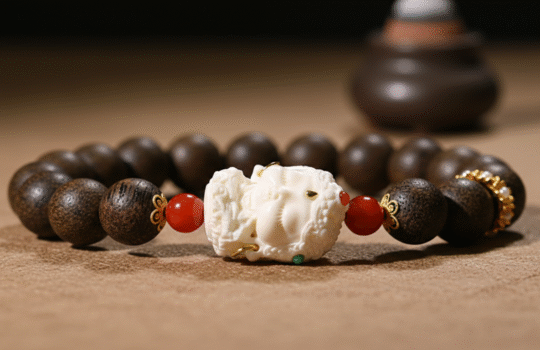
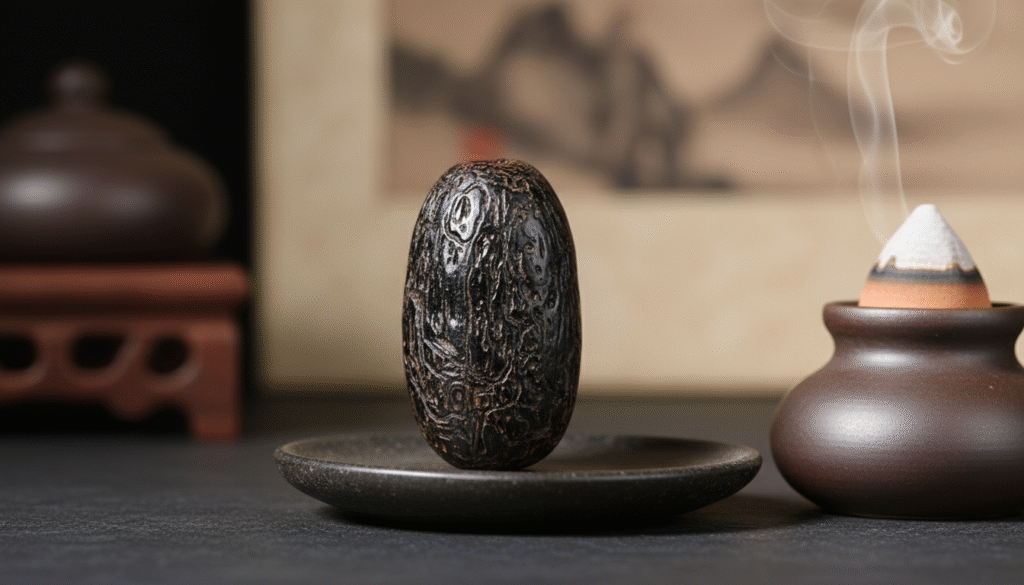
When I first processed this batch of material, my carver suggested making round beads for better ‘marketability.’ I stopped him immediately—’Don’t waste a gift from heaven!’ For a natural wonder like ‘Tree Nail’ burls, forcing them into roundness is an erasure of their nature. A Burl is the trace of distorted growth in healing tissue; every irregular pit and hollow is a history book of the tree’s self-healing. Thus, we insisted on the ‘Irregular Shape’ (Sui Xing) craft. Following the direction of the grain, we did only the most restrained polishing. This allows each bead to retain its original tension—some like undulating mountains, others like swirling mist. How is this ‘imperfect’? This is the highest realm of Chinese literati aesthetics—’Great skill appears clumsy.’ Wearing it, you are not wearing an accessory; you are touching the texture of nature and feeling a wild life unconstrained by worldly rules.
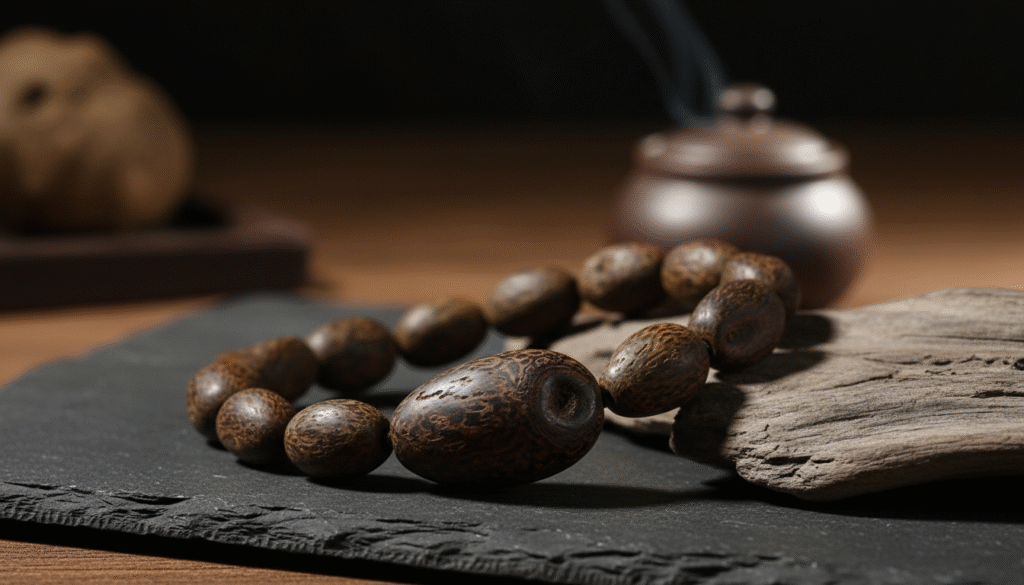
The Charm of Domestic Agarwood: A Breath of ‘Medicinal Honey Orchid’ Across a Millennium
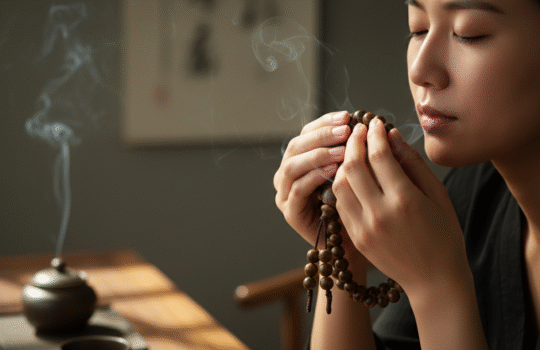
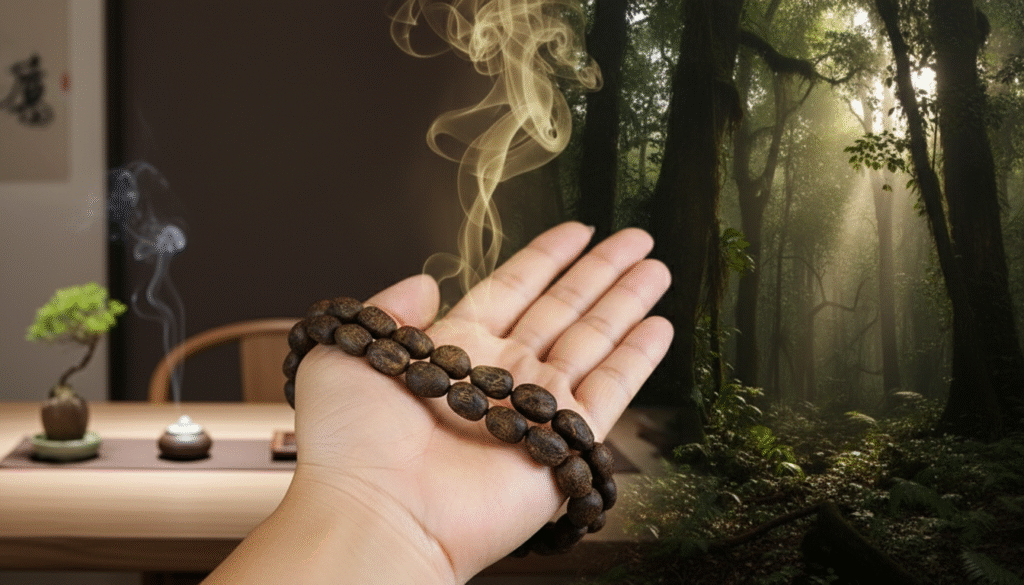
Ultimately, playing with Agarwood is about playing with its soul. Why do I always promote domestic Agarwood? Because of its irreplaceable ‘rhyme.’ This old Tree Nail material emits a highly penetrating fragrance at room temperature. At first sniff, it is a crisp ‘coolness,’ like the wind in a forest after rain, hitting the crown of the head and instantly soothing the day’s anxiety. Next, a rich honey-sweet aroma wraps around—the unique foundation of Hainan old material. The most exquisite part is the tail note: as body heat slowly warms the resin, a hint of elegant medicinal fragrance accompanied by orchid rhyme emerges leisurely. This ‘Medicinal-Honey-Orchid’ three-in-one experience can only be presented by an old Tree Nail that has undergone long maturation and has extremely pure resin. [Expert’s Message]: Honestly, I only have a very limited number of such high-level old material bracelets in my private collection. If you are also looking for this ‘Life Fragrance’ that can calm the spirit, or want to identify if the incense in your hand is a real ‘Tree Nail,’ feel free to follow me and send ‘Tree Nail’ in a private message. Not for business, but to find a true home for these few rare masterpieces. Let’s make a friend.
FAQs
Q.Lao Zhao, why do you often say beginners play with beads, while experts play with ‘Tree Nails’?
A.Good question! Because ‘Tree Nail’ is the ceiling of Agarwood density. It is the joint of a branch fork, bearing the greatest physical pressure and the longest resin formation time. The resin often penetrates straight through the core. Compared to ordinary parts, Tree Nails are the rare solid materials found in the ‘nine out of ten wood pieces are hollow’ reality. Beginners often seek roundness in appearance, but experts know that this ‘scar’—which has experienced breakage and repair—is the ‘Sarira’ of Agarwood, possessing irreplaceable and rare collection value.
Q.There are so many ‘Medicinal Honey Rhymes’ on the market. How do I distinguish between Domestic and Xingzhou systems?
A.This is a core issue. Simply put: the soul of Domestic Agarwood (Hainan, Hong Kong old material) lies in ‘elegance’ and ‘penetrating power.’ Its fragrance drills into the brain—cool at the start, sweet in the middle, and an elegant medicinal-floral note at the end; you never tire of it. While the Xingzhou system (Indonesia, Malaysia, etc.) has a strong and domineering aroma, it often carries a fishy, dry, or earthy smell, lacking the Zen-like quality of Domestic Agarwood that ‘makes one quiet instantly.’ If you want to soothe the nerves and help sleep, take my advice: Domestic is the first choice.
Q.The irregular-shaped bracelet looks bumpy. Is it actually comfortable to wear?
A.Haha, you’re overthinking it! Real high-quality irregular shapes, while retaining natural contours, must undergo high-grit fine polishing. That means grinding the ‘edges’ into ’rounds.’ The touch is actually warm and smooth as jade. Moreover, I personally recommend the irregular shape because the contact surface with the wrist varies, offering better breathability than round beads. After wearing it for a long time and a patina forms, that oily and smooth hand-feel will truly become addictive.
Q.This market is so deep. How can I be sure this string of Tree Nails is real?
A.I’ll teach you three tricks: 1. **Look at the texture**: Real Tree Nail oil lines are a messy web, naturally interwoven like blood vessels, not stiff black lines; 2. **Feel the weight**: Due to the extreme density, there must be a clear ‘sinking feel’ in the hand; 3. **Observe the luster**: Real resin has a deep, restrained dark glow that gets brighter the more you wear it. If it’s instantly shiny or smells of chemical fragrance, black-list it immediately! If you’re unsure, send me a photo anytime, and I’ll help you check.