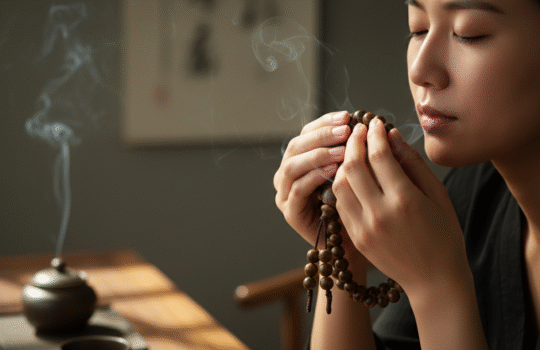
[Appraisal Notes] The Vanishing “National Fragrance”: Reviewing a 32.8g Sinking-Grade Wild Chinese Old-Growth 108-Bead Agarwood Mala
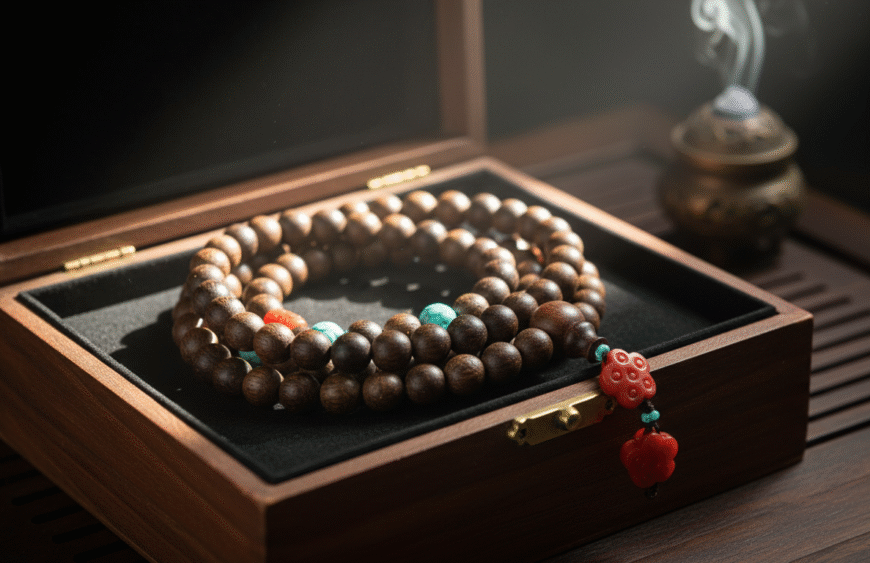
Having spent over twenty years in this industry handling tons of raw materials, I often tell fellow collectors: ‘It is the fragrance that finds the person, not the person who finds the fragrance.’ When this mala was placed on my desk, I didn’t rush to weigh it; I sat in silence first. Its unique, refined honey-sweetness—carrying that distinctively reserved Eastern temperament—instantly transported me back to the old forest farms of Guangdong in the early 90s. Back then, old farmers dug ‘Iron Knots’ out of the mud, which became this black, oily luster once cleaned. Today’s market is flooded with ‘Tech-wood’ or ‘Compressed Agarwood,’ but this strand, with its heavy 32.8-gram weight, silently tells the story of the vanishing ‘National Fragrance.’ To be honest, this isn’t just a product; it’s a legend of Guan-xiang sealed by time, waiting for a true connoisseur to unlock its ancient scent.
The Weight of Time: The ‘Hardship of Resin’ Behind 32.8g
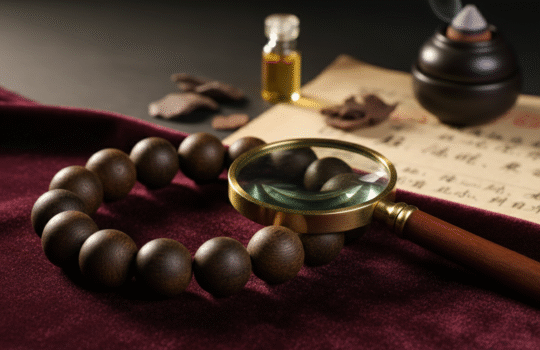
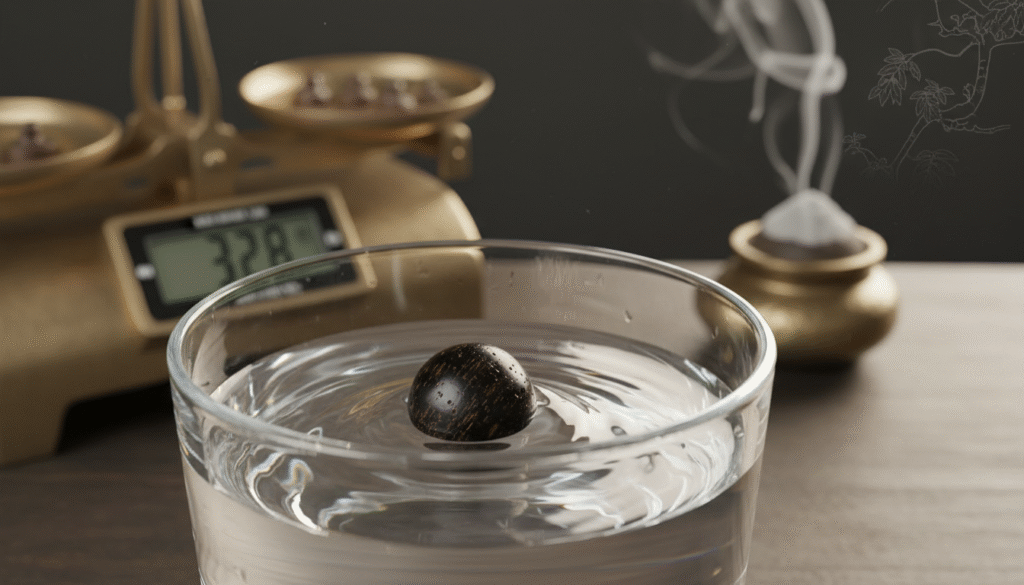
Experts don’t look at certificates; they feel the weight first. But this strand feels more than heavy—it has a ‘plunge’ that pierces the palm. Measured at 32.8g, for 108 beads of 6-8mm, this hits the physical ceiling of density. This weight cannot be faked with lead; it comes from the tree’s desperate resin secretion after lightning strikes or insect bites decades ago. After long maturation and shrinkage, it forms an ‘Old Iron Head’ grade patina. When a single bead is dropped in water, its unhesitating ‘instant sinking’ is ironclad proof of the perfect fusion of resin and fiber. Every gram is a medal of the tree’s struggle against nature. Under a magnifying glass, the silk-fine resin lines look like micro-landscape paintings of frozen time.
The Soul of National Fragrance: From Cool First Sight to Deep Honey Notes
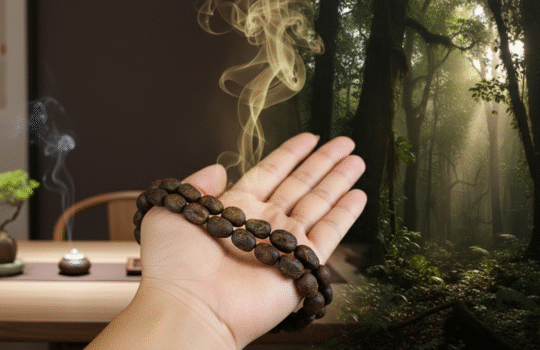
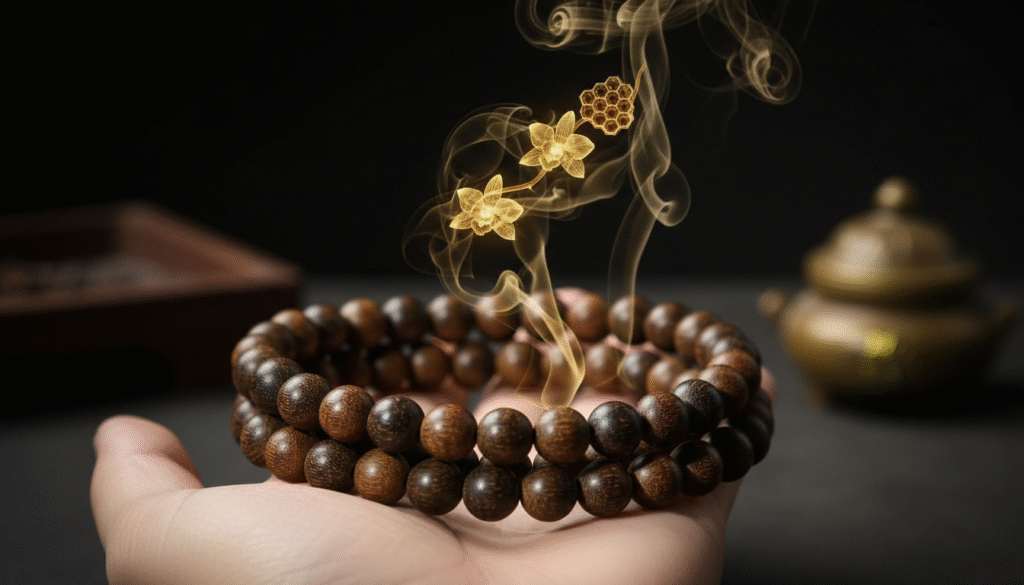
If weight is the skeleton, scent is the soul. Many ‘old materials’ on the market only smell like rotting wood, but wild old-growth Chinese material (Guan-xiang) boasts an irreplaceable ‘Honey Scent Profile’. Gently rub the beads: the first hit is a piercing coolness, like a mountain spring clearing the mind. Then, the middle note unfolds like silk—a rich honey sweetness, neither greasy nor dry, with a fragrance like ripe fruit. This is the ‘fire’ leaving the wood after decades of aging. The base note is a lingering mix of medicinal and floral tones. This scent is inclusive, not aggressive. Wearing it is like carrying a spiritual Peach Blossom Spring; in a noisy city, this breath of air is more precious than anything.
Red and Green: A Landscape on the Literati’s Wrist
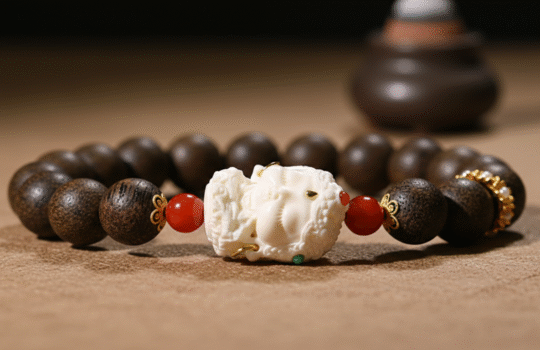
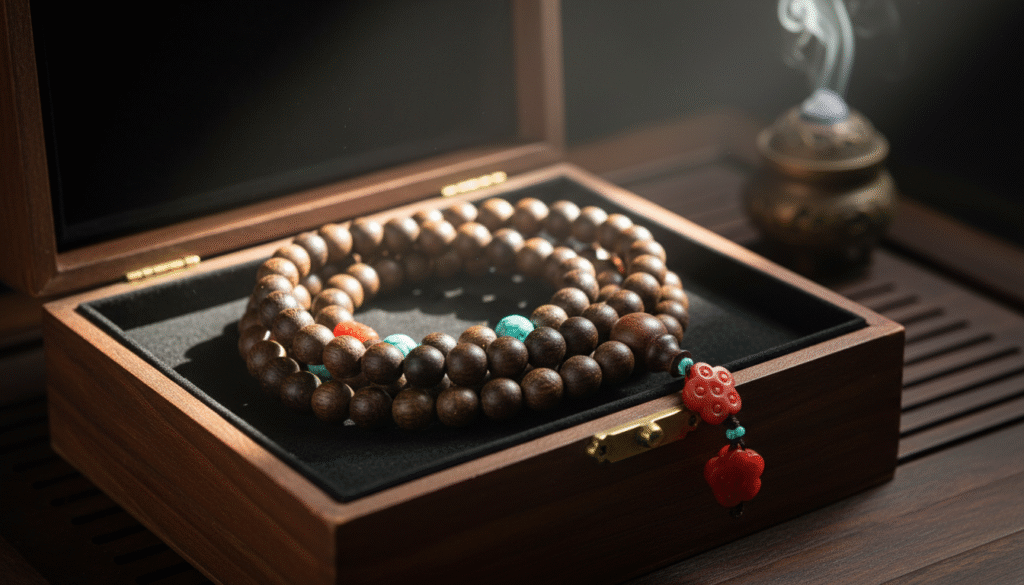
A good mala is both a ritual tool and an aesthetic projection. I dislike dull, all-black designs. This strand captures the essence of Eastern aesthetics by selecting Southern Red Agate (Nanhong) and Raw Turquoise as spacers. The ‘crimson’ of Nanhong symbolizes passion and luck, while the ‘azure’ of Turquoise represents the vast sky. Nestled among the dark, oily Agarwood, these colors act as the ‘finishing touch’ in a landscape painting. Following the classic 108-bead format, it adds the refined taste of a literati’s plaything. This contrast makes it not just a mala, but a piece of artistic jewelry fit for any elegant gathering. This is true ‘quiet luxury.’
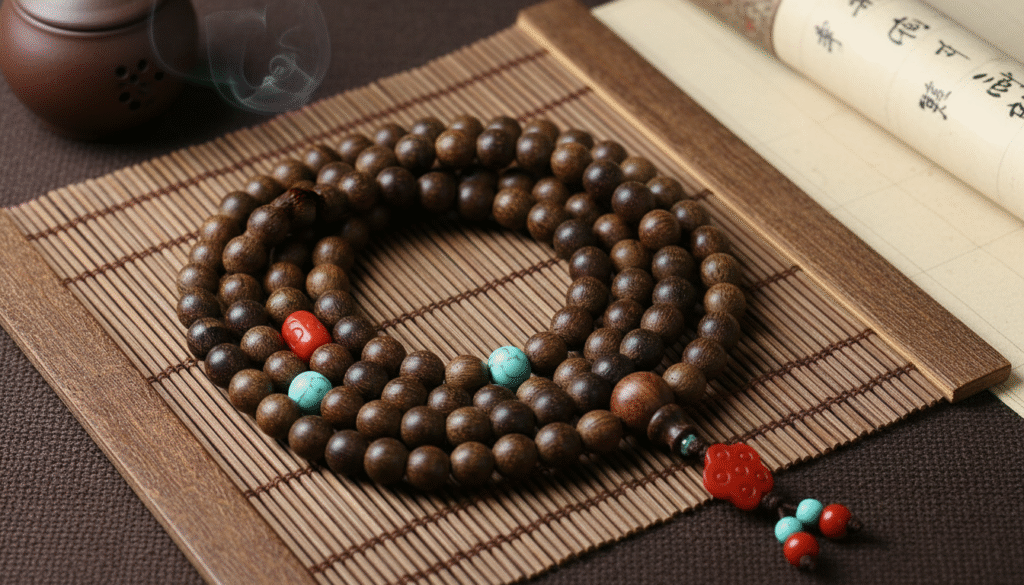
Expert Conclusion: This is Not Just a Collection, But a Guardianship
As an exporter who has handled countless incense materials, I must be honest: items like this are becoming increasingly rare. China’s wild Agarwood resources are nearly exhausted. Raw materials that can yield a 32.8g sinking-grade mala are usually ‘family heirlooms’ kept by incense farmers. In the secondary market, this is an absolute ‘hard currency,’ moving beyond consumer goods into asset allocation. Over time, the internal resin will mature further, and the scent will become even purer. [Closing Thoughts] Fragrance meets its soulmate, jade goes to its destined owner. If you are moved by this ‘lost pearl of the sea,’ or wish to authenticate your own Agarwood, do not hesitate to DM me the word ‘National Fragrance’. I have reserved a tea seat for you. Let’s talk about elegance, not just business, and together protect this lineage of incense heritage.
FAQs
Q.What does ‘Sinking-Grade’ actually mean for this 32.8g mala?
A.In the world of Agarwood collection, ‘sinking’ is the highest standard of density. A 32.8g weight for 108 beads means the average density is extremely high, with resin content exceeding the limit of the wood fiber. For wild Chinese material, reaching this weight usually signifies over a century of resin formation and perfect maturation, representing top-tier quality found in one in ten thousand pieces.
Q.What is the fundamental difference between ‘National Fragrance’ (Chinese Agarwood) and Southeast Asian varieties?
A.’National Fragrance’ refers specifically to Agarwood from China’s Guangdong, Hainan, and Yunnan regions. Unlike the strong medicinal or spicy notes of Southeast Asian (Xing-zhou system) varieties, Chinese Agarwood is famous for being ‘Clear, Elegant, and Sweet.’ Its core feature is the famous ‘Honey Scent Profile’—a penetrating yet non-aggressive fragrance with a unique cooling sensation, hailed by generations of literati as the ‘Chief of All Fragrances.’
Q.Will the accompanying Southern Red Agate and Turquoise affect the storage of the Agarwood?
A.With proper care, they complement each other perfectly. Southern Red Agate and Turquoise have higher hardness and serve as excellent spacers, reducing direct friction between the Agarwood beads. However, note that Agarwood is sensitive to chemical detergents, while Turquoise can lose color if exposed to high heat/dehydration. We recommend avoiding perfume and soaps, and keeping hands clean when handling to nourish all three natural materials with natural skin oils.
Q.How can a beginner distinguish this heavy old-growth material from ‘Compressed’ or ‘Oil-soaked’ fakes?
A.Genuine old-growth resin lines are natural and irregular; under a lens, the resin looks as if it is ‘overflowing’ from the wood’s vessels with a natural, mellow luster. Compressed wood lacks clear pores and looks lifeless. Oil-soaked fakes have a pungent chemical smell or a greasy feel and may release oily slicks in water. The most reliable way is the scent: fakes cannot replicate the layered, penetrating honey-sweetness of authentic material.