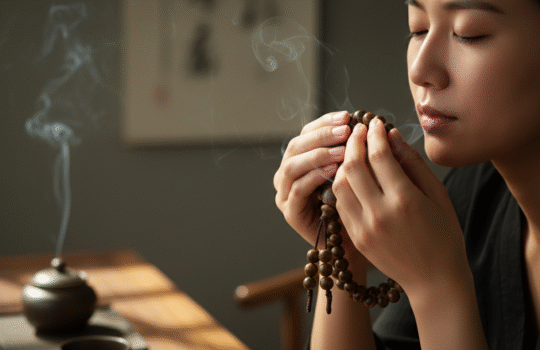
The Last Pearl of Lingnan: Why This ‘National Fragrance’ Black Oil Grade 108-Bead Set is a Geological Swan Song of Wild Aquilaria Sinensis?
To be honest, after years in the agarwood collection circle, there are few ‘new arrivals’ that can make my heart skip a beat. Elders often say, ‘Fragrance finds the person, not the person the fragrance.’ A decade ago, incense farmers in deep mountains might occasionally carry a bag of wild material down the slopes; today, if they present a piece of ‘Black Oil Grade’ wrapped in layers of red cloth, it is a sensation in the industry. This 108-bead mala in my hands is a miracle born from such a near-desperate search. Please forgive my excitement; this is not a mere commodity, but a piece of solidified Lingnan mountain history. Sourced from the ancient production areas of wild Chinese agarwood (Aquilaria sinensis), every bead carries the unique wind, thunder, rain, and dew of this land. As ‘Guanxiang’ and ‘Qiongzhi’ gradually become terms found only in museums, this Black Oil Grade old-growth material, which retains its original wild aura, may be our last physical connection to that glorious incense culture.
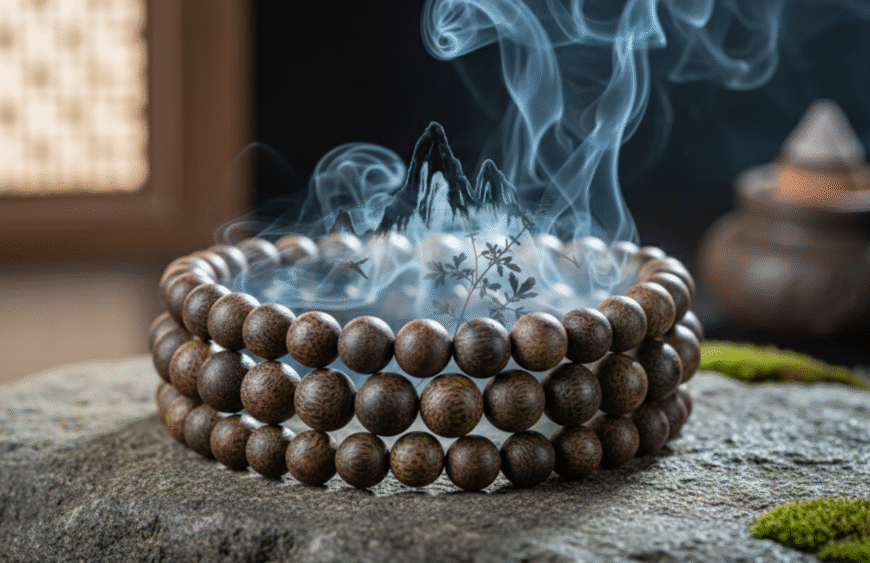
Scars of Time: ‘Black Oil Grade’ Sculpted by Lingnan Storms
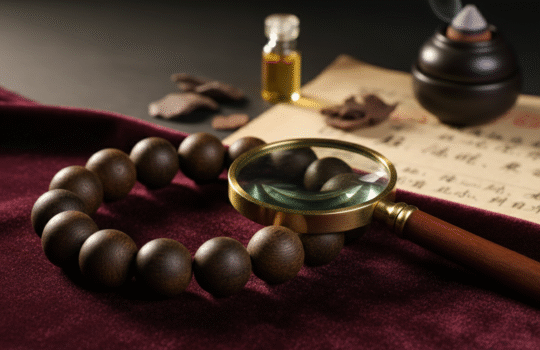
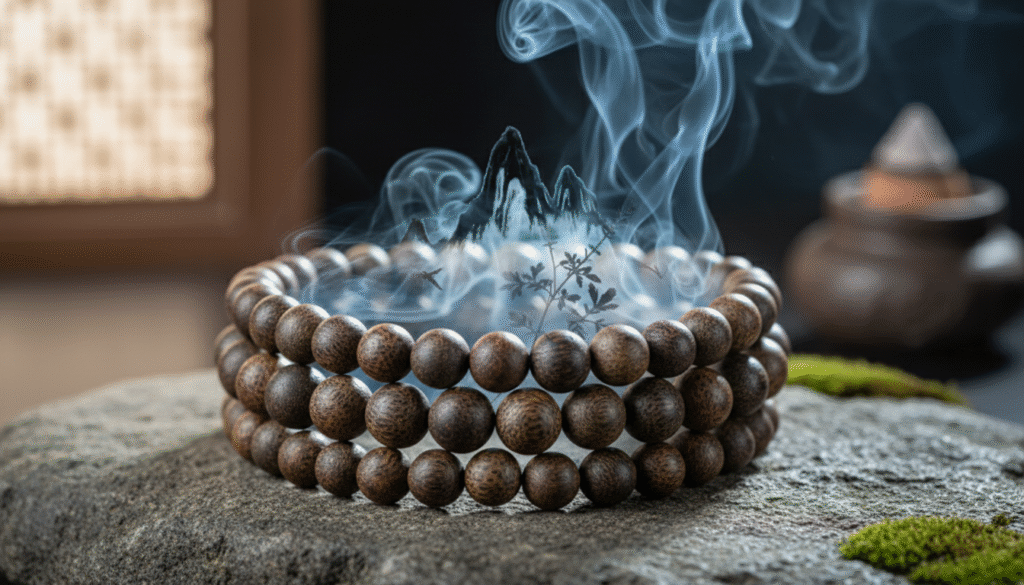
Please lean closer to the screen and examine the deep, ink-like oil lines on the surface of these beads—these are strokes no human hand could ever replicate! In industry terms, we call this ‘Black Oil Grade’ (Hei You Ge). Its birth is a cruel epic of survival. The raw material for these beads originated from high-altitude forests along the Lingnan coast. Centuries ago, an Aquilaria tree was snapped by lightning or torn by a typhoon. To survive, the tree frantically secreted resin to wrap its wounds, engaging in a life-and-death struggle against invading fungi over vast spans of time. This process of ‘healing with oil’ eventually formed a ‘steel-boned’ texture where wood fibers and resin are highly integrated. The densely interwoven textures on the beads are actually ‘war medals’ left by nature. This is not dead wood, but a ‘living fossil’ seasoned by time. Holding it, the heavy weight in your palm is the weight of over a hundred years.
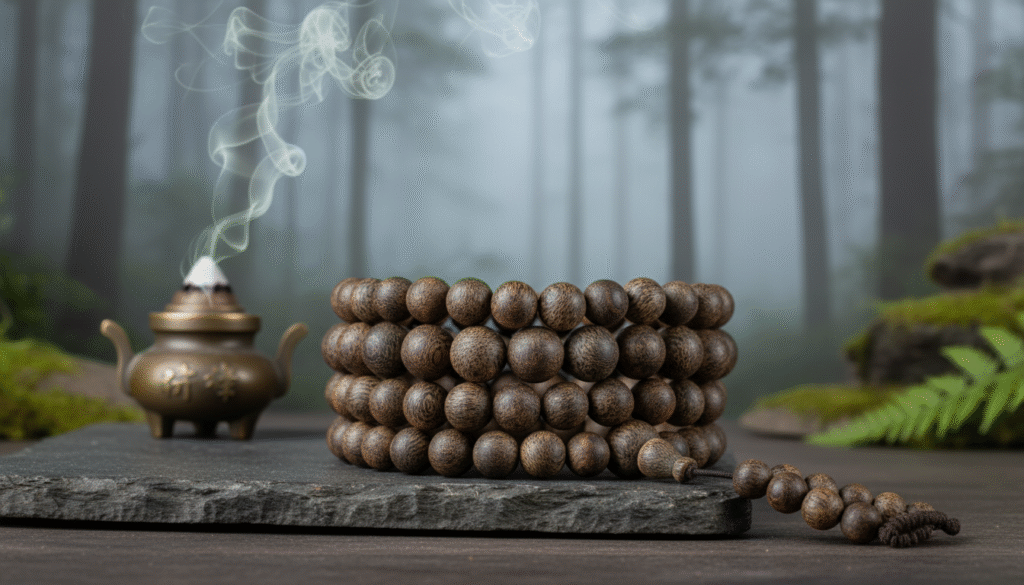
The Cultivation of Natural Beauty: Preserving the ‘Breathing’ Pores
During the processing of this masterpiece, I had a heated debate with the craftsman: should we polish it to a mirror-like shine to please the eye, or keep its original form? Ultimately, we chose ‘natural beauty.’ Real old-growth national fragrance should never have a ‘fake glare.’ These 108 beads utilize a minimalist dry-grinding process for perfect rounds, without wax, glue, or excessive high-grit polishing. The matte texture you see in natural light is the truest dignity of the wood. Look closely at the surface; those tiny natural pores (vessels) are still clearly visible. They seem to be still breathing, inhaling and exhaling the aura of the Lingnan mountains as the surrounding temperature and humidity change. As an expert, I must tell you: this ‘breathable’ craftsmanship allows the beads to blend perfectly with the owner’s body temperature during future handling, eventually forming a beautiful, jade-like patina.
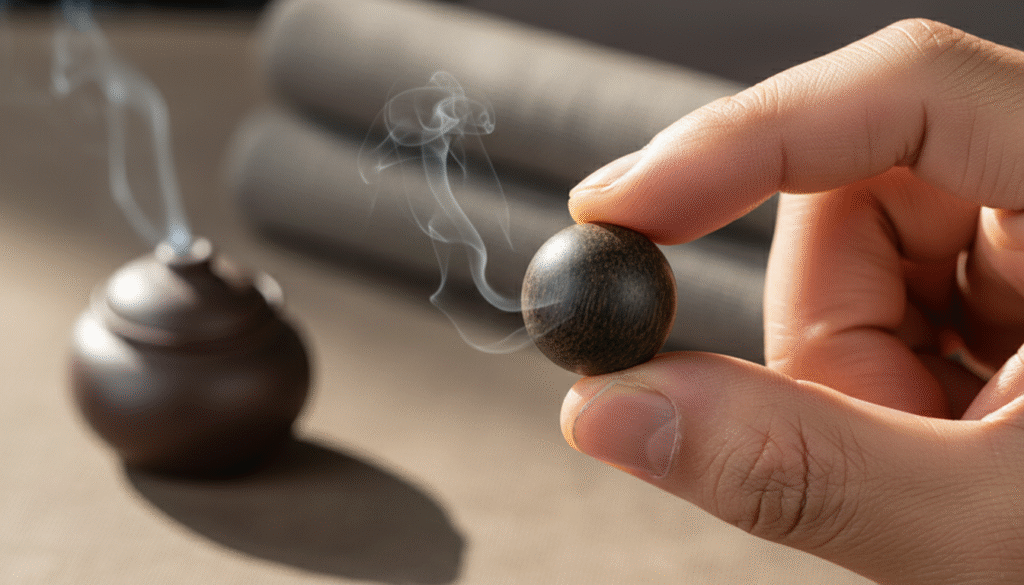
The Soul of National Fragrance: The ‘Cool Rhyme’ Through Time and Space
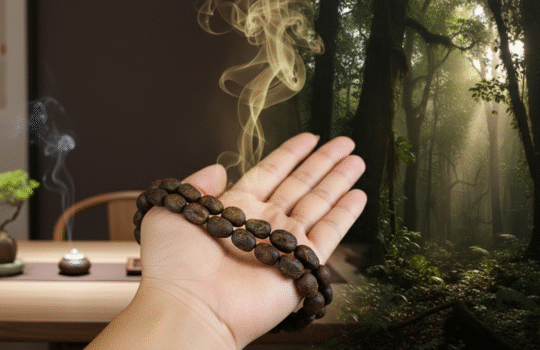
If the texture is its form, then the ‘Cool Rhyme’ (Liang Yun) is its soul. What fascinates me most about this set is how it perfectly replicates the essence of ‘Hainan Agarwood’ described by Song Dynasty scholars. Upon the first scent, a piercing coolness hits the brow—this coolness is not the pungent sting of mint, but rather the crisp freshness of stepping into an ancient mountain temple after rain. This is the unique genetic code of Chinese Aquilaria sinensis, a ‘righteous energy’ that Southeast Asian agarwood cannot imitate. Following this, an elegant honey-sweetness spreads slowly, accompanied by a long, lingering medicinal fragrance. This scent is neither seductive nor flashy, yet it instantly calms a restless heart. It is a ‘heavenly fragrance’ brewed by the unique trace elements of Lingnan’s red soil and the monsoon climate; wearing it is like carrying a quiet forest with you.
The Price of a Swan Song: Why 108 Beads are a Collector’s Masterpiece
Why do I dare assert that these beads are a ‘vanishing legend’? Because at a geological and geographical level, the depletion of China’s wild agarwood resources is irreversible. To craft a 108-bead set with uniform color, full resin, and zero defects requires a massive, solid piece of raw material. In today’s market, finding a wild ‘Black Oil Grade’ log large enough to cut such regular beads is one in ten thousand. These beads were essentially traded for an extremely precious, specimen-grade whole log. For a collector, owning this is not just owning a string of prayer beads, but rescuing a piece of non-renewable botanical history. [Expert’s Private Invitation] Facing such a unique item, pictures and words are ultimately pale. If you are a true lover of fragrance, even if you do not seek to own it but only to smell it, please click ‘Book a Tasting’ below or DM me directly. I have prepared a high-definition ‘Agarwood Macro Texture Map’ and a video of the raw material being cut. We can even schedule a video call for a one-on-one analysis of this final resonance of national fragrance.

FAQs
Q.The oil in these beads is so dark; are they ‘submerging’ grade (sink-water)?
A.This is a very professional question. To be frank, these beads belong to the ‘90% sinking’ or ‘near-submerging’ grade. In today’s extreme scarcity of wild national fragrance, finding ‘Black Oil Grade’ with such dense resin and deep color is already rare. While it may physically lack that final ounce to sink completely, its resin density and fragrance level surpass many ‘hard-sinking’ materials from common regions. As an expert, I suggest: for old-growth national fragrance, the integrity of ‘Fragrance Rhyme’ and ‘Oil Quality’ is far more valuable for collection than simple physical sinking.
Q.Why is ‘National Fragrance’ (Chinese origin) better for collection than other regions?
A.The core value lies in cultural legitimacy and irreplaceable scent. Since the Tang and Song dynasties, the core aesthetic of Chinese incense culture has been built on the ‘clarity, elegance, and righteousness’ of Hainan and Guangdong agarwood. Compared to the intensity of the Star Island series (Indonesia) or the sweetness of the Huian series (Vietnam), the ‘Cool Rhyme’ and ‘Medicinal Fragrance’ of Chinese Aquilaria sinensis better suit the Eastern pursuit of inner cultivation. With the cliff-like depletion of wild resources, every surviving piece is a non-renewable unique item.
Q.How should this ‘Black Oil Grade’ old material be maintained or ‘played’ with?
A.Remember my eight-word mantra: ‘Greatest truths are simple; avoid intentionality.’ Because it is wild old material, its resin structure is very stable. You only need to keep your hands clean and dry for daily wear. Your body temperature will slowly activate the aromatic substances locked deep inside, making the scent more vivid. Absolutely avoid oiling or waxing, and do not let it touch chemicals like shampoo or perfume, which block the natural pores and destroy its precious breathability. Good fragrance needs to be ‘nurtured’ by a person, not ‘toiled’ over.