Collector’s Secrets: The ‘Double-Sided 18 Arhats’ Won Through Gambling on Raw Materials—This is the Pinnacle of National Agarwood
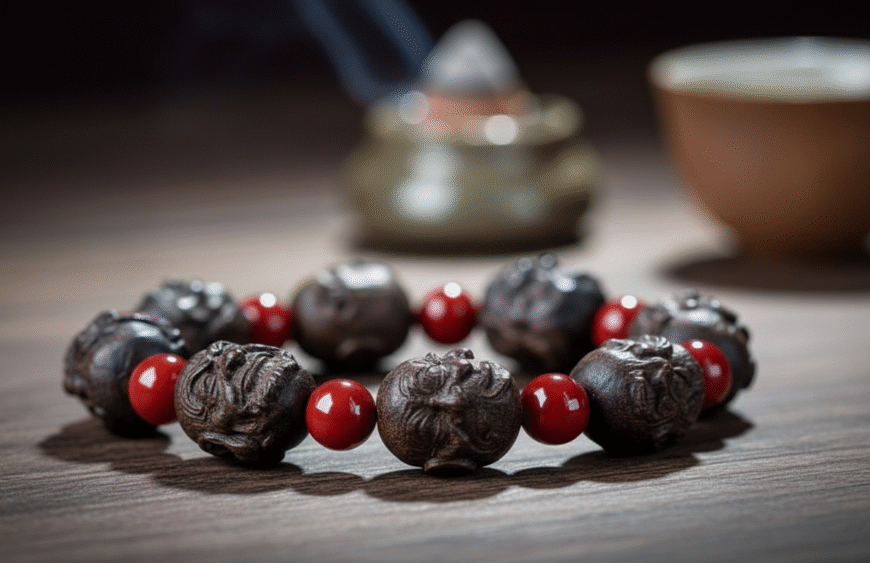
In this industry for long enough, one’s eye becomes ‘spoiled.’ I’ve handled wood by the ton, and there aren’t many pieces left that can make my heart skip a beat. But the other day, when this string of Agarwood Double-Sided 18 Arhats was placed on the tea table, I didn’t rush for the magnifying glass; I held my breath first. At that moment, the surrounding noise seemed to freeze. That unique, elegant coolness pierced my senses before I even touched it, much like a mountain morning in Hainan after the rain. This is the typical ‘National Fragrance’ (Guo Xiang) charisma—unobtrusive, yet impossible to ignore. Today, I’m not here to talk about boring export data, but as a long-time connoisseur, I want to have a heart-to-heart: why this ‘graduation-level’ collectible is so expensive and what makes it divine.
Sinking Grade at First Glance: The Scab of Ages, the Black Gold of Time
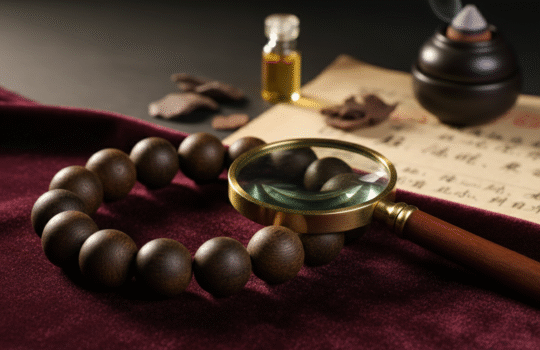
Many friends ask me, what is ‘Sinking Grade texture’? Don’t listen to theoretical parameters; look at the pictures directly. Stare at the surface of these beads, and you’ll find they lack the dry, woody texture of new material. Instead, they possess a deep, dark, and oily patina. This state only appears when the resin content is extremely high, as if the oil is about to overflow from the pores!
There is an unwritten consensus in the collector’s circle: the best agarwood is the crystallization of a tree’s self-healing after injury. The ‘fine-grained and oil-filled’ state of these beads represents decades or even centuries of healing and accumulation. The heavy, solid feel in the hand cannot be faked. Only high-density old material can maintain this lacquer-like oily luster after so many years. This isn’t just a string of beads; it’s black gold condensed from time.
A Risky Move on the Knife’s Edge: The Gamble of the 18 Arhats and ‘Soft Gold’
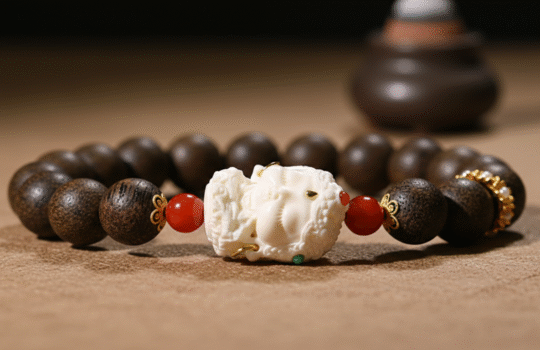
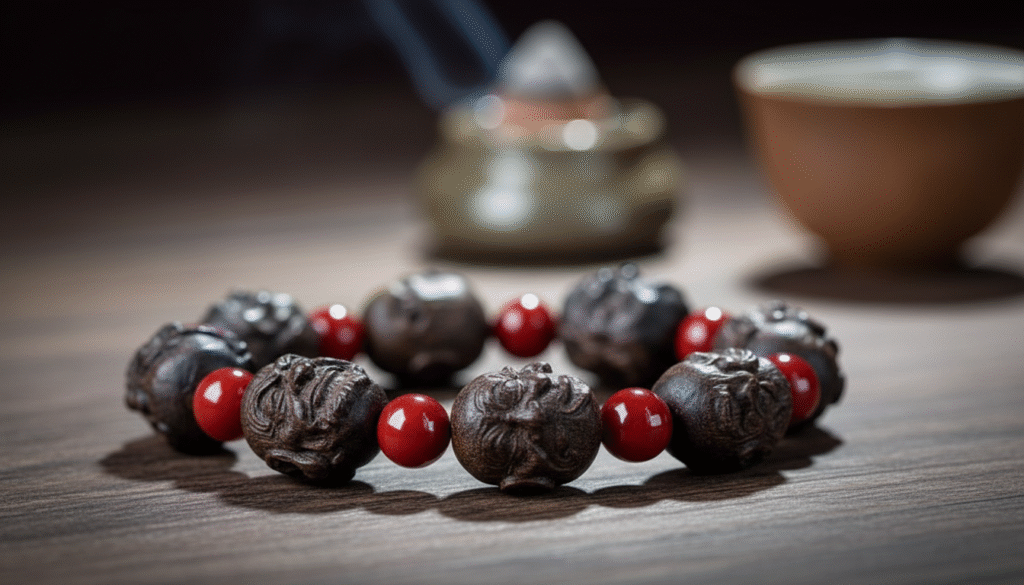
Anyone who plays with carvings knows that figures consume the most material and are the most selective about it. Implementing Double-Sided 18 Arhats micro-carving on beads of limited diameter is a hellish test for the hardness and toughness of the agarwood! Behind this lies a hidden story of ‘gambling on materials’: ordinary agarwood is soft and prone to cracking under a blade. Only top-tier ‘National Fragrance’ old material, where resin has completely permeated the wood fibers to a hardness comparable to rhinoceros horn, dares to carry such intricate carving.
Look at this bracelet; the eyes and expressions of every Arhat—joy, anger, sorrow, and happiness—are carved deep into the wood. This is not just superior technique; it is absolute confidence in this top-grade material. The carver is gambling with a knife tip against expensive material; the slightest error results in an astronomical loss. Coupled with red-toned spacer beads, that dash of red leaps out from the deep agarwood black, like the sincere heart of an Arhat traversing the world—solemn yet spirited.
A Feast for the Senses: The Irreproducible ‘National Fragrance’ Honey Rhyme
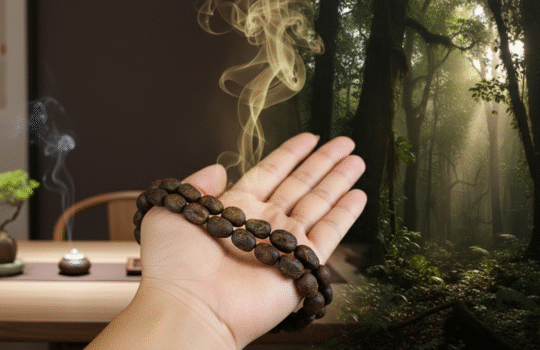
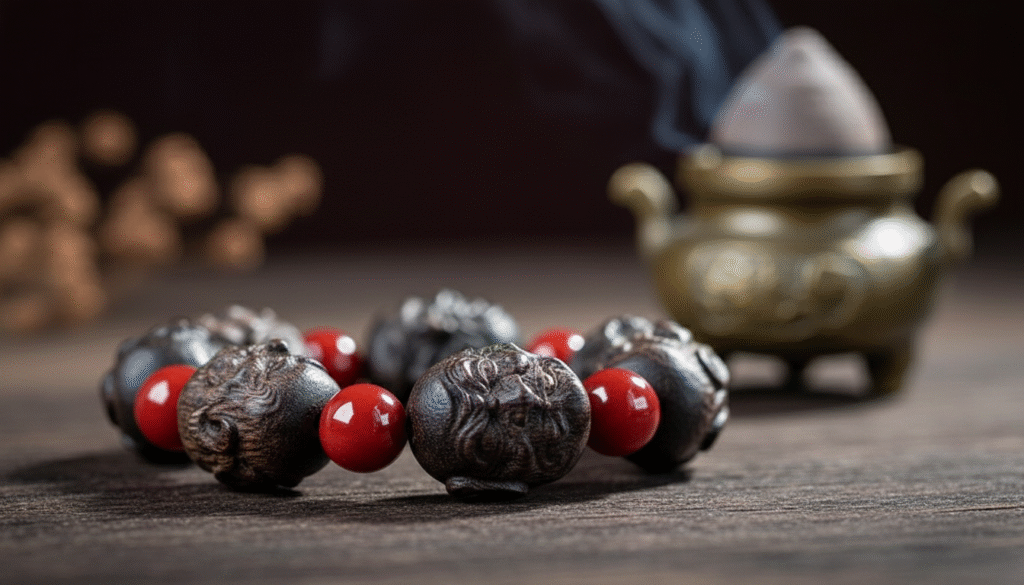
If appearance is the skin, then scent is the soul of agarwood. Agarwood from Chinese regions is honored as ‘National Fragrance’ precisely because of its elusive ‘transformations.’ The scent of these beads is by no means a one-dimensional fragrance found in the common market. Upon first sniff, there is a distinct coolness, like the breath of a stream when spring snow melts, instantly clearing the mind. After warming with body heat, breathe deeply, and you will sense a rich but not cloying honey rhyme, where floral notes and sweetness intertwine, with a faint medicinal scent lingering in the tail.
This sense of layering is incomparable to the single-note scents of ordinary agarwood. It is not a pungent perfume smell, but an aroma that lets you settle down and sink into peace.
To be honest, no matter how clear the photos are, they cannot convey one ten-thousandth of its charm. If you are a ‘connoisseur’ picky about scent, or looking for an object to calm your mind in this impetuous era, feel free to click below to chat with me. Even if you don’t buy, coming over to make a friend and smell this true ‘National Fragrance’ is a rare piece of fate.
FAQs
Q.How should I maintain such a fully carved agarwood bracelet during daily wear?
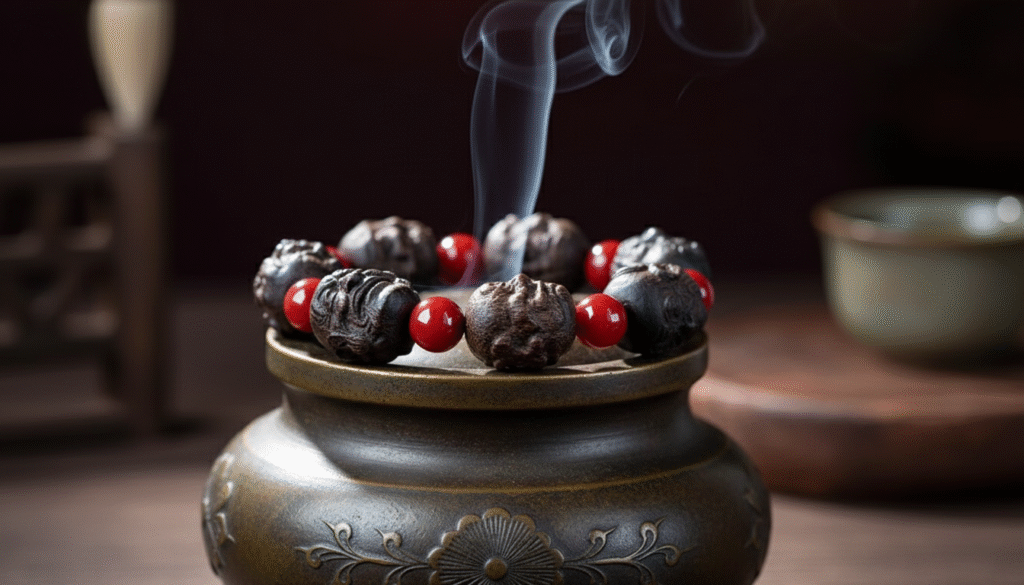
A.Remember one thing from the experts: preventing odors is more important than preventing cracks. Because it is rich in resin and has complex carvings, the biggest fear is contamination by chemical fragrances (like perfume or shampoo) which mask the original scent. Also, while it is ‘Sinking Grade,’ there are many carving crevices; try to avoid prolonged soaking in water. If it gets dirty, wipe it gently with a soft cloth. The natural oils on your wrist are its best maintenance.
Q.Why emphasize ‘National Fragrance’ (Guo Xiang)? Is it very different from the Star Region (Singzhou) agarwood?
A.The difference is massive! ‘National Fragrance’ usually refers to agarwood from Chinese regions (like Hainan and Guangdong). It is characterized by high sweetness, a strong sense of coolness, and an elegant, balanced aura that fits Oriental aesthetic philosophy. Compared to the intense and aggressive scent of the Star Region (Singzhou) series, National Fragrance is more reserved and noble. Crucially, wild National Fragrance resources are nearly exhausted, so its collection value is often several times that of other regions.
Q.Does double-sided carving affect the weight and collectible value of the agarwood?
A.You’ve hit the nail on the head. Carving does result in weight loss, but for a theme like the ’18 Arhats,’ the artistic value has long surpassed simple weight. Material that can withstand double-sided fine carving is ‘steel-plate material’—one in ten thousand. The added artistic value is extremely high. In the auction market, works combining top-tier craftsmanship with top-tier material often have more room for premium pricing than plain beads of the same weight.