Why Does the ‘Zen Buddha Realm’ Domestic Old Material Attract Collectors? — Identification Record of ‘Iron Bone Black Oil’
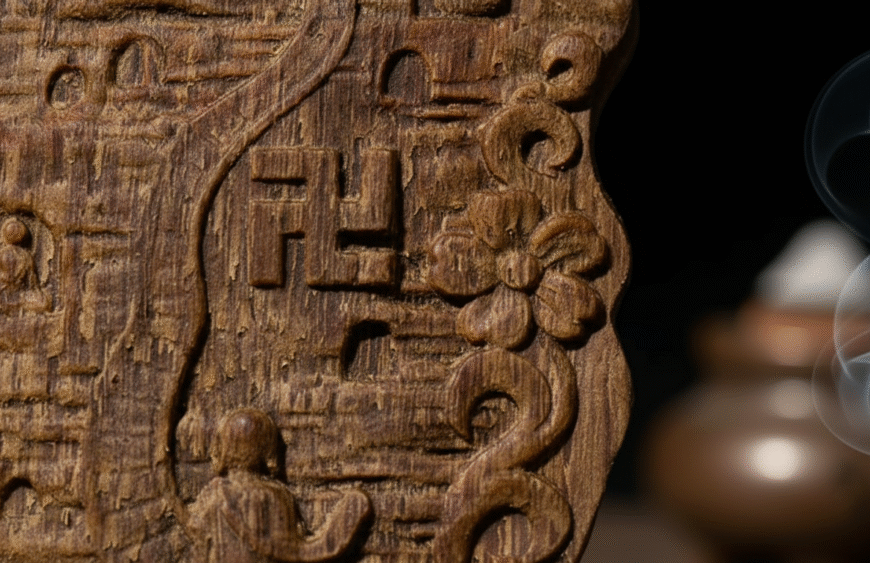
I remember ten years ago, deep in the Wuzhi Mountains of Hainan, where the air still carried the scent of damp moss. An old agarwood harvester pointed to an inconspicuous piece of black wood and told me: ‘This incense has been wounded; struck by lightning, bitten by insects, it finally formed this scar. It is the tears of the tree and the soul of the mountains.’ I have remembered those words my whole life. Today, most ‘Guoxiang’ (domestic agarwood) on the market are accelerated products resulting from artificial inoculation. Natural old materials that survived natural hardships have long since become legendary ‘unique pieces.’ The hand-carved ‘Zen Buddha Realm’ pendant I am presenting today is a typical old material of the ‘Iron Bone Black Oil’ type. It is not just a piece of jewelry, but a physical testament to rebirth and spiritual practice. Many friends ask me why, in this era of capital speculation, I insist on promoting this ‘simple-looking’ old stock. It is because I see in it something more precious than gold—the sincerity of time.
Scars of Time: Understanding the Vitality of Deep Brown ‘Living Oil’
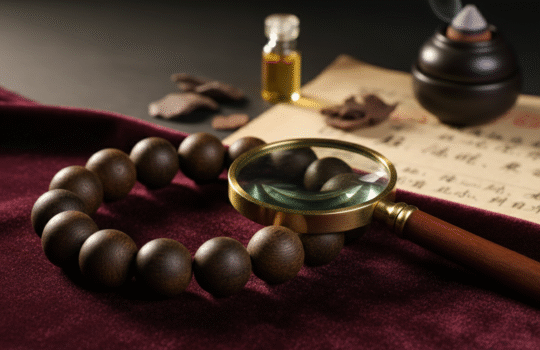
Experienced collectors never look for a dull, dead black color, but for ‘rhythm.’ The most striking feature of this ‘Zen Buddha Realm’ piece is the deep brown, high-fluidity resin lines. This is not the boring blackness produced by modern high-pressure oil injection, but a callus tissue (scar tissue) secreted by the wood over decades of wind and rain to heal its wounds. If you look through a magnifying glass, you will find those oils twisting and soaking through the wood vessels like capillaries. This ‘living oil’ shows an amber-like transparency under light, known in the trade as ‘Baoguang’ (Precious Glow). It tells us that before being carved, this material stood alone in the deep mountains resisting countless seasons. Acquiring it is acquiring a history of resilient life.
Refinement on the Blade: ‘Simplicity’ and ‘Ingenuity’ in Shape-Followed Carving
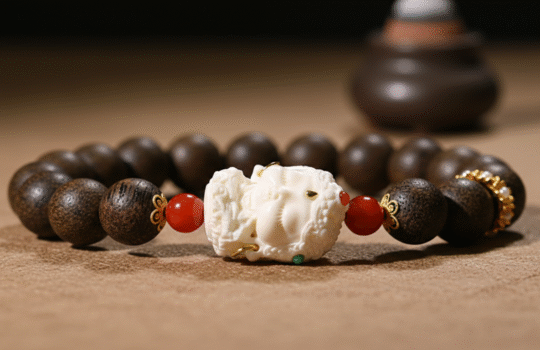
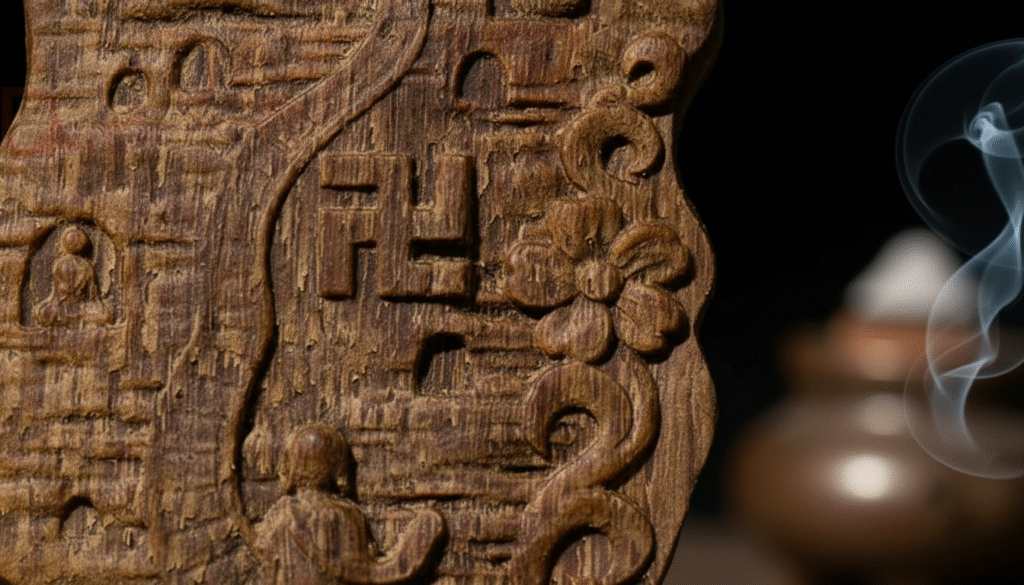
Good materials require high craftsmanship. When dealing with such non-renewable domestic old material, any excessive cutting is a waste of a natural gift. The artisan chose ‘carving according to the shape,’ a kind of restraint that requires great skill. Look closely: the carver did not level the original uneven surface of the wood. Instead, they utilized these natural undulations to skillfully carve a Buddha head with downcast eyes and a compassionate expression. The Swastika pattern lines extend along the densest paths of the resin, as if the Buddha was already hidden within the wood, and the craftsman only removed the excess. This ‘primitive simplicity,’ which retains the original roughness and warmth of handwork, perfectly fits the theme of ‘Zen Buddha Realm’—imperfection is true perfection.
The Sorrow of the Gap: When Domestic Old Material Becomes an ‘Absolute Seller’s Market’
Beyond emotions, business is business. As an exporter, I must provide a set of harsh data: over the past three years, while the prices of the Vietnamese Hoi An agarwood series grew steadily by 15%-20% annually, there is still a source of supply. However, wild domestic old agarwood material has reached a ‘resource gap’ due to early unregulated extraction. This means that for old materials of the same quality as ‘Zen Buddha Realm,’ the average annual price increase exceeded 35%, and it is often a market where there is a price but no supply. In high-end circles, it has moved from the ‘incense material’ category to become a rare anti-inflation financial asset. This collection is noteworthy because it represents the ‘Golden Age of Domestic Incense’ that can never return.
The Collector’s Cornerstone: Three Tips to Spot Fake ‘Painted Skin’ Incense (Inquiry Channel Attached)
To ensure your passion isn’t betrayed by ‘technical tricks,’ I’ve summarized three simple identification methods to help you spot fakes: 1. Observe the Pores (Look for Breath): In real domestic incense, the resin ‘grows’ inside the vessels. Under magnification, there should be natural, irregular pores. Counterfeits are often pitch black and smooth everywhere, a result of high-pressure glue injection blocking the pores, looking as if wrapped in plastic. 2. Smell the Coolness (Identify the Soul): This is the DNA of domestic agarwood. When smelling the raw material, besides sweetness, there should be a sharp sensation of coolness (similar to a medicinal mint note). Counterfeits only have a heavy, suffocating fragrance without this penetrating ‘coolness.’ 3. Burn for Aftertaste (Taste the Layers): If a small amount of powder is heated, the scent of old material is multi-layered: a cool top note, a honeyed middle note, and a milky base. Chemical fragrances have only one pungent note from start to finish. [Expert’s Message]: Connecting with agarwood depends on recognizing its true nature. If you have a ‘black block’ you’re unsure about, or want to see a clearer macro video of this ‘Zen Buddha Realm’ texture, feel free to leave a message or click for consultation. I can’t appraise the world’s prices for you, but I can help you understand the most authentic source of this wood.
FAQs
Q.Which has higher collection value: ‘Guoxiang’ old material or Vietnamese Nha Trang?
A.It depends on your collection criteria. In terms of a sweet and strong scent, Vietnamese Nha Trang is indeed pleasant. But regarding ‘scarcity’ and ‘cultural authenticity,’ domestic old material (especially Hainan black oil) is currently in a period of absolute resource depletion. In the high-end market, the price per gram of same-grade domestic old material is often 30%-50% higher than Vietnamese material because it is an ‘irreplaceable’ authentic Chinese treasure, and its unique medicinal ‘cool rhythm’ cannot be replaced by other regions.
Q.The surface of this ‘Zen Buddha Realm’ looks very black. Is it artificial?
A.This is where beginners are easily misled. ‘Black’ doesn’t mean fake; the key is whether it looks natural. Artificial black is ‘dead black,’ like dye applied to the surface. The blackness of this piece is ‘living,’ the result of resin gradually filling the vessels over decades. You can look at it against strong light; if you can see the dark brown resin texture intertwined with the light-colored wood, it is a genuine mark left by time. If it’s a solid black block that doesn’t transmit light, then you should be cautious.
Q.Will the oil on an old material agarwood pendant like this wear off during daily wear?
A.Real old material is ‘stable’; the oil is secreted from the inside out, so it doesn’t fear normal wear. On the contrary, the constant temperature of the human body and the nourishment of skin oils (known as ‘patina development’) will make its surface smoother and the fragrance more dynamic. But remember the ‘Three Avoids’: avoid chemical detergents (body wash, perfume), avoid high temperatures and sun exposure, and avoid environments with strong odors. It is alive; please treat its ‘breathing’ gently.