[Appreciation Notes] Echoes of the Borneo Rainforest: The ‘Wood and Stone Alliance’ of Aged Kalimantan Agarwood and Hetian Jade
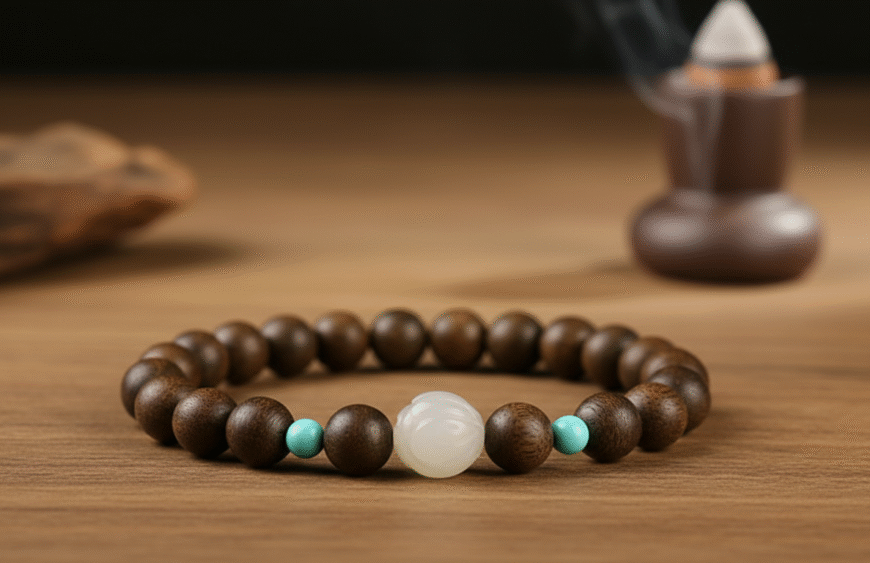
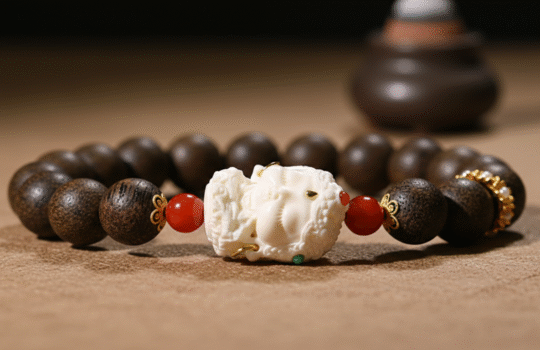
Friends often ask me, ‘Lao Wang, what is the essence of playing with agarwood?’ I believe it is not the price per gram, but the memories of time and space it carries. Years ago, I traveled deep into Kalimantan, Indonesia. Located on the equator with long rainy seasons, the humid air of the old forest—a mix of humus soil and unique herbs—still haunts my dreams. When I first saw this [Aged Kalimantan Material with Hetian Jade Lotus] bracelet, those memories were instantly ‘activated.’ This is not just a string of beads; it is a dialogue across mountains and seas—weathered wood from the tropical rainforests of Borneo meeting warm jade from the Kunlun Mountains. This ‘Wood and Stone Alliance’ is a philosophical pairing in the agarwood circle: wood represents growth yet remains silent, while jade is steadfast yet gentle as water. Today, please join me in exploring the inner world of this unique piece and feel that long-lost tranquility.
Tracing Origins: The ‘Resin Legend’ Deep in the Rainforest
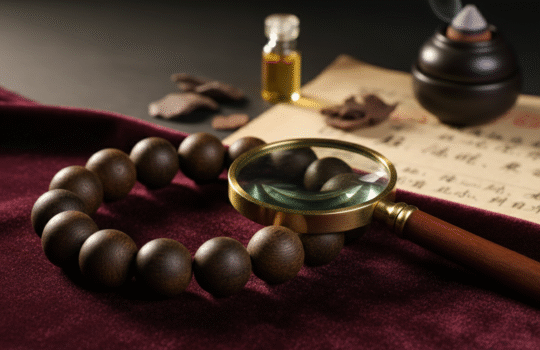
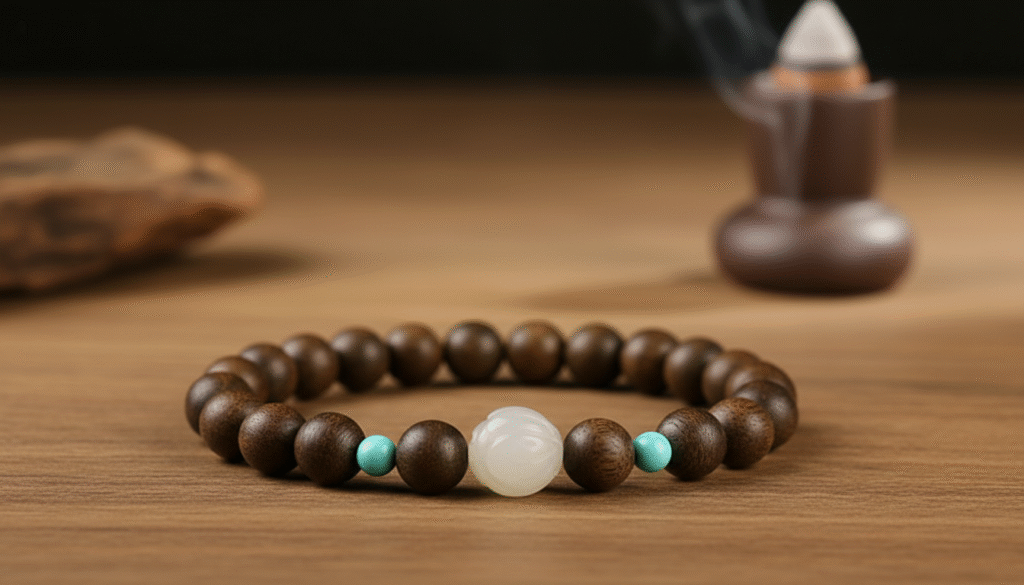
Having played with incense for many years, I have always held a special respect for Kalimantan material. Look closely at the beads in the image; those subtle ‘tiger stripes’ are something ordinary material simply cannot produce! This unique texture only forms in specific environments of swamp and red soil within this region, through decades or even centuries of maturation. This aged material comes from an elite production area in eastern Kalimantan. When the harvesters found it, the raw material was buried at the base of a fallen tree; through years of erosion, the white wood rotted away, leaving only the resin-hardened parts. This ‘life through death’ process grants it high density and a deep black-brown color. When you run your fingertip over it, you can feel the natural unevenness formed by the contraction of oil lines—a premium texture that no manual polishing can replicate.
Encounter: The Zen of ‘Lotus’ and Kunlun White Jade
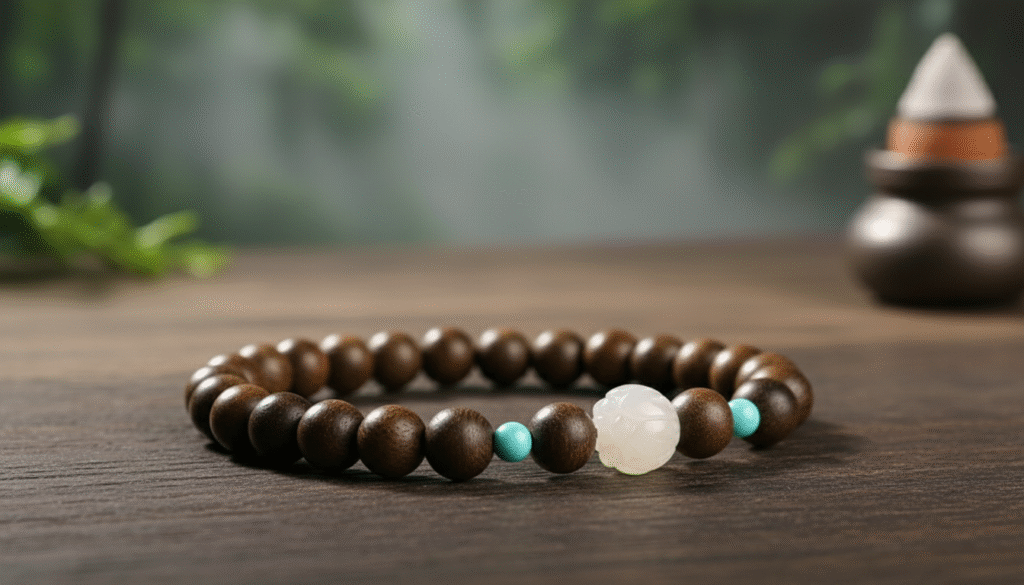
As the saying goes, ‘fine incense requires fine vessels,’ but gaudy accessories would ruin the elegant vibe of agarwood. I give this design full marks—a bold introduction of the collision between ‘hard’ and ‘soft.’ The main bead is a finely carved Hetian white jade lotus, with a texture as oily and delicate as mutton fat, emitting a soft glow under light. The lotus symbolizes ‘rising from the mud unsullied,’ which perfectly echoes the agarwood’s trait of ‘fragrance from rotten wood.’ To balance the strong contrast between black agarwood and white jade, the designer added two high-porcelain blue turquoise beads. This splash of blue is like a sliver of sky peeking through dense rainforest leaves. When worn, the cool smoothness of the jade and the warmth of the agarwood alternate on the wrist—this is the ‘Wood and Stone Alliance’ often mentioned by the ancients, combining the strength of stone with the softness of wood.
Listening to Silence: Medicinal Bone, Milky Soul
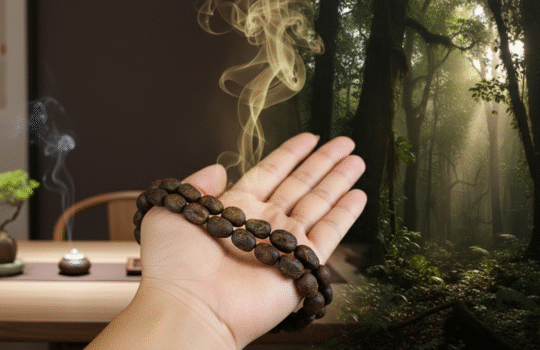
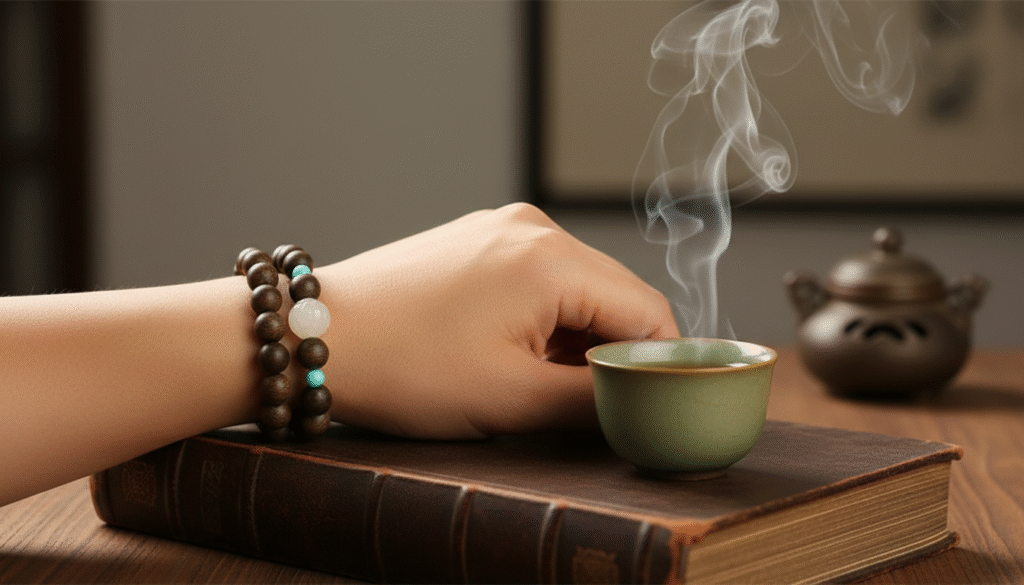
The reason Kalimantan is hailed as the ‘backbone’ of the Xingzhou series lies in its highly recognizable scent. At room temperature, this bracelet emits a crisp, sweet herbal fragrance—the primitive breath of rainforest vegetation that clears the mind instantly. After wearing it for half an hour, a magical thing happens: with the help of body temperature, the milky scent (milky rhyme) hidden deep within the resin begins to permeate, thick but not cloying. This scent is layered: the first whiff is cool, the fine tasting is sweet, and the aftertaste is mellow. In a bustling city, a deep breath from your wrist provides a peaceful power from nature, enough to soothe any inner anxiety. [Expert Message]: Connecting with agarwood depends on ‘eye affinity’ and ‘nose affinity.’ If you want to know if this Kalimantan ‘medicinal-milky rhyme’ fits your aura, or want to see what a ‘living oil line’ looks like under macro, feel free to DM ‘Appreciation’ on my homepage. I have the tea ready; let’s talk about the world of incense within these few inches, not just business.
FAQs
Q.The hardness of agarwood and Hetian jade is so different; won’t they wear each other out?
A.That is a very professional question! Hetian jade (hardness 6-6.5) is indeed much harder than agarwood. To solve this, we used a ‘flexible partition’ technique: small turquoise spacers and imported cowhide pads are placed between the jade lotus and the agarwood beads. This not only adds a pop of color but also creates a physical ‘shock absorber.’ You can wear and play with it daily without worrying about the hard jade damaging the precious agarwood!
Q.How should I maintain this aged Kalimantan material to keep its fragrance?
A.Remember: agarwood is ‘alive.’ The core of maintenance is ‘nurturing the energy.’ First, avoid contact with chemicals like perfume or soap, which ‘clog’ the pores. Second, although Kalimantan material is resin-rich, avoid prolonged sun exposure or soaking in water. The most natural maintenance is ‘human nurturing’—wear it often, as your body’s oils and warmth are the best conditioning agents. If the scent fades, place it in a sealed glass jar for three to five days to let the fragrance return, known in the trade as ‘Hui Qi’ (returning energy).
Q.I am a beginner; could these ‘tiger stripes’ be painted on?
A.There are indeed ‘painted’ fakes on the market, but as an expert, I can teach you two secrets to spot the truth: First, look for the ‘diffusion effect.’ Real oil lines follow the wood’s vascular bundles, so the edges are blurry and natural, like an ink wash painting. Painted lines usually have harsh edges and sit on the surface. Second, look for ‘randomness.’ Resin formation is unordered; it won’t be perfectly uniform like zebra stripes. In our Kalimantan piece, every bead is unique, and under a magnifying glass, you can see the crystalline resin filling the ducts—a witness to nature’s work over decades, not a brushstroke.