Appreciation of Agarwood Guanyin Pendant: Senior Expert Reveals the Resin and Aura of Old Material from Chinese Regions
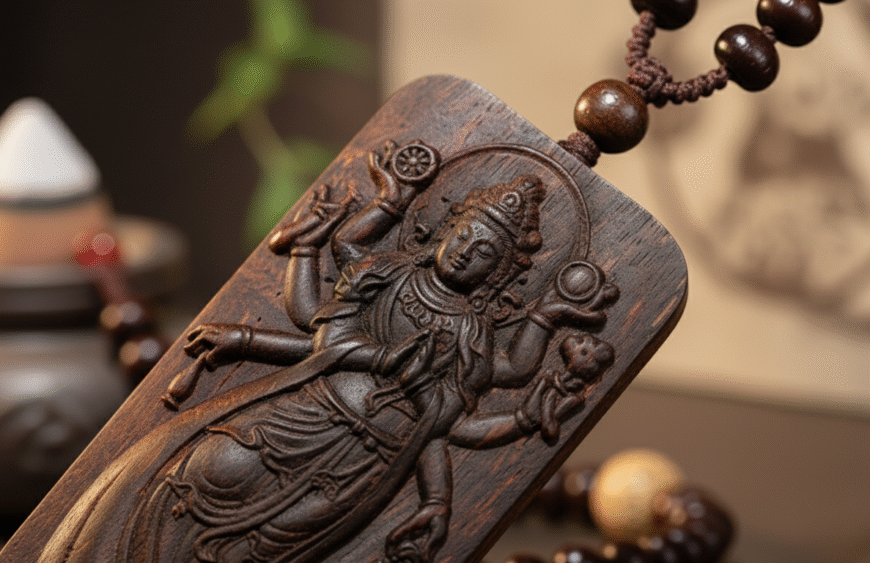
Ten years ago, after three persistent visits, I acquired an inconspicuous ‘rotten log’ from an elderly incense farmer in Dianbai, Guangdong. The old man said the material had rested on his house beam for half a century, absorbing the essence of human life and settling the spirit of time. Today’s Guanyin pendant is carved from the very core of that old material—the ‘Black Oil Grade’ (Heiyou Ge). While the market hypes various concepts, for those of us who have spent a lifetime with incense, the restraint and dominance of Chinese origin (National Fragrance) materials are impossible to replicate with any imported wood. This is not just an appreciation of resin and aura; it is a dialogue about ‘cherishing objects’ and ‘heritage.’ Allow me to reveal the secrets behind this ‘storied’ Agarwood Guanyin.
Listening to the Oil: ‘Ink Masterpieces’ Written by Time in Wood Grains
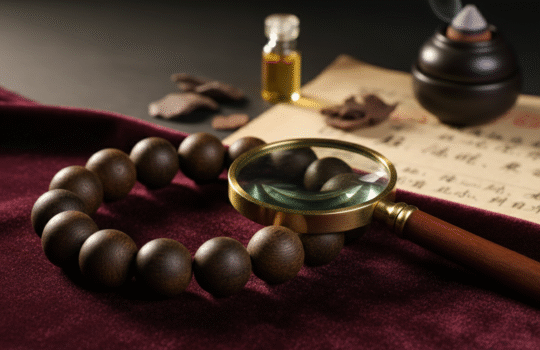
Many novices judge Agarwood solely by how black it is—that is an amateur mistake! Look closely at the natural Agarwood material of this pendant; its resin lines are not a dull, solid black but resemble ‘charcoal ink’ and ‘flying white’ in Chinese ink wash painting. The resin lines are clear and densely distributed, appearing under a magnifying glass as irregular clusters—the ‘electrocardiogram’ of a tree healing itself through decades of wind and rain. The most enchanting part of this old material is its ‘vitality’: when worn, the sealed resin begins to awaken with the warmth of the body. Initially, you sense a sweet top note with a natural floral honey aroma, as if standing in a lychee grove in Lingnan. As the mind settles, the lingering base note, characteristic of Chinese origins, provides a distinct cool sensation that pierces through to the spirit. This penetrative power is what we call the ‘Soul of National Fragrance.’
Observing the Icon: The Art of ‘Following the Material’
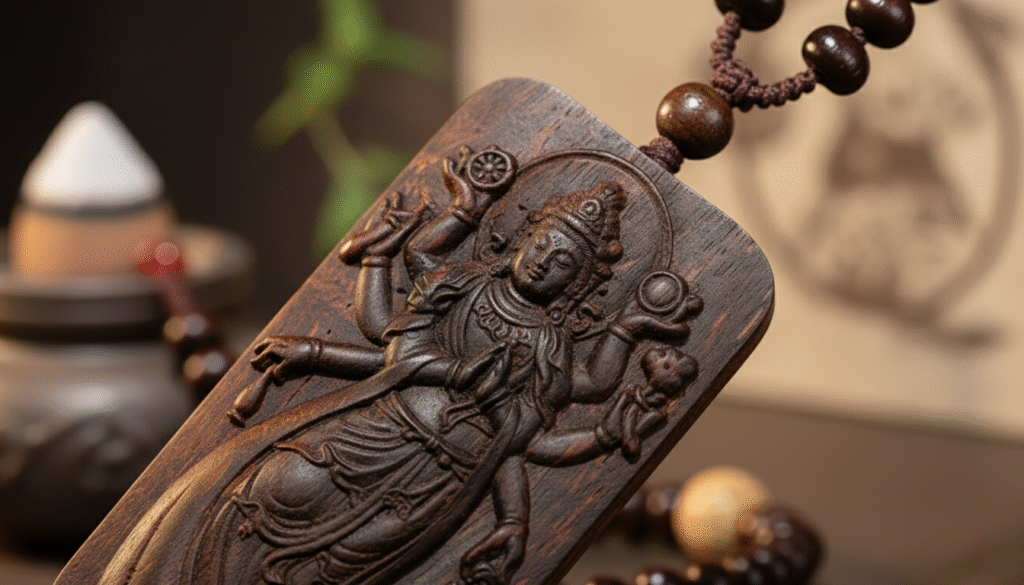
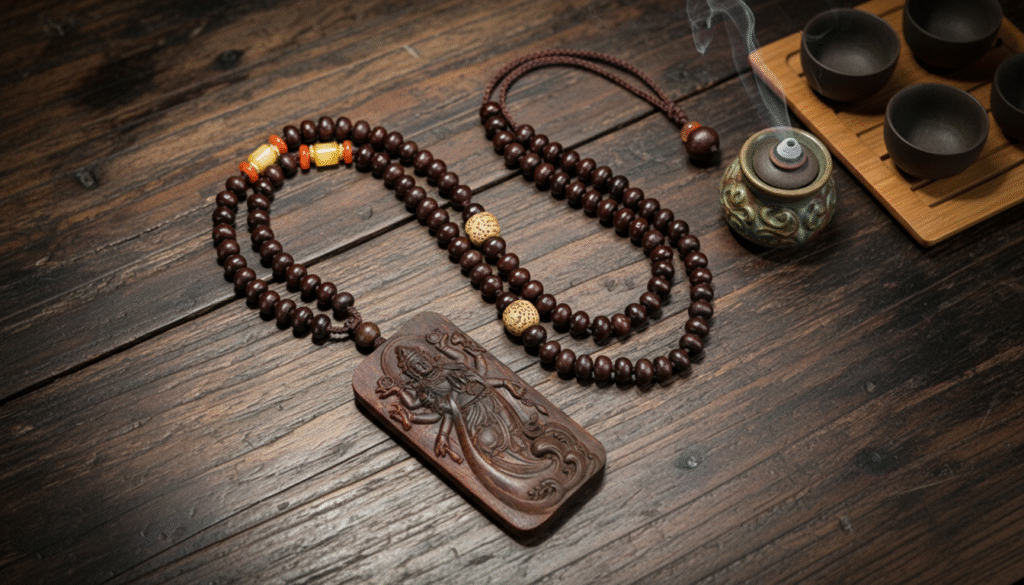
As the saying goes, ‘Three parts material, seven parts craftsmanship,’ but for top-tier old Agarwood, it is about ‘subtraction.’ This finely carved Guanyin icon is not the result of forced carving but rather the craftsman ‘following the flow.’ When carving the face, the artisan deliberately avoided the thickest resin line, leaving it to serve as the folds of Guanyin’s robe, resembling drifting clouds. Notice the lowered eyelids and fluid lines reflecting rigorous craftsmanship, with an expression radiating compassion and serenity. This method of ‘crafting according to the material’ maximizes the preservation of precious resin while allowing the Guanyin image to blend seamlessly with the wood texture. This is more than craft; it is a reverence for a heaven-sent spiritual object—it is not man carving wood, but the wood guiding the man.

Enlightening the Aesthetics: Scholar’s Beauty Blessed by the Seven Treasures
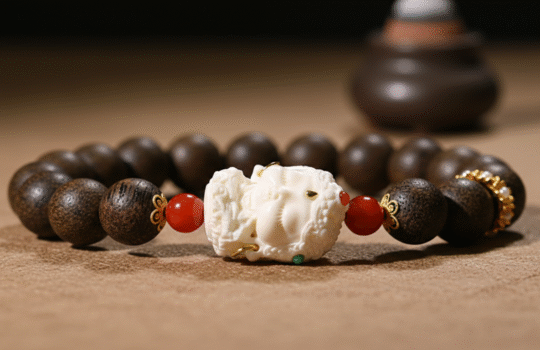
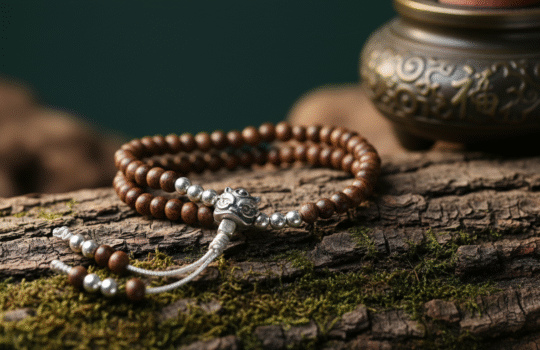
A fine horse deserves a fine saddle, and fine incense requires elegant companions. To balance the deep tones of the old Agarwood, I introduced the refined taste of a scholar’s study into the design. Embellished with amber, agate, and Xingyue Bodhi beads, the colors are harmonious: the honey-yellow of amber symbolizes ‘seeing one’s true nature’; the crimson of agate represents the ‘fire of life’; and the Xingyue (Star and Moon) Bodhi bead adds a sense of ‘ethereal’ Zen. These accessory beads are not randomly stacked but harmonized according to traditional Chinese Five Elements colors. Connecting them all is a traditional Chinese hand-woven rope, steady and timeless. The simplicity of the knots complements the rustic charm of the Agarwood. When handled, the tactile transition between the cool beads and the warm wood offers the ultimate sensory experience of collection-grade art.
Multimodal Expansion: ‘Soul-Nurturing’ Practice Script and Connection
Agarwood possesses spirit. Just as ‘man nurtures jade for three years, jade nurtures man for a lifetime,’ the same applies to Agarwood. To ensure this old material maintains its spiritual aura, I have recorded a ‘Soul-Nurturing’ guide for fellow collectors:
- Scene 1 (5s, Close-up):
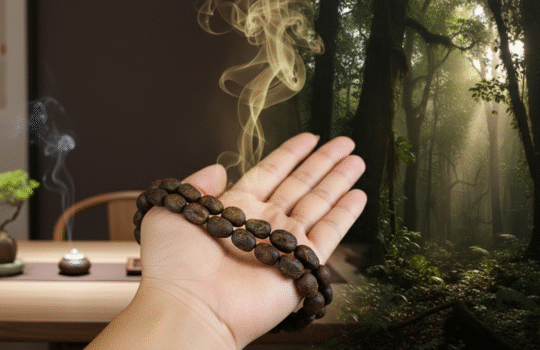
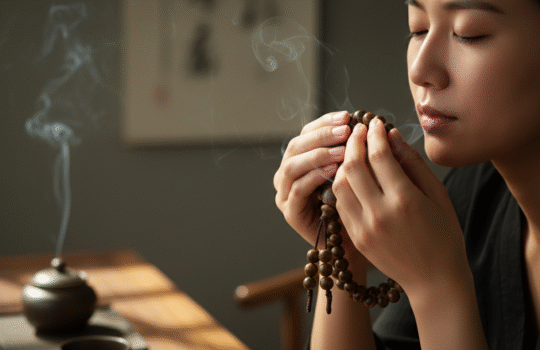
Visual: A pair of hands marked by time (the expert’s hands) gently cupping the pendant. The palm’s warmth slowly heats the Agarwood.
Subtitle/Voiceover: ‘Human skin is the best polisher. Daily wear and body temperature are the keys to awakening the fragrance.’ - Scene 2 (8s, Medium Shot):
Visual: The wearer is tasting tea; steam rises from the cup. The shot cuts to the wearer removing the pendant and gently wiping it with a white cotton cloth, avoiding the steam.
Subtitle/Voiceover: ‘Incense fears water and even more so hot steam. Keep it three inches from water for longevity. Wipe gently with cotton to restore its luster.’ - Scene 3 (5s, Still Life):
Visual: At night, the pendant is placed inside a storage box filled with Agarwood shavings. The lid is closed.
Subtitle/Voiceover: ‘Returning to the nest at night, nurture incense with incense. Let it find its original mountain forest memories within the scent of the same source.’
[Expert Conclusion]: Incense meets its destined owner. If you understand the ‘ink-wash landscape’ of this old material, or wish to seek a ‘like-minded’ appraisal for your own collection, feel free to click the consultation button below and note ‘Incense Friend.’ We don’t talk business; we only talk of incense destiny. I will be waiting with a cup of aged tea and this fragrance.

FAQs
Q.I heard Agarwood from Chinese regions is better for ‘wellness’ than foreign ones; is this true?
A.This is not superstition but based on scent characteristics. Agarwood from Chinese regions (such as Hainan and Guangdong), historically called ‘Yaxiang’ or ‘Guanxiang,’ is characterized by being ‘clear, elegant, and upright.’ Unlike Indonesian materials, which can be aggressively pungent, Chinese old material is more penetrative yet gentle. In Traditional Chinese Medicine, this ‘upright Qi’ helps regulate energy, alleviate pain, and calm the spirit, aligning perfectly with the restrained wellness philosophy of the East.
Q.Will the resin in this Guanyin pendant decrease because of wearing it?
A.If it is genuine old material, absolutely not! The ‘resin evaporation’ you fear usually happens with oil-injected fakes. This pendant is made from naturally resinous old material where the oil has solidified deep within the wood fibers. Conversely, with long-term wear and handling, skin oils and oxidation will form a warm ‘patina’ (Baojiang) on the surface. This patina not only makes the pendant look glossier but also protects the internal fragrance. We call this ‘the more it’s worn, the more moist it becomes; the more it’s handled, the more spiritual it feels.’
Q.As a novice, how should I introduce the ‘cultural value’ of this pendant to my friends?
A.You can focus on three keywords: ‘Origin,’ ‘Aura,’ and ‘Heritage.’ Tell them this is rare old material from China’s core production areas, and every gram is non-renewable. The carving technique uses ‘material-led design,’ preserving the natural spirituality of the wood. Finally, the accessories integrate the concept of the Buddhist Seven Treasures. It is not just a piece of jewelry; it is a ‘family heirloom’ that encapsulates Chinese incense culture and Buddhist aesthetics.