Collector’s Private Selection: Why This 108-Bead Domestic Old-Growth Agarwood is the “Crown Jewel” of My Export Stock?
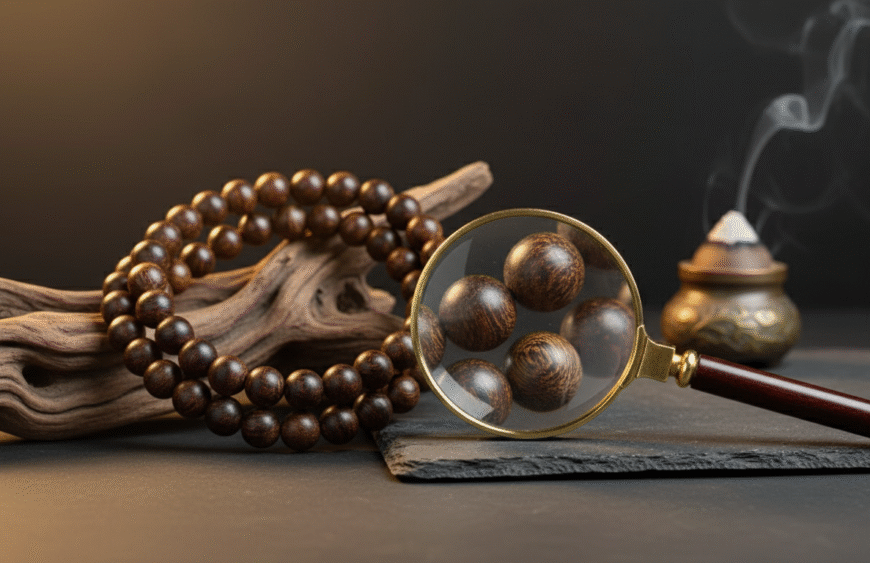
In my twenty years of agarwood export trade, I have handled thousands of treasures—from the milky richness of Dalagan to the clear coolness of Nha Trang. Each has its charm. But in my private “export list,” there is always a blank space reserved specifically for this 108-bead string of domestic old-growth agarwood. This is more than a commodity; it is a memory of “fragrance hunting.” I remember an old village at the border of Guangdong and Guangxi, where a forest guardian took a piece of “rotten wood” from a beam covered in the dust of ages. The moment it was cut, a unique cooling medicinal aroma instantly overwhelmed the stale air of the room! This prayer bead string is the direct lineage of that raw material. Today, I don’t want to talk about boring parameters. As a senior insider, I want to help you understand why this string, which rejects “dead black” and insists on its “chestnut brown” nature, is my proud benchmark against “high-tech” market imitations.
Visual Narrative: Beware of Industrial “Dead Black,” Understand the “Chestnut Brown” Ink-Wash Tempered by Time
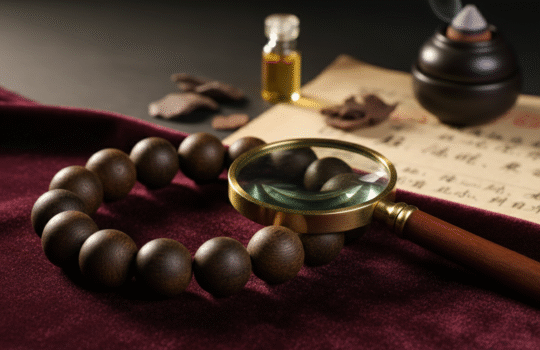
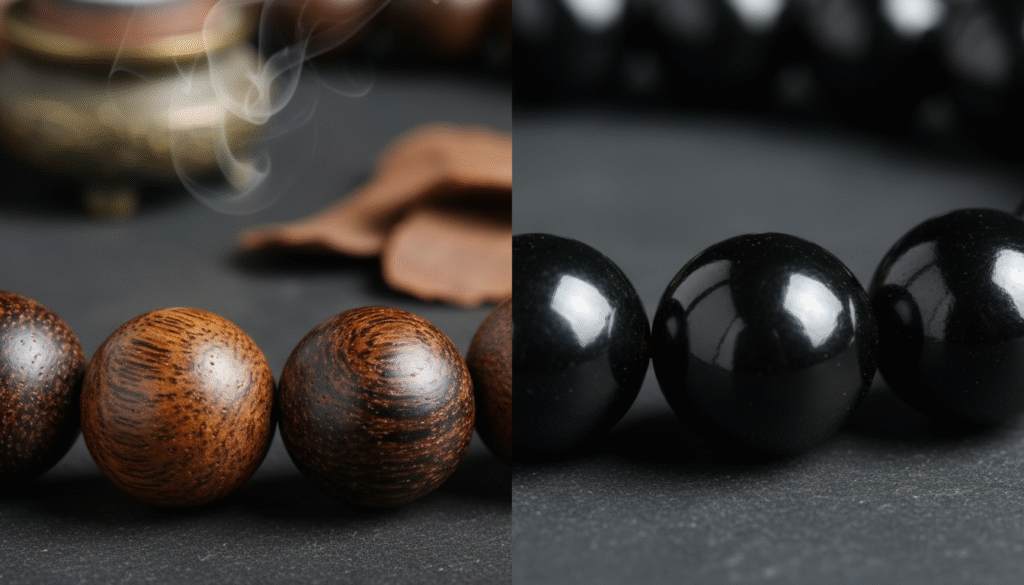
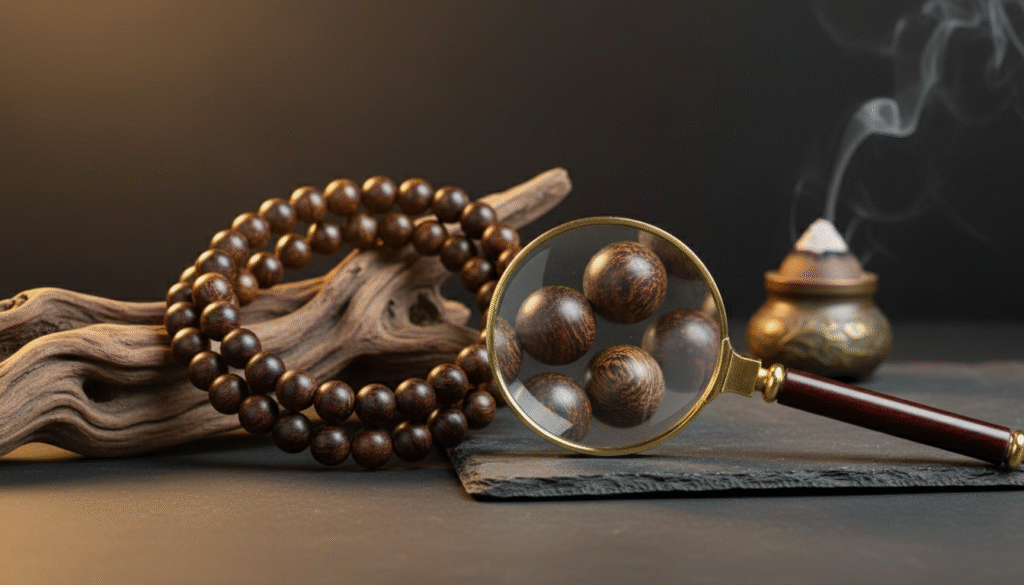
Many new collectors are easily deceived by beads that are shiny black and mirror-like. I must be blunt: those are often products of “industrial plastic surgery”—high-pressure oil injection or dyeing! Real domestic old-growth material, like this 108-bead string, has a deep and restrained chestnut brown base color. Looking closely, it’s not just wood, but a miniature ink-wash painting. The oil lines are not rigid black marks but spread naturally like splashed ink along the vessels, with blurred edges between reality and void. This vitality of “oil swimming in wood” cannot be replicated by any machine. Furthermore, observing the surface closely reveals needle-sized breathing pores. Real agarwood is alive and needs to breathe. Fakes filled with chemicals have clogged pores and a suffocating “glassy” artificial shine. The heavy texture of this string comes from the weight of oil accumulated over decades or even centuries, not the superficial wet weight of oil-soaked fakes.
The Olfactory Soul: Awakening the “Medicinal Solace” in the Depths of Eastern Spirituality
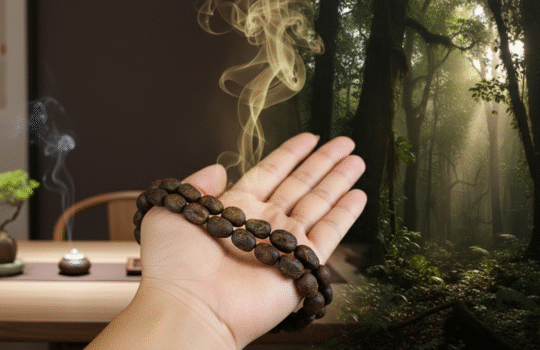
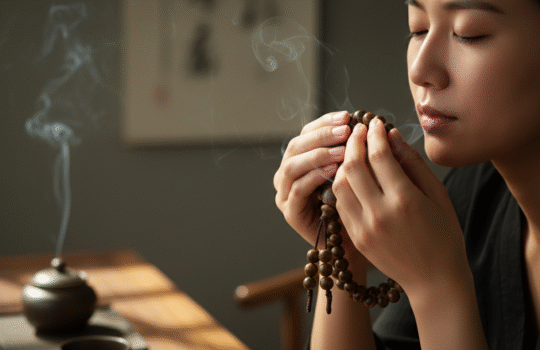
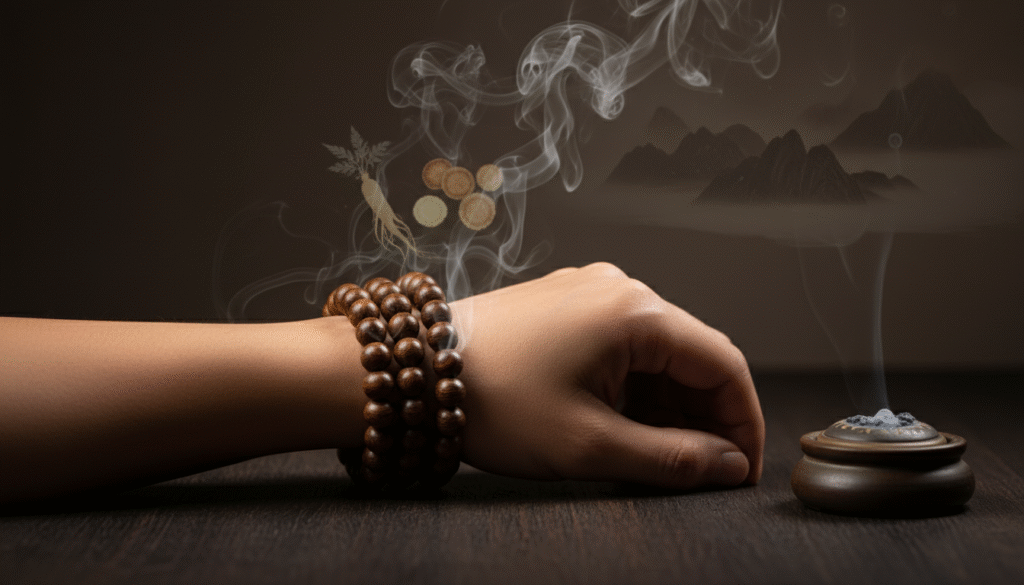
If texture is the body, then “Qi” or aura is the soul of agarwood. Domestic agarwood holds the status of “Uncrowned King” in high-end circles entirely because of this irreplaceable “elegant medicinal rhyme.” The scent of this 108-bead string has a script. At room temperature, it is like a hermit—initially just a faint sweet coolness, not aggressive or overwhelming, completely different from those “exploding” chemical fragrances. The real “climax” occurs when you wrap it around your wrist and body temperature becomes the catalyst: the oil molecules are activated, a surge of coolness hits the mind, then transforms into a mellow, clean herbal fragrance and honey sweetness. This scent is much like the sense of security in an old apothecary from childhood, or a refreshing cool breeze in the mountains on an autumn day. For business elites in the arena of fame and fortune, this wisp of “centering fragrance” that pierces through anxiety is why it is more precious than gold.
Collection and Heritage: The “Moat” of Rare Domestic Old-Growth Material
In this fast-paced era, finding a string of authentic domestic old-growth material is harder than buying a limited-edition supercar. Why do I consider it a “lost pearl”? Because the genetics cannot be replicated. Wild resources of the Chinese production areas (Guanxiang species) are nearly exhausted after several large-scale harvests in history. The material used for this string is old stock from many years ago—every piece cut is one piece less. New materials (oil-soaked white wood) or artificial materials on the market depreciate upon purchase; however, this old material with clear “ink-wash” veins, perfect chestnut brown color, and mellow medicinal rhyme is a friend of time. It is not just an accessory, but a piece of Eastern fragrance culture history. Whether as a ritual tool for meditation or a family heirloom passed to future generations, it possesses strong value retention and cultural depth. [Expert’s Note]: Frankly, the world of agarwood is deep, and “tuition fees” are expensive. If you don’t want to spin in the pits of “fakes” and “modified goods,” and want to personally feel the true “chestnut brown” face of domestic old-growth material, or have fragrances you’re unsure about that you’d like me to evaluate, feel free to click the consultation button below to communicate with me directly. Even if you don’t buy, making a friend who knows fragrance and speaks the truth is a more precious fate than the beads themselves.
FAQs
Q.How to quickly judge if this agarwood has been “tampered with” (such as oil soaking)?
A.Remember three points: Color, Luster, and Scent. Color: Real items are chestnut brown with natural ink-wash patterns; fakes are dead black with rigid lines. Luster: Real items have a warm matte finish with clear pores; fakes have “artificial shine” (piercing brightness) and clogged pores. Scent: Real fragrance is layered and smells better when heated; fakes usually have a single, pungent, or overly strong scent that causes dizziness after long exposure.
Q.Why are the prices of domestic old-growth materials more stable than many imported materials?
A.The core lies in cultural identity and scarcity. Chinese production areas (such as Guanxiang, Hainan) are the source of agarwood culture, and their unique “elegant medicinal rhyme” fits Eastern aesthetics, which Southeast Asian agarwood cannot replicate. Combined with extremely low wild old-growth inventory, this non-renewable scarcity forms a solid price moat.
Q.Are there any taboos for daily wear and maintenance of 108-bead prayer strings?
A.As a spiritual old-growth material, its greatest enemies are chemical corrosion and high temperatures. Please remove it when bathing, spraying perfume, or applying hand cream to prevent chemicals from clogging the precious oil pores. In daily wear, human oils and body temperature are the best maintenance; normal wear will form a beautiful patina. Avoid intentional oiling or exposure to intense sunlight.