Soul-Stirring Chinese Agarwood: Why is this Sinking-Grade Thousand-Hand Guanyin Pendant a Worthy Heirloom?
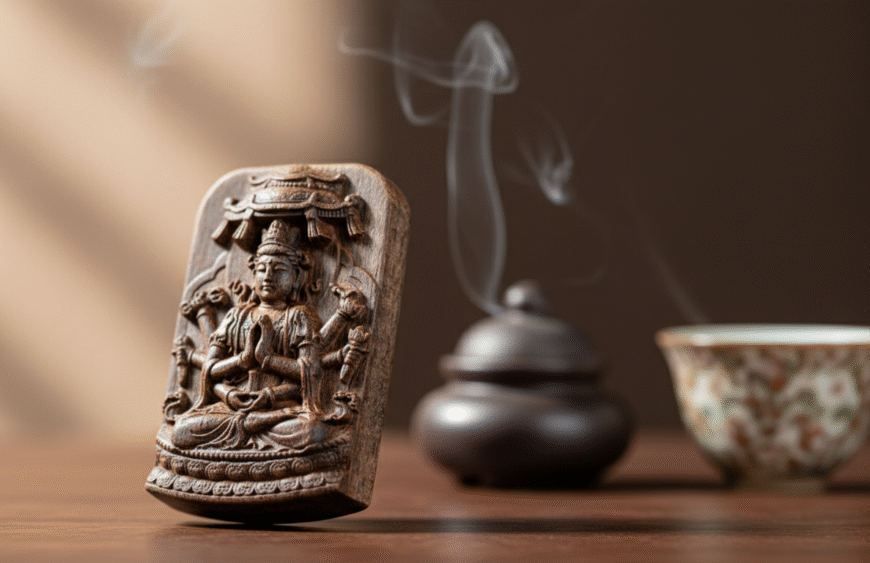
Having spent twenty years in the agarwood export industry and handled thousands of pieces, my heart has long been as calm as still water. However, when I held this Chinese Agarwood Thousand-Hand Guanyin, the heavy, substantial feel in my palm made my heart skip a beat. I remember an old agarwood farmer in the mountains of Hainan telling me years ago: ‘True agarwood is the crystallization of the mountains, sun, and moon; it is the wood suffering on behalf of man, and it chooses its master.’ Looking at the resin that seems to overflow from the surface, I see the century-long ‘cultivation’ of this wood resisting fungal erosion in the deep mountain red soil. This is not just a piece of wood; it is a fragment of frozen time. Today, I want to step aside from my role as a merchant and, in the name of an agarwood lover, guide you through this ‘work of integrity’ and the heirloom value of the Chinese Agarwood lineage.
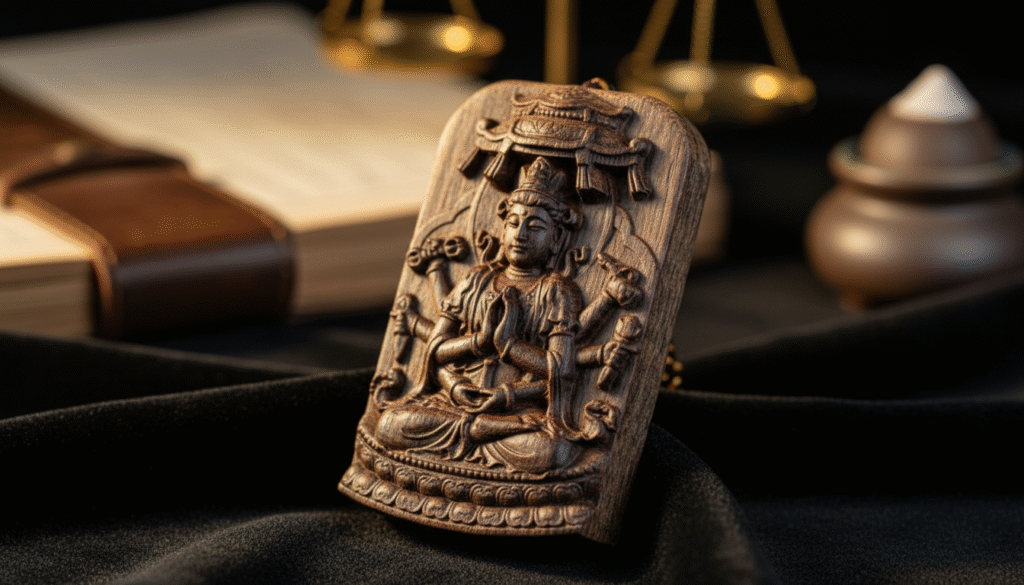
Visual Impact: The ‘Paste-like’ Raw Material Language and Earthly Imprints
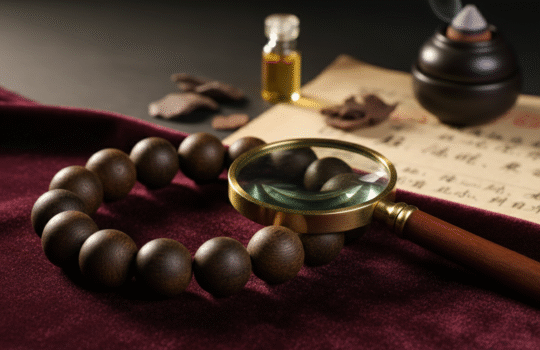
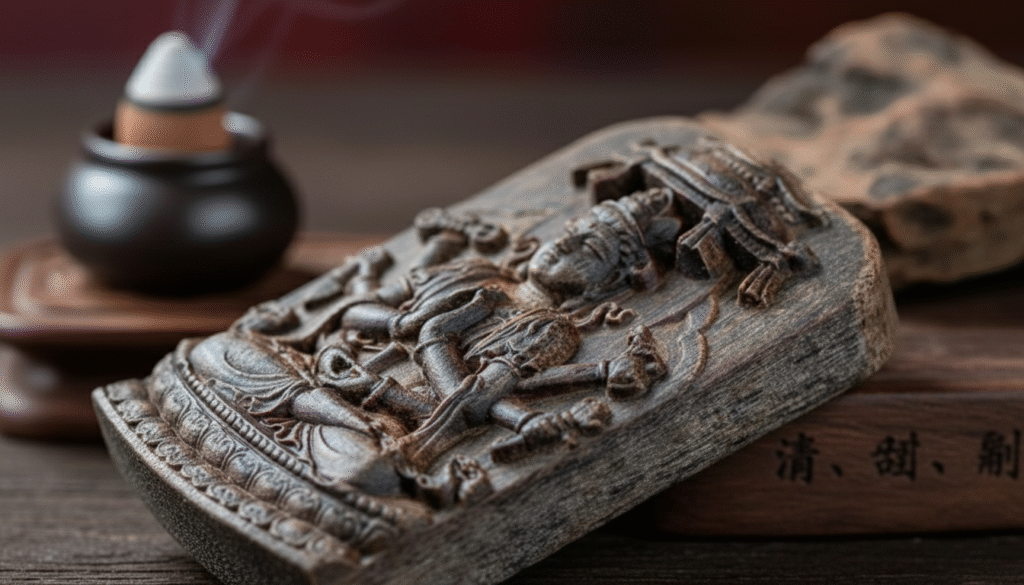
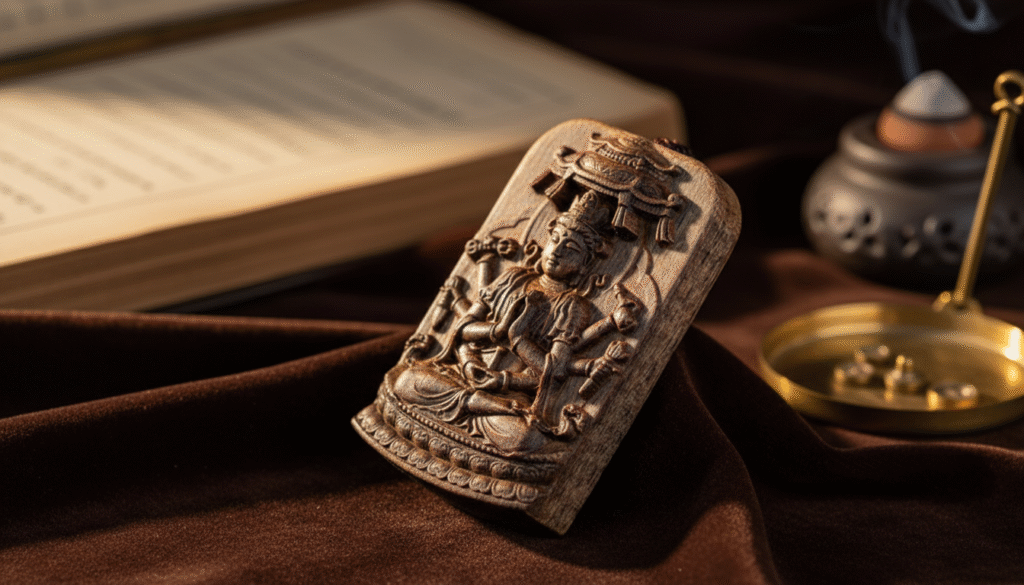
Many beginners ask me, ‘What is Qi-Nan texture?’ To be honest, don’t look at textbooks; looking at this one piece is enough. Under natural light, you can clearly observe the intense resin overflow, with the surface exhibiting a typical ‘paste-like’ greasy luster. This luster is not a ‘fake brightness’ created by high polishing, but a mellow warmth that ‘oozes’ from the internal wood fibers when the resin is saturated—an industry term known as ‘oil overflowing to the surface.’ This is the unique genetic code of old-growth Chinese Agarwood: fine, deep, and dense oil lines, interlaced in black and brown, like an ink wash landscape painting. Each winding oil line records the geological changes this agarwood tree underwent in ancient production areas (such as Dongguan or the deep mountains of Hainan). This outer skin can only form such visual tension—soft as silk yet hard as iron—after a century of mellowing in specific red soil layers, absorbing the essence of heaven and earth. One glance for ten thousand years; it is the epitome of an era.
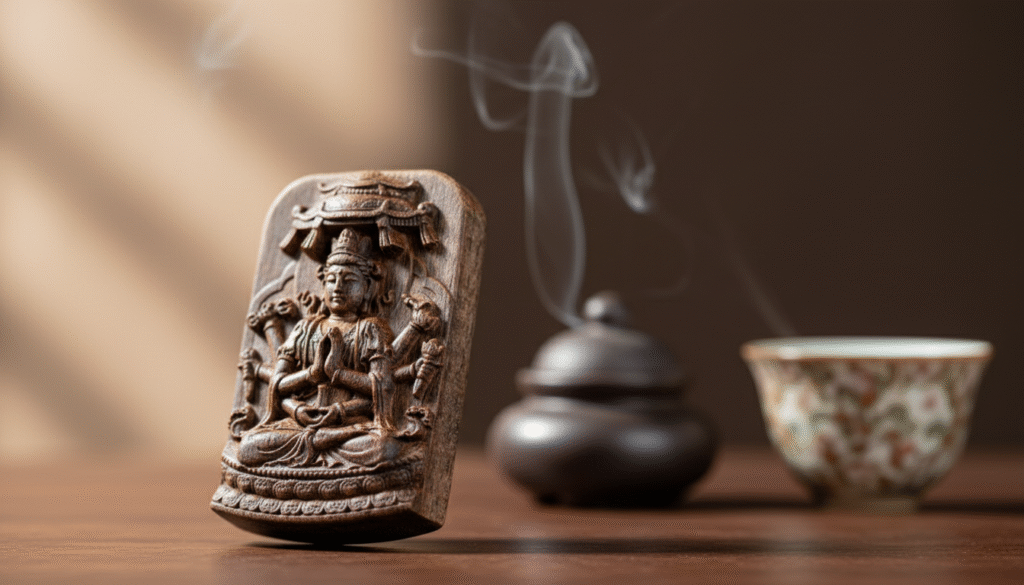
Faith Under a Macro Lens: Mercy on the Blade’s Edge and the Pride of ‘Sinking Grade’
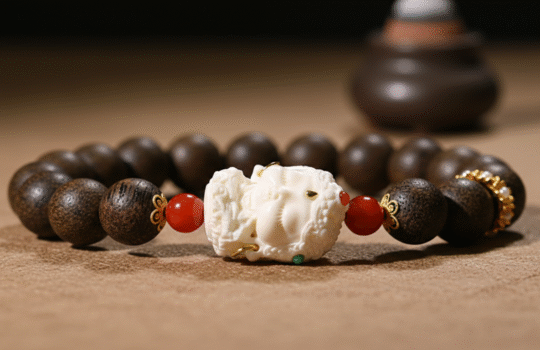
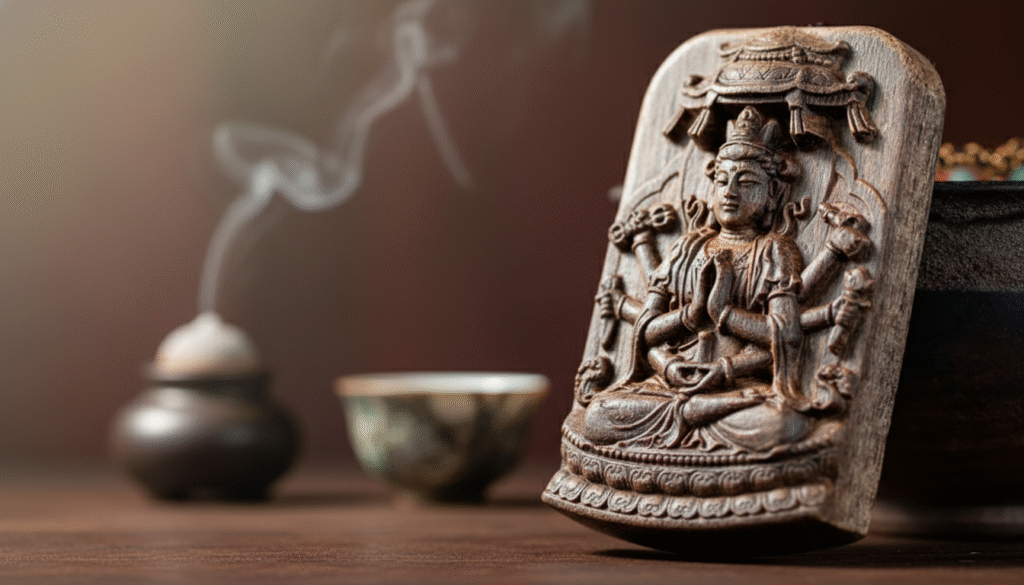
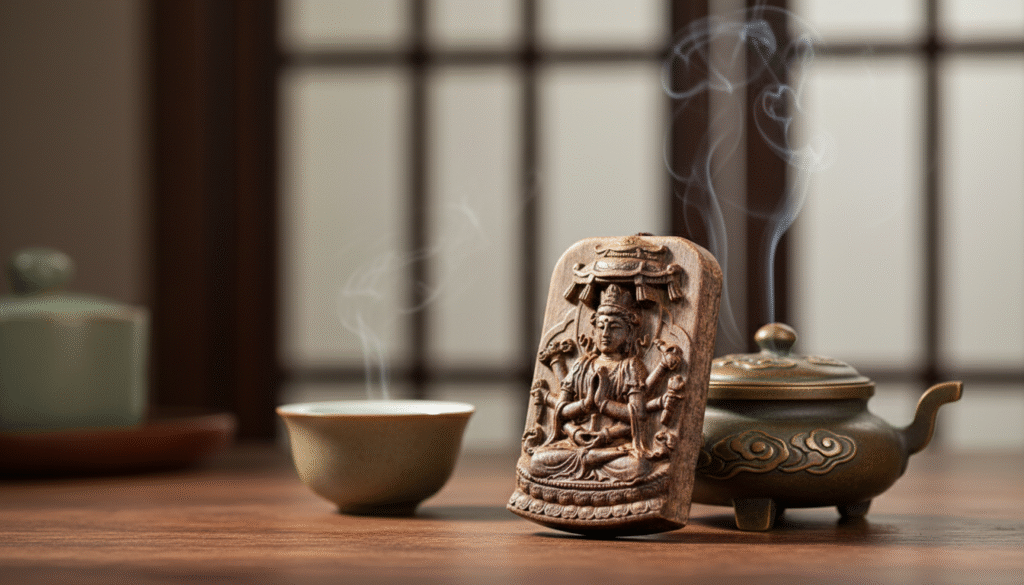
Agarwood has a very strange temper: areas with high resin are both sticky and soft for the carving knife, while areas without resin are brittle and prone to collapsing, making carving extremely difficult. However, this Thousand-Hand Guanyin statue has a compassionate face, with robes and ritual instruments carved with meticulous detail. The master craftsman clearly adopted the ‘carving along the grain’ technique, placing the face of Guanyin at the finest resin area, avoiding messy textures to ensure a clean and solemn appearance. Note the connection between the arms and the ritual instruments; the lines flow like water without a single chip. What does this mean? It means the wood fiber structure of the base material is extremely dense, reaching the physical density of ‘Sinking Grade.’ A work of this level is a ‘two-way encounter’ between top-tier material quality and master craftsmanship. It is not just an object, but a Buddha who attained enlightenment after enduring suffering (resination), carrying the auspicious meaning of ‘Thousand-Hand Protection.’ Wearing it brings a heavy, grounded sense of peace.
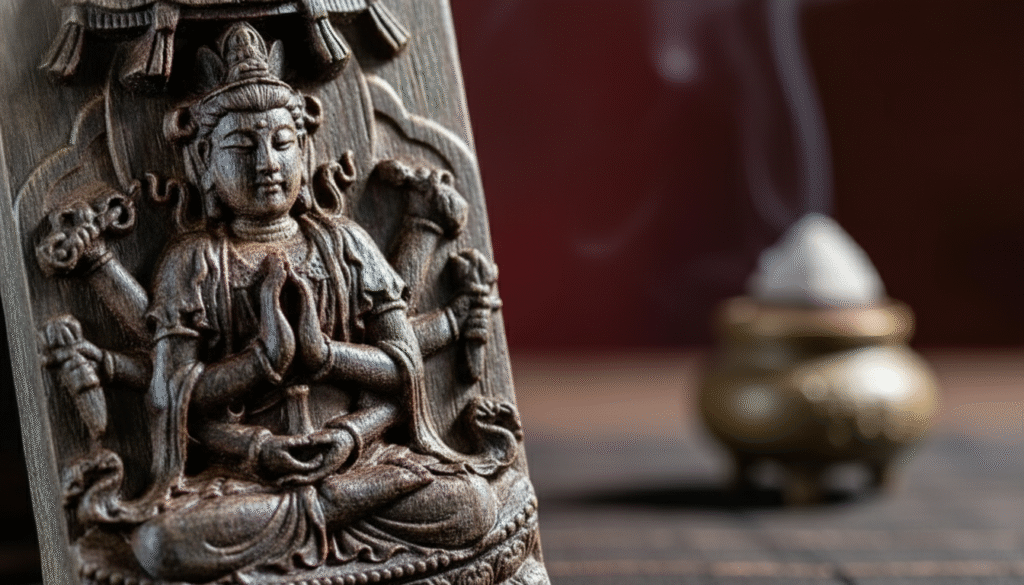
Discerning Scents and Rhymes: From Cool Mint to the Honey Sweetness of Guan-Xiang
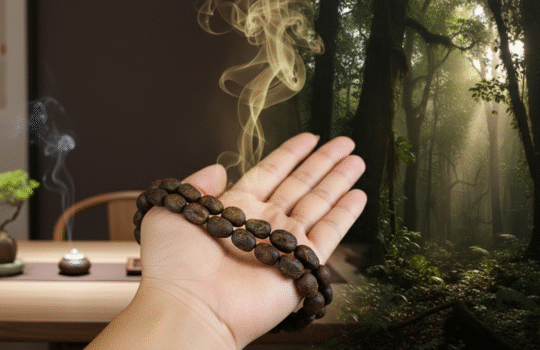
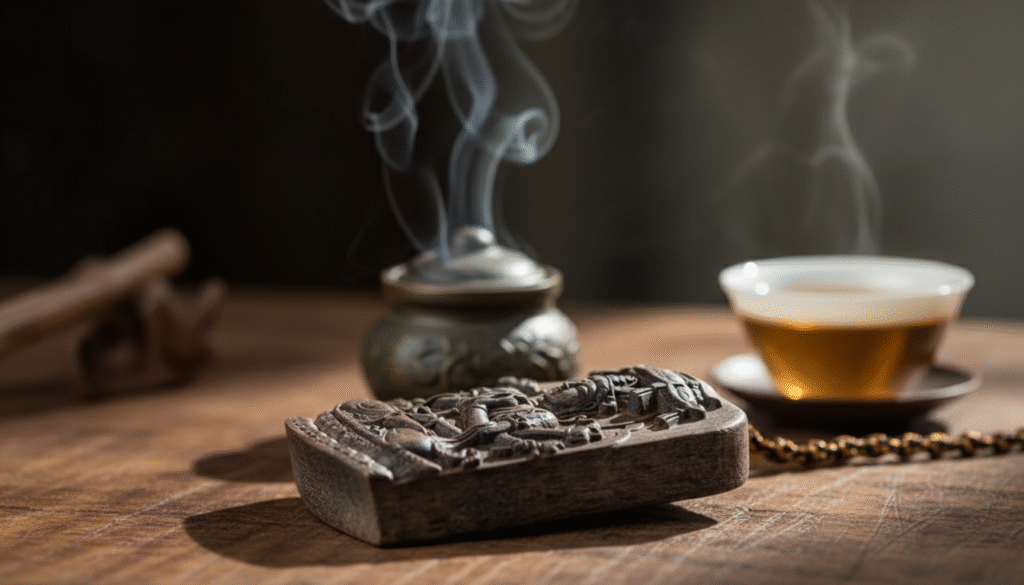
Good agarwood has breath and character. The raw scent of this pendant is enough to instantly calm a heart in a bustling city. Upon first sniff, the nasal cavity is filled with a fresh minty coolness that reaches the top of the head, like standing in an ancient forest after rain. Subsequently, as the wearer’s body temperature warms the resin, a rich and mellow blend of floral honey and milky fragrance begins to release—sweet but not cloying, elegant to the bone. This is the most charming ‘soul’ of the old Chinese ‘Guan-Xiang’ lineage. Unlike the intense and flamboyant scents of Southeast Asian regions, it has a ‘clear, graceful, and upright’ character described by Song Dynasty literati. The lingering notes carry a faint medicinal fragrance, with a transparent aura. This ‘Clear, Sweet, and Mellow’ three-stage experience is the gold standard for identifying top-tier Chinese Agarwood.
Collection Value: Heirloom Assets from Scarce Origins and Expert Advice
As an exporter, I must speak truthfully from a market perspective: real wild Chinese Agarwood resources on the international market are currently near exhaustion. Famous historical production areas can now often only be found in ancient texts. This piece, combining the ‘Sinking Grade’ hard indicator with exquisite religious carving, is a classic ‘hard currency’ asset. In the high-end Chinese cultural collection market, due to its non-renewable nature, the price per gram of such items has long surpassed gold. It is not only an amulet for safety but also a family asset that can be passed down through generations. Owning a unique piece that fuses ‘Qi-Nan texture,’ ‘historical heritage,’ and ‘master craftsmanship’ is the best proof of one’s discernment. [Expert Connection Guide]: If you are moved by this ‘Sinking Grade’ masterpiece or wish to witness its sinking state and microscopic oil line details via video, please contact me directly. Good incense meets its destined person; I am willing to provide a one-on-one video appreciation, inviting you to admire the ‘Sinking’ character of this Guanyin. Opportunity is fleeting; do not miss this chance to connect with a lifelong incense destiny.
FAQs
Q.This pendant is labeled as ‘Sinking Grade,’ how can I verify this?
A.As a professional exporter, our definition of ‘Sinking Grade’ means the resin content is so high that its physical density is greater than water. While the most intuitive method is a water test, for top-tier carvings like this, frequent immersion may affect the patina’s luster. You can judge by the ‘dense wood fiber structure’ and ‘paste-like resin luster.’ It will have a noticeable ‘heavy hand-feel,’ which is physical evidence of high density and the indicator veteran collectors value most. Of course, if you require it, we can provide a one-time professional sinking test video before finalization.
Q.Compared to Vietnamese or Indonesian agarwood, what are the unique advantages of Chinese agarwood?
A.Chinese agarwood (especially the Guan-Xiang lineage) holds a central position in historical incense records. Its greatest advantage lies in its ‘rhyme’ (Yun). Compared to the heavy medicinal smell of the Xing-Zhou system (Indonesia, etc.), Chinese agarwood emphasizes ‘clear sweetness’ and ‘transparency.’ As mentioned earlier, it features signature minty coolness and honey-sweetness; the scent is more restrained and refined, conforming to the Eastern aesthetic of ‘inner sage and outer king.’ Furthermore, because Chinese wild resources have been harvested for centuries, existing high-grade old materials are extremely rare, often holding higher collection value than common imported materials.
Q.With such intense ‘paste-like’ resin overflow, will daily wear stain my clothes?
A.Please rest assured, it will not. The ‘resin overflow’ we describe refers to the visual oiliness and internal resin saturation, not an actual flow of liquid oil. On the contrary, this ‘paste-like’ surface will form a crystal-clear patina after being worn and handled, which will not stain clothes but instead make the agarwood surface appear as warm and lustrous as jade. This is the joy of collecting agarwood.
Q.To preserve it as a family heirloom, how should I maintain it?
A.Top-tier agarwood is sensitive to cross-contamination of scents and chemical detergents. For daily wear, simply keep it clean and avoid contact with perfumes, shampoos, etc. When not in use, it is recommended to place it in a sealed glass jar or with agarwood powder; this helps ‘nourish the scent’ and prevents resin volatilization. Remember, the best maintenance is your body temperature and natural oils; frequent wearing is the best way to let this piece radiate life. Humans nourish the wood, and the wood, in turn, nourishes the human.