Top-Tier Visuals of Hui’an Agarwood: Why is this ‘Tiger Stripe’ Old Material 108-Bead Mala the ‘Ultimate Totem’ for Collectors?
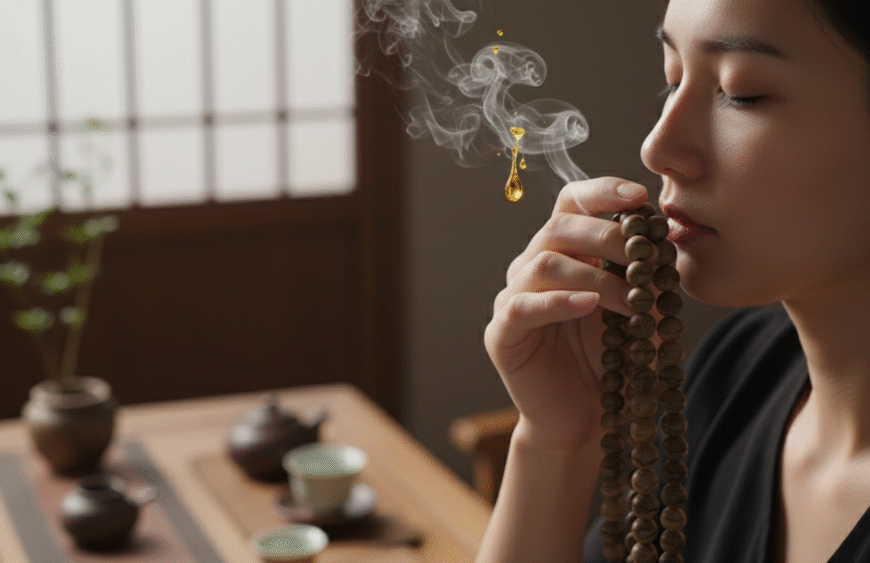
Honestly, in this era of fast-moving consumer goods, very few objects can make my heart tremble and hold my breath. But the moment I invited this Hui’an system old material 108-bead mala out of its storage box and laid it on my desk, a sense of frozen time rushed over me. Having been in the industry for over twenty years and handled countless pieces of Agarwood, seeing this rare natural ‘Tiger Stripe’ still gives me a sense of pressure and reverence from the passage of time—how is this a mere commodity? It is clearly a practitioner reborn from the red soil layers after enduring life’s vicissitudes! Today, I won’t talk to you about dry ‘Grade 1 or Grade 2’ data. I want to drop the title of ‘expert’ and, with the heart of a fragrance seeker, tell you the true story behind these beads—a journey of ‘rebirth’ and ‘destiny’ from the deep mountains of Quang Nam, Vietnam, to your hands. If you are looking for a family heirloom that can anchor your soul and calm your mind, please read on.
Visual Totem: Decades of Practice Under the ‘Tiger Stripe’ Texture
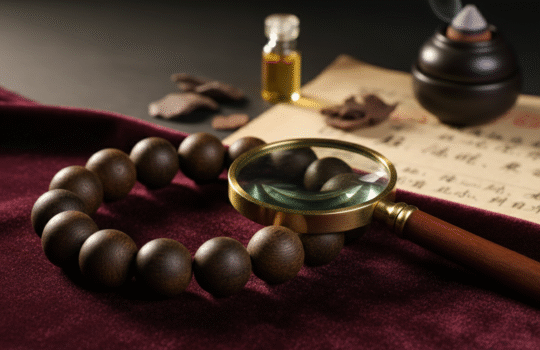
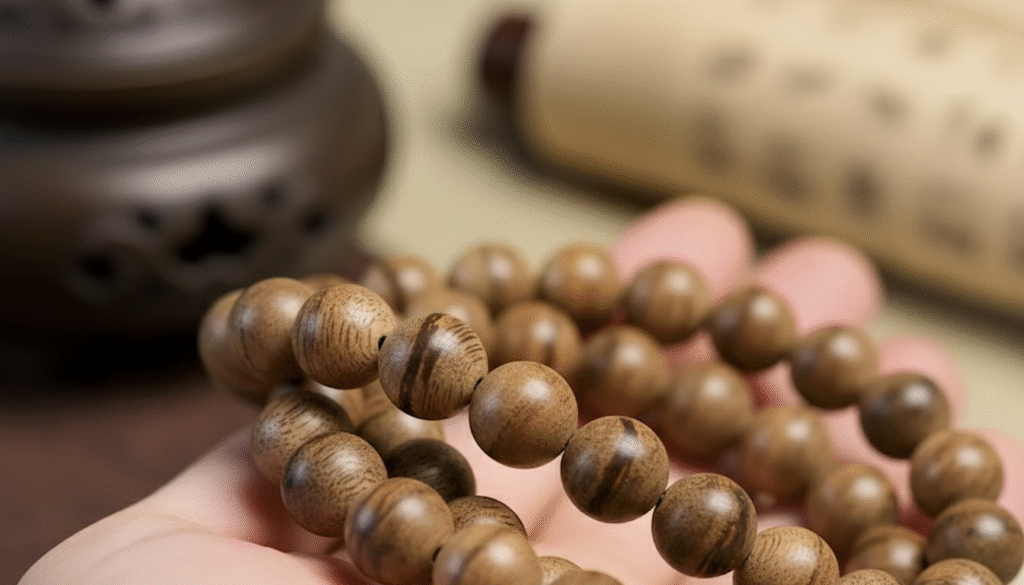
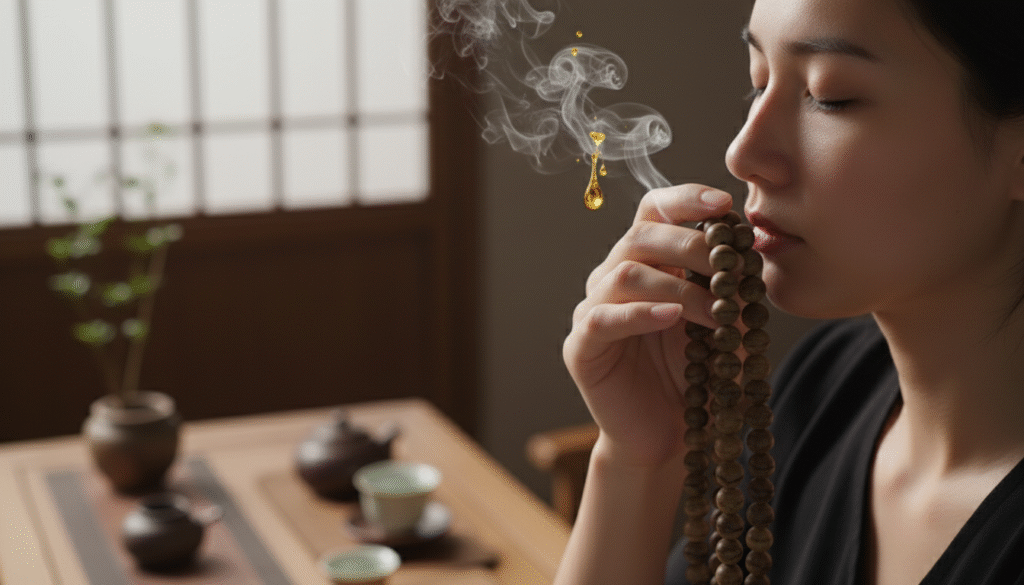
The formation of Agarwood is a tragic struggle between a tree and its wounds. The reason I regard this mala as ‘top-tier’ is its visual directness—it vividly displays the glory of this struggle! Look at these ‘Tiger Stripes’; they are not the stiff lines painted on the market but the result of resin explosively seeping and accumulating along the wood’s vascular bundles during long years of aging. Under natural light, the deep brown oil lines cross the light brown base like bold ink splashes, resembling the patterns on a tiger’s back as it descends a mountain, full of primal vitality. Among the 108 beads, no two textures are identical, as if recording 108 different trials of practice. This sense of resin overflow is incomparable to the ‘fake luster’ of oiled or polished beads; it is a warm, jade-like texture radiating from the inside out—what we call ‘strong aura.’ Truly, holding it in your hand, that heavy weight is the best answer given by time.
Olfactory Synesthesia: The Herbal Scent and Honey Rhyme of the Hui’an System
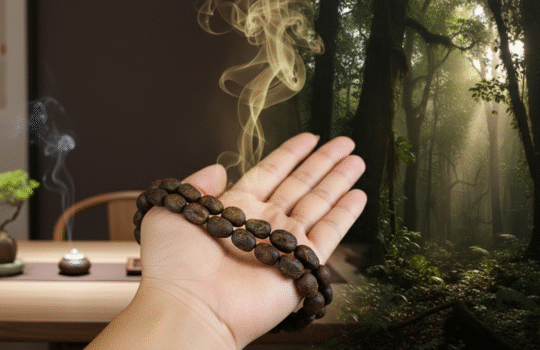
If visuals are the body of Agarwood, the scent is its soul. Many friends ask me, what is the difference between the Hui’an system and the Xingzhou system? As soon as you pick up this old material and sniff, the answer becomes clear. It lacks the intense aggression of Xingzhou; it emphasizes ‘rhyme.’ The top note is the elegant herbal fragrance unique to Hui’an, a tranquil scent that instantly transports you to a Zen room in an ancient temple, smoothing away all anxiety. This batch of naturally air-dried old material has long lost its raw moisture, leaving only the pure resinous aroma. With the warmth of your body when worn, the heart note shifts to a sweet floral honey scent. This sweetness has strong penetration, reaching deep into the core, while the base note carries a hint of cool sweetness. This is not just an olfactory pleasure but a ‘synesthetic’ experience—it allows you to carve out a piece of spiritual pure land for yourself in the noisy city.
Field Record: A ‘Tiger’ Encounter Deep in the Red Soil of Quang Nam
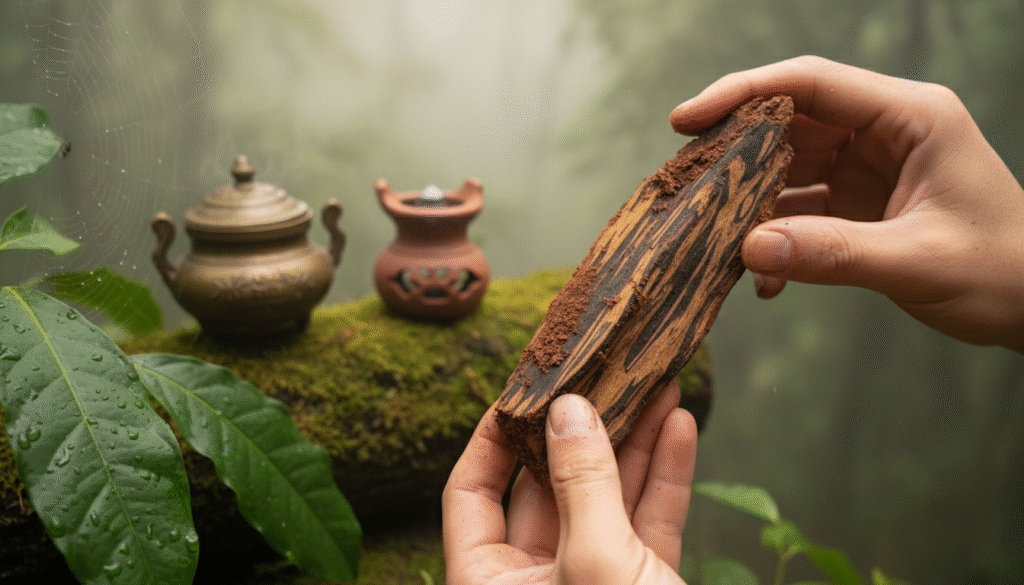
The predecessor of this mala was a piece of ‘plate-head’ old material I acquired four years ago in the mountains of Quang Nam Province, Vietnam. Thinking back still gives me chills—it was the peak of the rainy season, the mountain roads were extremely muddy, and a local farmer took me into a red soil forest area that was virtually untouched. At the base of a fallen tree that had been dead for years, we dug out this unremarkable raw material. Covered in decayed white wood and red mud, my apprentice shook his head, thinking it was a wasted trip. But relying on years of intuition, I insisted the farmer open a ‘window’ on the spot—with that one cut, jet-black resin was instantly revealed, with textures like a crouching tiger and a hidden dragon, and a rich, sweet, cool aroma exploded into the air! At that moment, I knew this was a ‘sarira’ (relic) left by nature. You are not just collecting Agarwood; you are collecting a story of wind and rain from the deep mountains of Quang Nam.\n\n[Expert’s Heartfelt Words] To be honest, this level of ‘Tiger Stripe’ old material is becoming scarcer by the day. I only have a few of these malas left. No matter how high the resolution, photos cannot capture even a tenth of the actual charm. If you are also a fragrance lover or want to see the resin tension when it sinks in water through the lens, feel free to contact me directly. It’s not about the transaction, but for this rare ‘fragrant destiny.’ Let’s chat over tea, and I’ll let you smell the remaining scraps of this raw material—then you will understand what ‘one glance for ten thousand years’ truly means.
FAQs
What amazing changes happen to this ‘Tiger Stripe’ old material after playing with it?
A.This is the ultimate joy of collecting old material! As you play with and wear it, the surface resin becomes more active due to body temperature, forming a transparent oxidation film—commonly known as ‘patina.’ You will be surprised to find the beads’ color becoming deeper and more lustrous, and the originally bold ‘Tiger Stripes’ will gradually appear more restrained and warm, like a decanted red wine. The fragrance will also evolve from a subtle emission to something more mellow and stable. Believe me, this process of ‘the person nurturing the incense, and the incense nurturing the person’ will be addictive.
Q.As an expert, do you have special advice for daily wear?
A.Agarwood has a spirit and needs to be treated well! I must seriously warn: the biggest taboos are chemical reagents. Shampoos, body washes, and perfumes will corrode the resin on the surface—a total waste of a treasure! Additionally, while Hui’an old material has stable wood, avoid long-term exposure to intense sun or soaking in water. I recommend taking them off during showers or sleep and placing them in the matching storage box I prepared for ‘scent recovery.’ Treat it well, and it will stay with you for a long time.
Q.Why is this mala said to have ‘non-renewable’ scarcity?
A.This is not comparable to the plantation Agarwood grown with artificial injections. This mala is made from wild old material from the mountains of Quang Nam, Vietnam. Its unique ‘Tiger’ texture and herbal-honey rhyme are the result of specific high altitudes, mineral-rich red soil, and decades or centuries of natural resin formation. Today, the old material resources in this area are nearly exhausted. For a mala of this quality, even if you have the money in the future, you may not encounter such destiny again.
Q.I’m afraid of buying fakes; how can I distinguish it from the ‘Flower Kinam’ (Hua Qi Nan) on the market?
A.That’s a great question! The most intuitive difference is the naturalness of the texture. Fakes usually have ‘Tiger Stripes’ that are painted or high-pressure soaked; the lines are stiff, blurry at the edges, and float on the surface—it just looks ‘fake.’ For this authentic piece, if you use a magnifying glass, you can see the resin ‘overflowing’ from the vascular bundles, following the wood structure extremely naturally. The scent is worlds apart: fakes only have a single, pungent synthetic smell, while this Hui’an old material has distinct layers of ‘herbal-honey-cool’ transformation that never tires the nose. That kind of penetration is something no technology can imitate.