Legendary ‘Ink Rhyme’ Resurfaces: Why This 108-Bead Sinking Qi-Nan is the ‘Ultimate Hard Currency’ for Collectors?
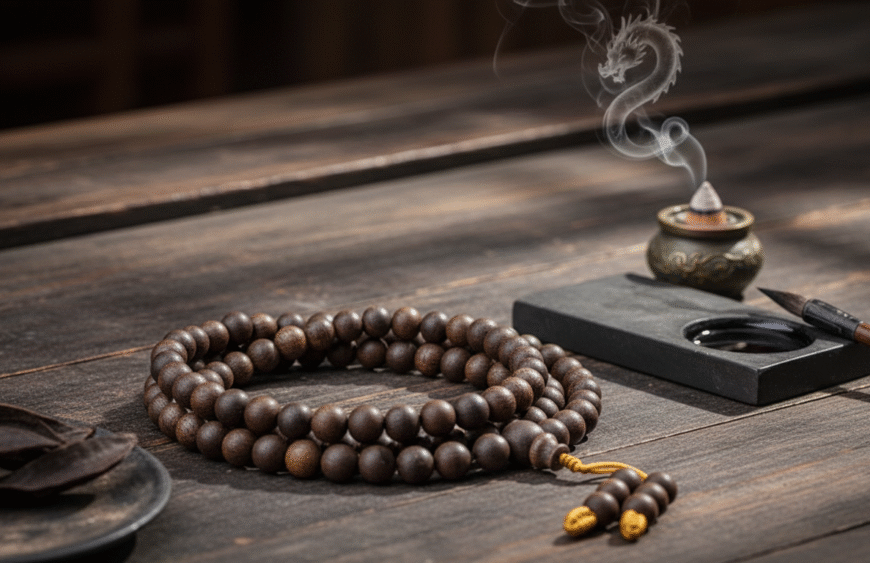
Having navigated the incense world for twenty years, I have handled countless pieces of wood labeled ‘Qi-Nan.’ Truth be told, there are very few moments that truly take my breath away under the lamp. Years ago, an old fragrance hunter living in the deep mountains of Hainan told me: ‘True top-tier Qi-Nan is as dark as ancient ink and as moist as black jade. It is the blood and tears of the tree, the “Ink Rhyme”—it is alive.’ When I first touched this 108-bead sinking-grade Qi-Nan mala, the heavy, sinking sensation instantly awakened that memory. It is more than just beads; it is a relic of time, a century of solitude and rebirth from the heart of the rainforest. Many friends ask me, what is a ‘graduation-level’ collectible? Forget the dry parameters. Today, I will lead you through the microscopic textures of this piece to read the life autobiography written by this ‘Wild Black Gold.’
Olfactory Dimensional Strike: A Century-Old Scent Narrative
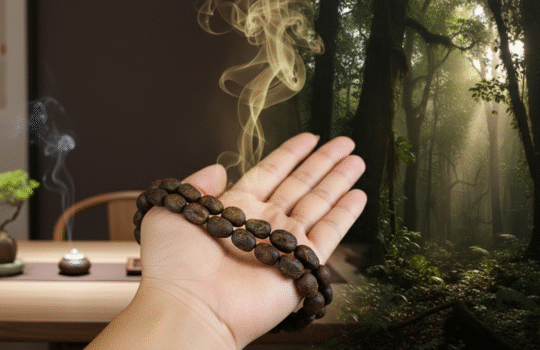
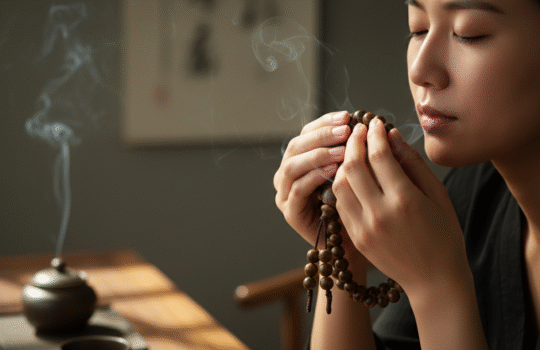
If appearance is the body, then the scent is the soul of agarwood. This Qi-Nan, known as ‘Ink Rhyme National Fragrance,’ offers a scent that is not a single note, but a narrative with a beginning, middle, and end. Upon the first sniff, there is a dominant coolness, as if you are standing in a pristine ancient forest at dawn. This piercing coolness hits the spirit directly—it is the ‘Royal ID Card’ that distinguishes Qi-Nan from ordinary incense. Then, the plot twists: a rich honey-sweetness intertwines with an elegant medicinal aroma, the fragrance left by the tree’s self-healing over long centuries. When worn on the wrist, catalyzed by body temperature, the scent erupts in waves like the lingering resonance of a Guqin. Trust my advice: this soul-cleansing journey that washes away worldly impetuousness is a shock you can never imagine through a screen.
The Truth of ‘Ink Rhyme’ Under the Microscope: Decoding a Century of Suffering and Rebirth
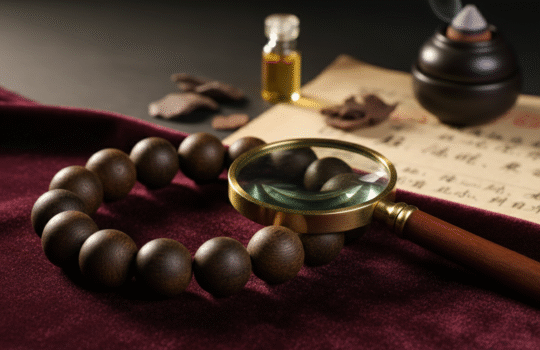
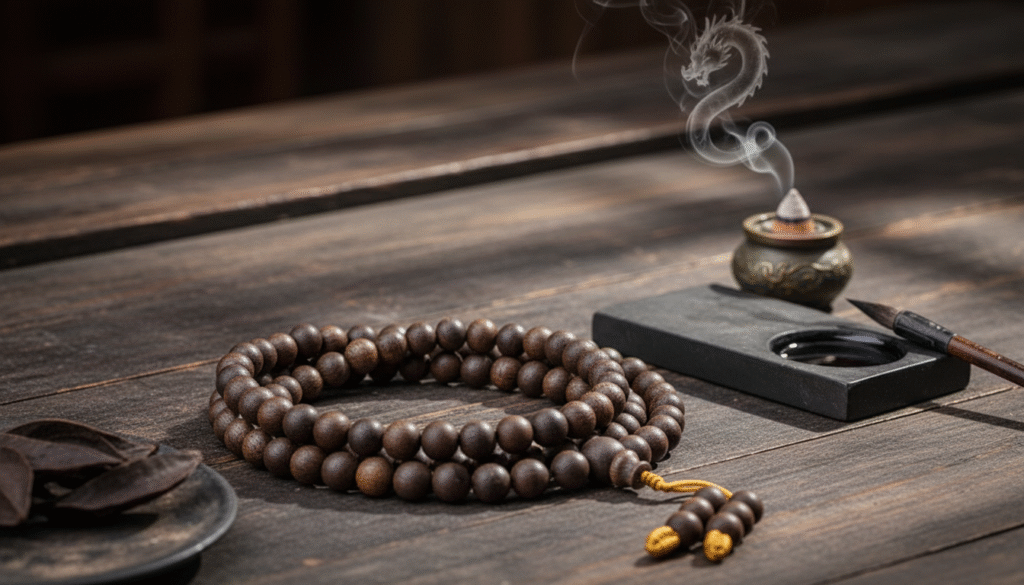
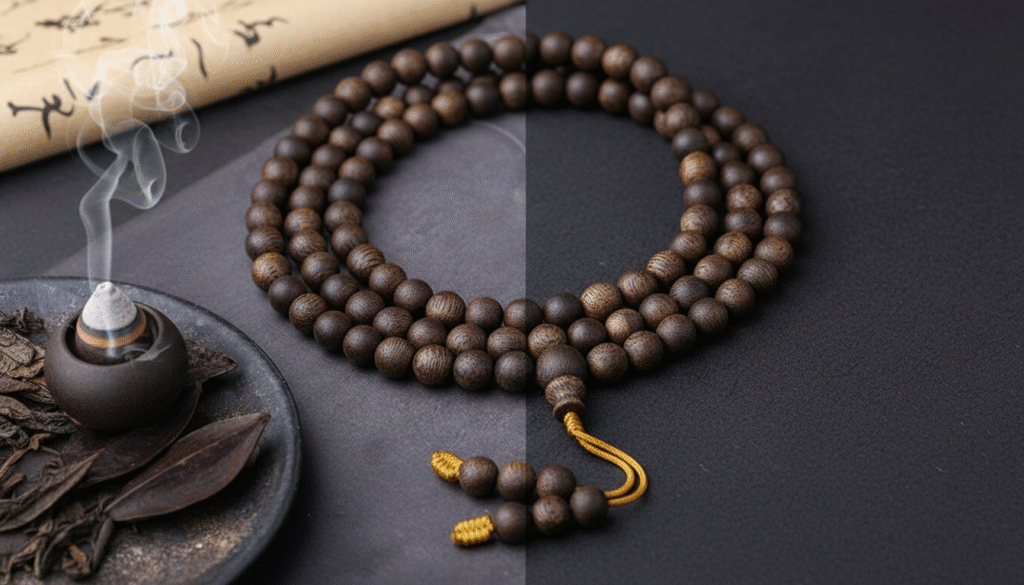
Currently, the market is flooded with ‘technological agarwood’—lifeless black beads made from what was once vibrant wood. True collectors know that top-tier incense is ‘alive’ under a magnifying glass. Look at the microscopic details of these beads; this is the climax of the story. In artificially induced agarwood, the resin is like stagnant water—accumulated and dull. But in this wild sinking Qi-Nan, you can clearly see the resin naturally blooming along the xylem vessels. Those lines of varying depth, like an ink-wash painting, are the ‘marching routes’ of the resin secreted by the tree over centuries of wind, rain, and lightning to resist fungal infection. This microscopic structure of ‘translucent darkness and rhythmic dispersion’ is a vitality that no chemical means can simulate. Each oil line is a certificate of authenticity signed by Nature itself.
The Ultimate Essence of Collecting: More Than a Hard Currency, a Family Spiritual Totem
In turbulent cycles, what are we searching for? A value anchor. Why do I dare to call this 108-bead mala the ‘ultimate hard currency’? Because the word ‘Wild’ means non-renewable. China’s wild agarwood resources are nearly exhausted, and sinking-grade Qi-Nan is usually a treasure hidden deep in an old collector’s chest—every encounter is rarer than the last. It transcends the category of mere playthings and becomes a form of asset allocation, even a carrier of family belief. The specifications are classic, suitable for both daily health cultivation through ‘handling’ and as a family heirloom to pass the ‘scented flame’ through generations. [Expert Conclusion]: Fragrance meets those who understand it; jade is gifted to those with destiny. If you are tired of the confusion in the market and want to see ‘the truth under the microscope,’ or find a legendary scent for your family, click below to connect with me deeply. I don’t sell stories; I only guard the most authentic ‘Ink Rhyme’ legend for you.
FAQs
Q.How is ‘Sinking Grade’ actually determined?
A.’Sinking’ is a physical property and a litmus test for density. This 108-bead mala sinks immediately in water, indicating extremely high resin content with density far exceeding water. However, as an expert, I must remind you: physical sinking is just the threshold. You must combine it with the natural flow of microscopic textures to rule out ‘high-pressure oil-injected’ fakes before it can be certified as authentic.
Q.How to distinguish wild Qi-Nan from artificial agarwood microscopically?
A.Look for ‘Aura’ and ‘Vitality.’ In wild Qi-Nan, the resin lines travel naturally along the plant’s vessels, creating a blooming effect like ink-wash landscapes. In artificial agarwood (or chemically treated ‘medicinal’ incense), the resin is often distributed rigidly, even clogging the pores, appearing as a ‘dead black’ state lacking the luster of life.
Q.What is the biggest difference between Qi-Nan and regular Agarwood?
A.It lies in the ‘Soul’ and the ‘Bone.’ Texturally, Qi-Nan resin has a high hardness but a ‘soft-silk’ waxy feel—it shaves into curls. In terms of aroma, the unique ‘coolness’ and piercing power of Qi-Nan are incomparable to regular agarwood; it is an experience that instantly connects the five senses and hits the soul.
Q.How should this bracelet be maintained daily?
A.The best maintenance is ‘mutual nourishment between human and scent.’ The oils and temperature of the human body are the best nutrients for agarwood. But remember the ‘Three Fears’: fear of chemicals (perfume, detergents), fear of high-temperature sun exposure, and fear of odorous environments. Always remove it when bathing, and place it in a sealed box when not wearing it to let it ‘rest and rejuvenate.’