Beyond the Splendor, Returning to Simplicity: Why This Sinking-Grade Old-Growth ‘Ping’an Wushi’ Tablet Is the Hard Currency of the Collection World?
I remember ten years ago at a border market, I held my breath when an old mountain villager tremblingly pulled out an inconspicuous ‘black lump’—it was genuine ‘lightning-struck wood,’ a unique piece mellowed over a century in solitude! I spent a fortune to acquire it, but let it sit at the bottom of a chest for three years, not daring to touch it. You ask what I feared? Because for this top-tier sinking-grade old material, every cut is a gamble with destiny! Ultimately, I chose the most extreme and luxurious way to showcase it—the ‘Ping’an Wushi’ tablet. Stripping away all complex carvings, I preserved only its original soul. Friends, slow your breathing; today we talk not of business, but of fate. Join me as we step into the century-old rainforest story behind this ‘plain-faced’ pendant.
Rainforest Orphan: ‘Scars of Time’ Under the Microscope
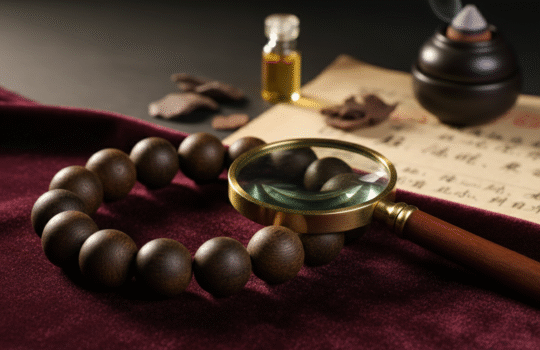
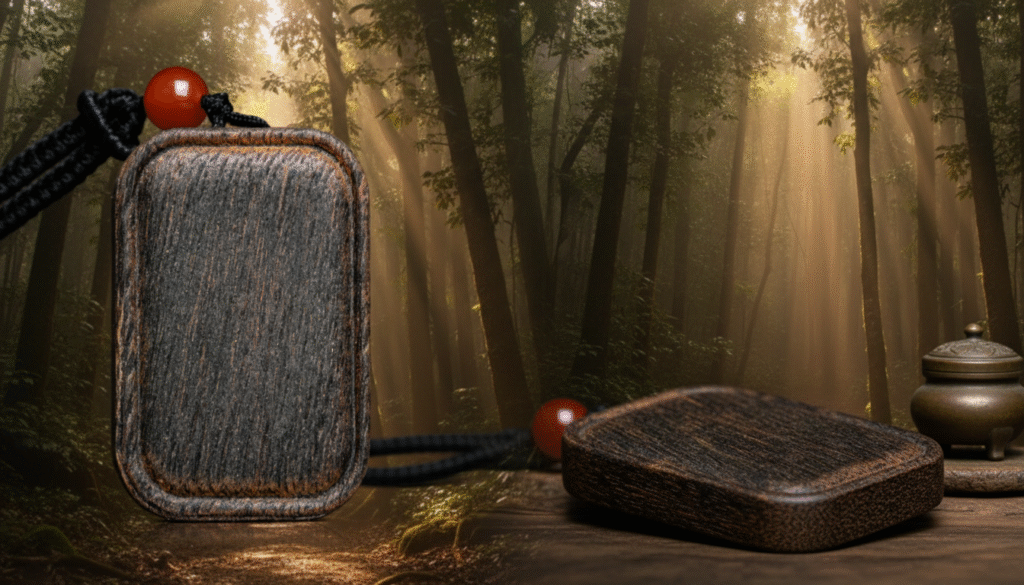
Don’t just look from afar; please lean in, preferably with a magnifying glass! Every thread of black oil vein before you is actually a ‘life-or-death breakout’ this tree experienced a century ago. The silk-like oil veins on this Wushi tablet, as dense as a woven net, are not static patterns but flowing vitality. They are the resins secreted by the tree to protect itself when attacked by fungi, layered over years. Under a macro lens, these dark resins seem to overflow from the wood fibers—this deep base color cannot be simulated by artificial high-polishing; it has a ‘waxy feel’ with body temperature. When you gaze at it, you see not just the ‘sinking grade’ standard of the collection world, but the thunder and silence of countless nights in the tropical rainforest. It is a survivor of time and a unique piece of nature.
The Soul of Medicinal Rhyme: The ‘Qi Sensation’ Philosophy Unique to Old Material
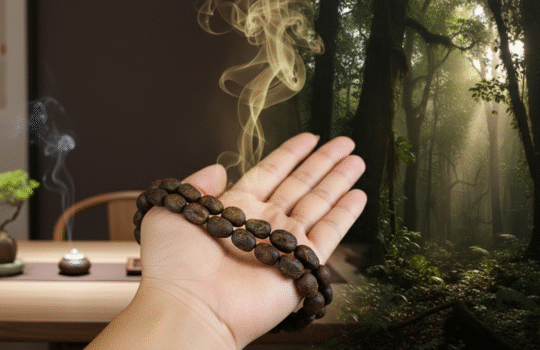
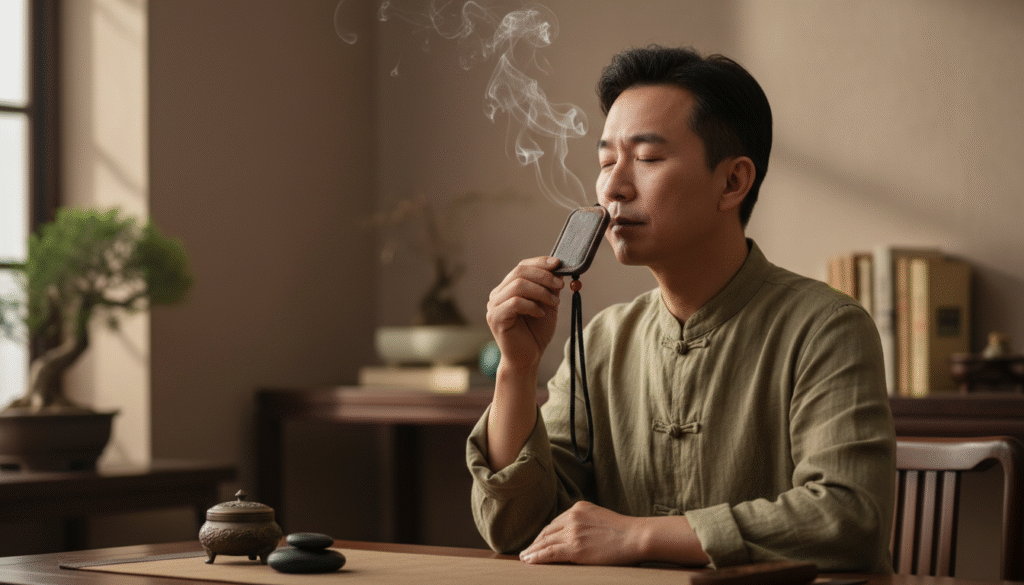
The fragrance of new material often floats on the surface, like a loud shout; the fragrance of this old material, however, is like the whisper of an old friend. When first worn, it might remain silent. But as you warm it against your skin, with the transfer of body temperature, a mysterious ‘Qi sensation’ begins to awaken. It is a scent blending morning frankincense with deep mountain medicinal rhyme—cool and refreshing at first, hitting the brow; then sweet, mellow, and long-lasting. This isn’t just a sensory experience; it’s a power that grounds a restless mind instantly. In ancient times, if a scholar had such a piece of old material in their study, there was no need for incense. What it emits is not just a scent, but a state of mind: ‘Building a hut in the human realm, yet without the clamor of carts and horses.’ This highly penetrating rhyme is the ultimate code for distinguishing wild old material from cultivated Agarwood.
The Art of Subtraction: Why is ‘Unadorned’ the Most Luxurious?
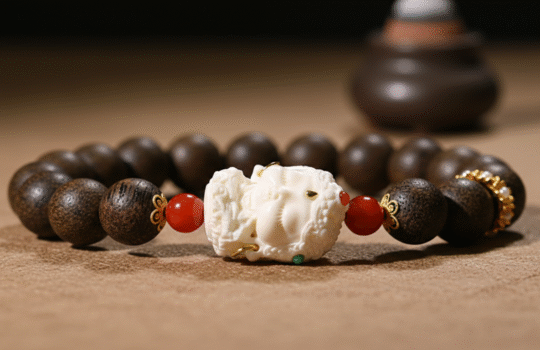
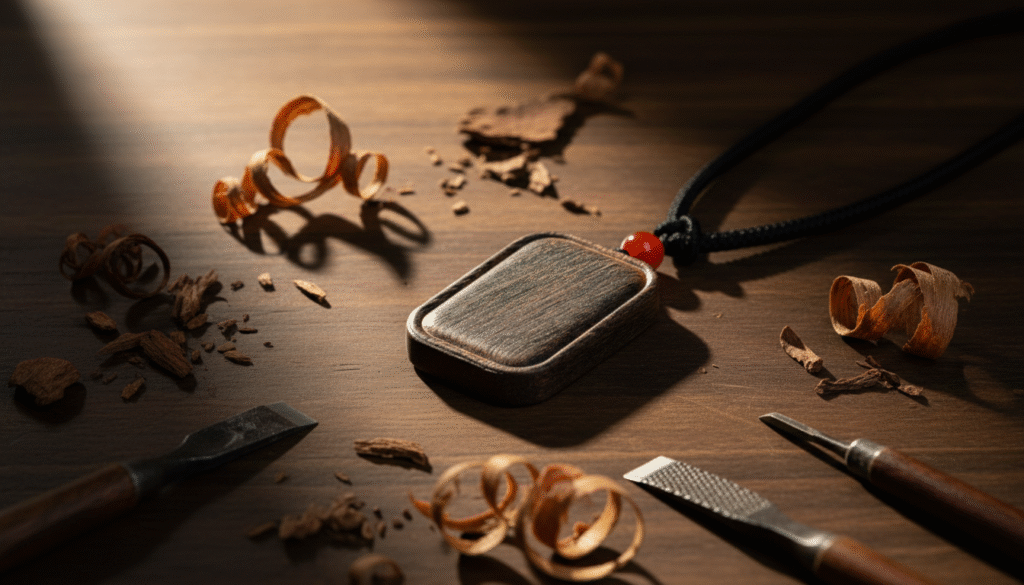
In collection circles, there is a saying: ‘Good material is not carved; carved material is not good.’ Daring to make a Ping’an Wushi tablet is a high-stakes gamble in itself! Imagine: to cut such a regular, thick, and flawless tablet on all four sides means cutting away all possible white sapwood, wormholes, and hollows surrounding this old piece. The waste rate is extremely high, even reaching a staggering 70%. What remains must be the core of the core, the essence of the essence. ‘Wushi’ (No-affairs) means ‘No-adornment’; it has no dragon or phoenix patterns to hide flaws; it honestly displays its truest texture to you. The value of this tablet lies not in how many cuts the craftsman made, but in how much splendor it discarded. If you also want to possess the confidence of ‘great skill appearing clumsy,’ or want to authenticate the Agarwood in your hand, feel free to private message me ‘Pin Xiang’ (Appreciate Fragrance). I will share my ten years of expertise with you.
FAQs
Q. What does the ‘sinking’ characteristic of this Wushi tablet mean for collection?
A. ‘Sinking’ is the watershed of Agarwood collection and the ID card of hard currency. It means the resin content has exceeded the density of water (above 0.5-0.8g per cubic centimeter), representing the longest resin-forming time and highest density. ‘Half-sinking’ or ‘floating’ materials on the market are often priced at only one-tenth of sinking grade. Owning a genuine sinking-grade old material is not just owning a scarce resource, but the best choice for asset preservation and appreciation.
Q. How can I make the patina of this old material more beautiful during daily wear?
A. Remember one phrase: the best maintenance is ‘human nourishment.’ This old material is rich in resin; the constant temperature and trace oils of the human body are its best supplements. When wearing, avoid contact with detergents, perfumes, and other chemicals. In your spare time, gently rub it with a clean cotton cloth or silk. You will find its luster gradually changes from matte to warm and transparent like jade—this is the legendary ‘glass-bottom’ patina, a witness to the fusion of human and fragrance.
Q. Why is the color in the picture not pure black?
A. Good question! This is exactly the true characteristic of wild old material. Genuine top-tier Agarwood shows a natural texture of alternating black and brown, deep and light intertwined during the fusion of wood and resin, rather than a dull pure black. Those ‘Agarwood’ pieces on the market that are pitch black without any texture are often fakes with high-pressure oil injection (Medicine-soaked). The silk-like texture under macro and natural color transitions are precisely its ‘anti-counterfeiting code’ and nature’s most unrepeatable art.