[Expert Records] Chinese Kinam ‘Wushi’ Pendant: Why Dare to Compete on a Plain Surface?
I remember a few years ago at an old fragrance friend’s home in Huidong; heavy rain poured outside while tea smoke curled within. My friend tremblingly pulled a piece of withered wood resembling black iron from the depths of his safe—a century-old Chinese Kinam raw material. At that time, everyone in the industry advised him: ‘Carve a Guanyin, it’s safer.’ After all, nine out of ten old logs are hollow; once cut, if there are flaws, hundreds of thousands of dollars vanish instantly. But he looked at me, gritted his teeth, and said: ‘With meat quality of this level, carving is a crime. I’m going to bet on a plain Wushi.’ As the shrill friction of the cutting machine filled the air, time seemed to freeze. The moment the slice fell, the room went silent, followed by a burst of amazement—full meat, black oil, not a single flaw! The 52mm high, 19mm wide Wushi pendant you see today is the king born from that heart-stopping gamble. It is not just a piece of agarwood; it is a legend of courage and luck.
Tactile Narrative: ‘Soft Gold’ at Your Fingertips
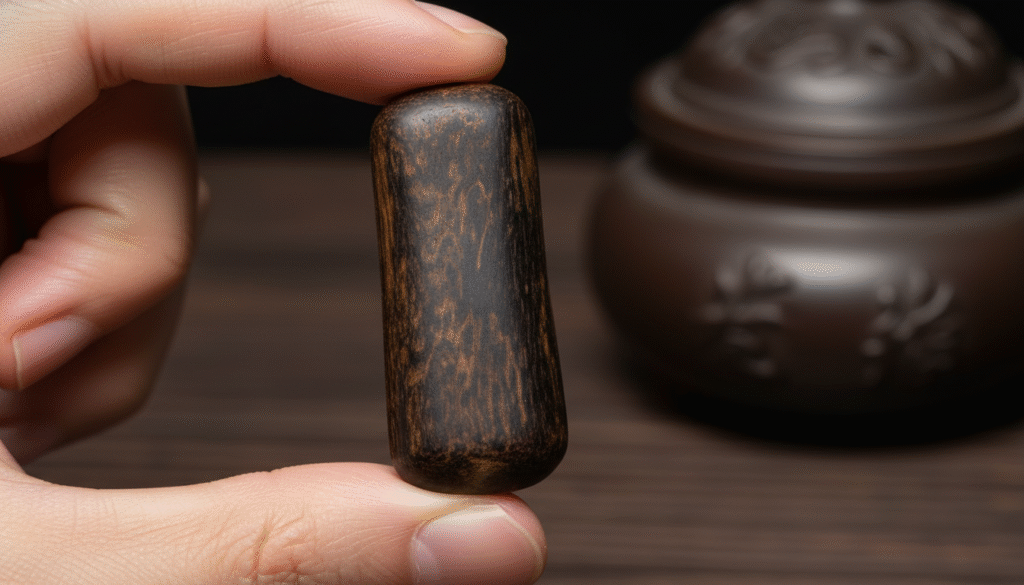
Photos can be edited, but the touch of your fingertips cannot lie. Frankly, having seen countless fragrances, my heart still skipped a beat the moment I held this piece. When you close your eyes and touch this Chinese Kinam, you will be surprised to find it lacks the dryness of wood. Instead, it feels as if your fingers are touching a piece of solidified resin—delicate, warm, and even slightly ‘sticky.’ This is the legendary ‘soft silk’ oil resin. Under a microscope, the oils aren’t just filling the vessels; they have completely softened the wood fibers, forming a ‘wood-oil symbiosis’ colloid. This texture is the result of decades or even centuries of fermentation by time and fungi in the microscopic world. Rubbing it for a long time leaves a fragrance on your fingertips; that moist sensation is like holding a piece of warm black jade that you simply cannot put down.
Visual Philosophy: A Plain Surface is the Greatest Ambition
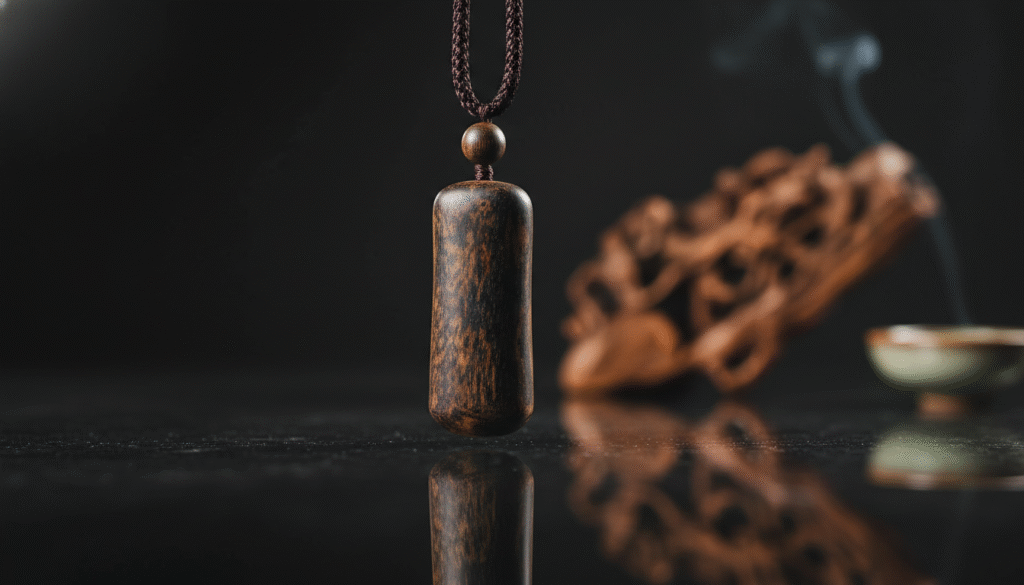
In this impulsive era, people are used to complex decorations to cover up emptiness. But in the world of agarwood, only the top-tier materials dare to face the world with a ‘plain face.’ This 52mm large pendant has no carvings whatsoever. Why? Because carving often means hiding flaws—removing white bark, avoiding wormholes, or cutting out rot. This Wushi pendant dares to expose every inch of its texture to the light of day. Look at those flowing oil lines, naturally smudged like ink-wash landscapes; that is the masterpiece of nature over eons. Wearing it conveys an attitude of ‘No-Decoration’: because the inner heart is abundant enough, no external embellishment is needed.
Olfactory Feast: The Unique ‘Dominant Coolness’ of Chinese Kinam
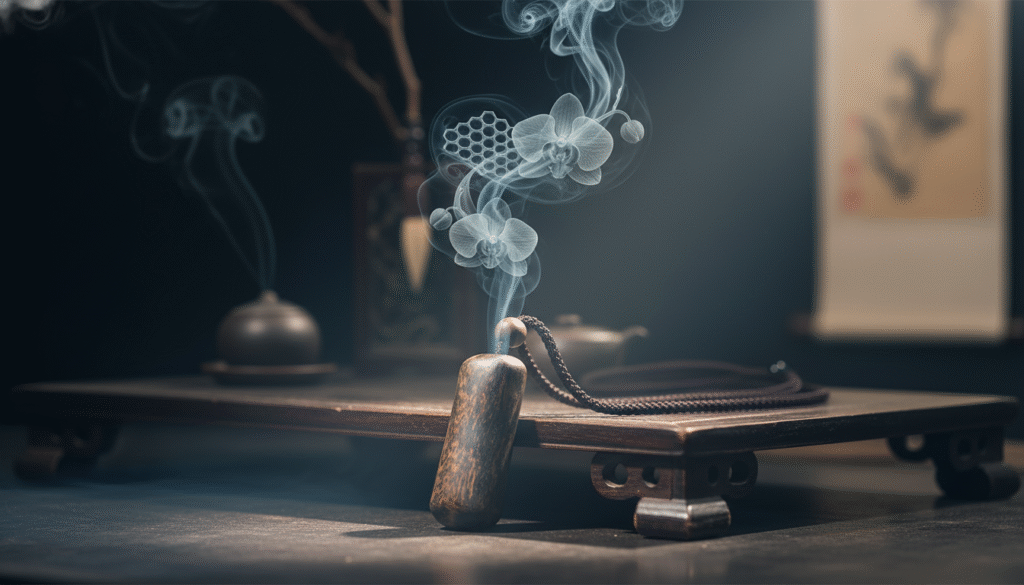
With just a bit of warmth, the soul of Chinese Kinam is awakened. Unlike the elegance of the Huian system or the intensity of the Xingzhou system, the initial scent of this Chinese Kinam is a highly penetrating ‘coolness.’ That coolness is like a sharp sword cutting through the muggy air, rushing straight to the crown of the head, instantly refreshing the mind. Subsequently, the coolness turns to sweetness—a complex fragrance blending wildflower honey and almond milk, so rich it won’t dissipate. The ancients said, ‘An ounce of agarwood is worth an ounce of gold, and an inch of Kinam is worth an inch of sincerity.’ This upright fragrance, nourished by the native soil and water of China, is a cultural memory that no imported fragrance material can replace.
Heritage Value: A Non-Renewable Masterpiece and an Invitation
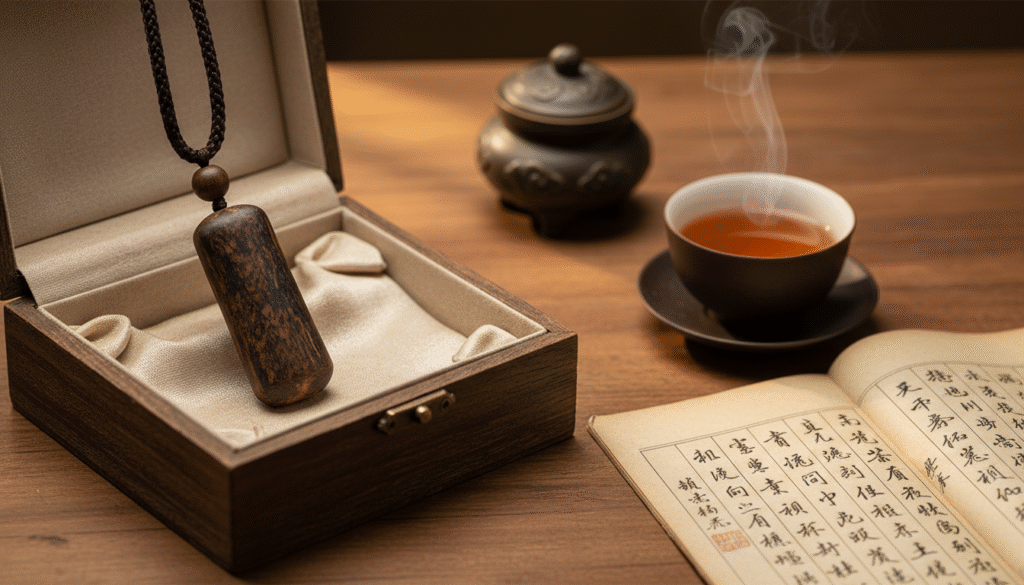
To be realistic, in my thirty years in this industry, I have seen pieces of Chinese Kinam this large with full meat and zero flaws only a handful of times. The birth of every plain pendant means the consumption of a piece of non-renewable, top-tier raw material. This is not just consumption; it is rescue-style collecting. As wild Chinese Kinam resources are exhausted, Kinam of this level is destined to be seen only in auction catalogs in the future. By acquiring it, you are not just keeping an accessory, but a physical textbook of China’s top-tier fragrance culture to pass down to future generations. If you are also a collector obsessed with the ‘ultimate,’ and want to see the oil lines of this material in natural light or discuss its layers of fragrance, welcome to send a private message with ‘Appreciation’ in the background. Good fragrance waits for no one; some destinies, once missed, are gone for a lifetime.
FAQs
Q. Why is a ‘Wushi’ pendant more collectible than carved pieces?
A. In the field of agarwood, especially at the Kinam level, the integrity of the material determines the upper limit of its value. Carving is often used to avoid flaws (such as white bark or hollows), while a ‘Wushi’ (plain) pendant requires the raw material to be in a perfect, solid, and oil-rich state. Therefore, it represents the highest grade of material.
Q. How long can the ‘cool scent’ of Chinese Kinam last?
A. This is the most miraculous part of Kinam. While ordinary agarwood oil evaporates relatively quickly, Kinam oil is a semi-solid waxy state with extremely strong fragrance-locking capabilities. If stored properly, this cool and honey-like scent can last for a century, and its profile changes with the temperature.
Q. How should such an expensive pendant be maintained?
A. The best maintenance is ‘human nourishment.’ Body temperature helps release the fragrance, and skin oils form a protective patina. However, avoid ‘the three’: hot water (which melts the oils), chemical detergents (shower gel or perfume), and odorous environments, as agarwood absorbs surrounding smells easily.
Q. How can you distinguish ‘soft silk’ from its appearance?
A. Visually, hard silk agarwood has a brighter, harder luster with stiff textures. Soft silk Kinam, like this piece, has a matte, oily luster that looks like a layer of wax. The oil lines have a ‘smudged’ edges, as if ink has soaked into rice paper.