Collection-Grade Chinese Kinam: Why This ‘Dark Amber’ Abacus Bead Bracelet is Worthy of Being an Heirloom
Having spent over twenty years in this industry, I have handled countless pieces of agarwood. Yet, to be honest, every time my fingertips touch true ‘National Fragrance’—Chinese Kinam—my heart still feels an indescribable sense of awe. I remember years ago in the depths of Wuzhi Mountain in Hainan, an old incense farmer pointed at a piece of weathered wood with black and red streaks and said: ‘This incense is the blood of the tree and the soul of the mountain.’ There are too many ‘common commodities’ on the market labeled as Kinam, leading many new players to mistakenly believe that anything dark and black is high quality. Today, I don’t want to talk about vague legends. I want to use this rare and luxurious ‘Chinese Kinam Abacus Bead Bracelet’ to help you understand what top-tier ‘resin accumulation’ and ‘scent profile’ really mean. This is no ordinary accessory; it is a series of ‘dark amber’ sariras left to the world after the tree endured lightning, insect bites, and the elements. Take my advice: good incense waits for no one. Understand its soul before you talk about fate.
Visual Evidence: Solidified ‘Dark Amber’ Honey Resin of a Century
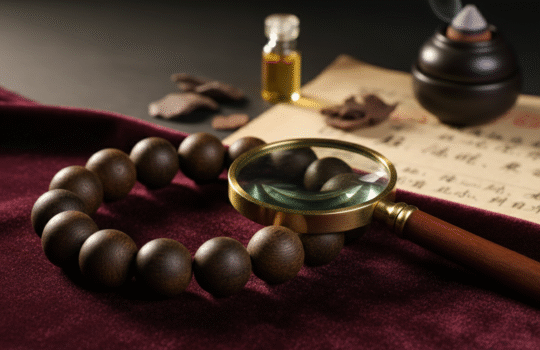
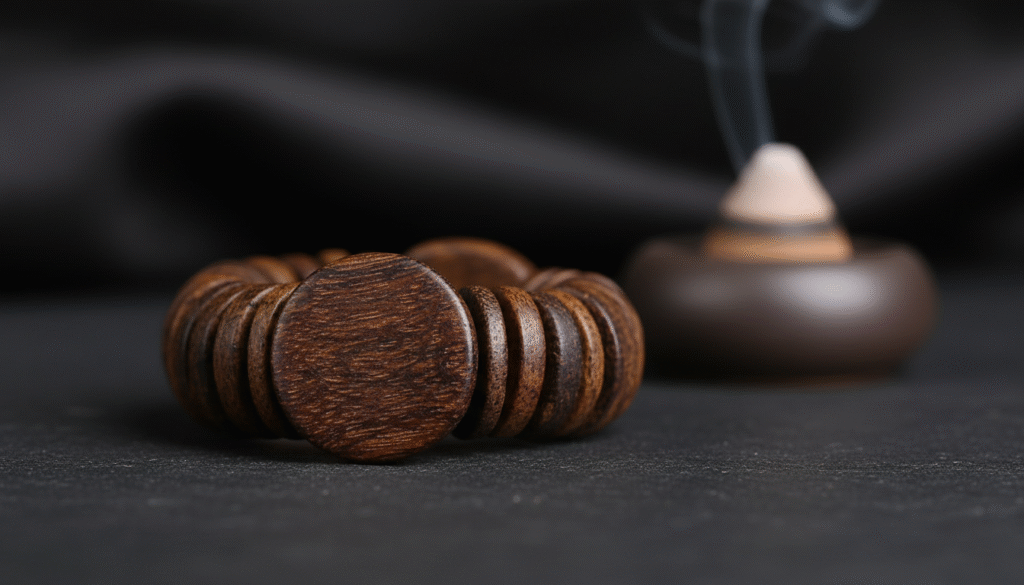
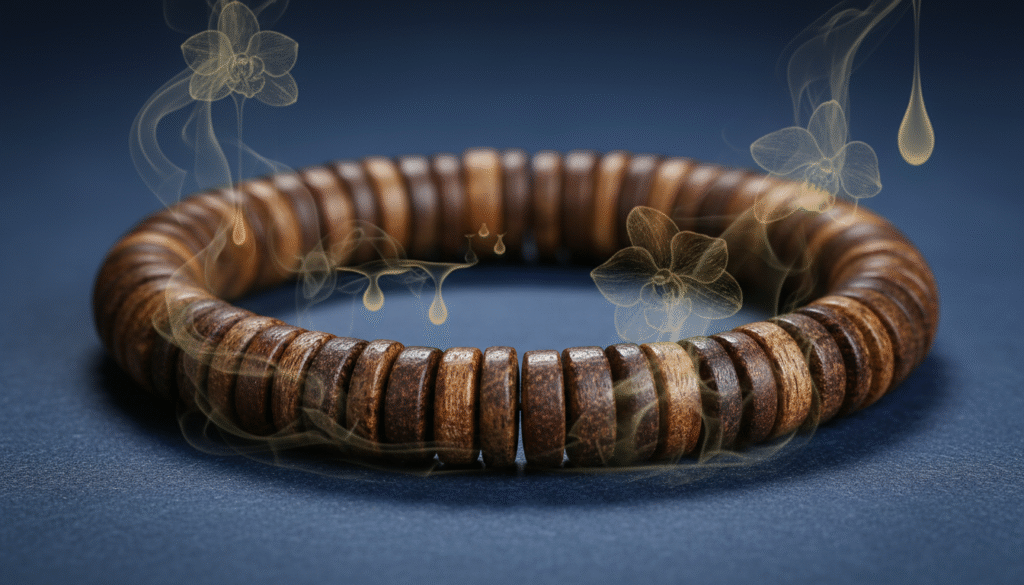
Many friends ask me how to distinguish the ‘spirit’ of Kinam at a glance. Look at this bracelet and you will understand. Please examine the macro details: it has completely shed the dry, woody texture of ordinary agarwood, replaced by a ‘honey-like resinous’ feel akin to solidified honey. This color is not a flat, dead black, but a ‘Dark Amber’ formed by the intertwining of deep brown and golden oil veins. It is a highly deceptive visual experience—appearing as hard as stone, yet under natural light, it reveals the unique waxy luster of rich resin, as if a finger could sink into it with a press. This density tells us that this material was not easily found; it lay hidden under soil and decaying leaves, undergoing at least a century of transformation. Every golden thread running through the beads is evidence carved by time—not painted on, but the result of resin overflowing from every duct. This visual impact is a ‘natural patina’ that no craftsmanship can imitate.
Deep Science: Micro-climate—The Natural Alchemy Behind the ‘Amber Glow’
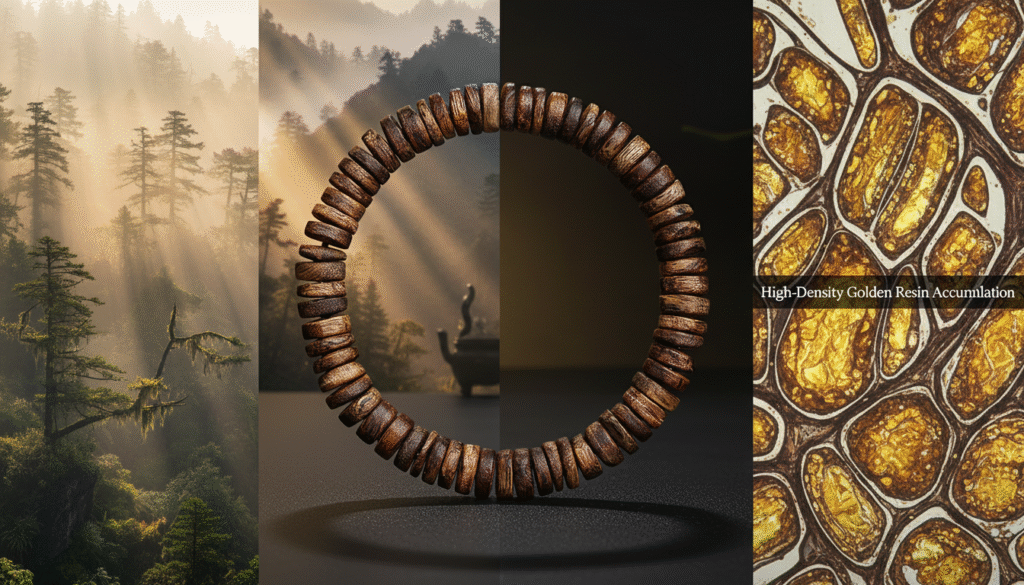
Why is it that Kinam from the core production areas of China can produce this soul-stirring ‘Dark Amber’ color? This is no accident, but the masterpiece of a specific ‘micro-climate.’ Unlike the continuous humid heat of tropical rainforests, Chinese Kinam often grows in cloud forest zones at higher altitudes. Here, the temperature difference between day and night is extreme, accompanied by the active periods of specific fungal colonies. This harsh cycle of temperature and humidity acts like a rigorous alchemist. It forces the agarwood tree, after being injured, to secrete highly active, small-molecule defensive resins to resist fungal invasion. This ‘tug-of-war’ lasting decades causes the resin to penetrate inward and compress, eventually forming the famous ‘Soft Silk’ (Ruan Si) structure. The amber luster we see is actually the physical manifestation of resin highly concentrated after countless cycles of ‘liquefaction-solidification-reliquefaction’ under specific micro-climatic pressure. Every shimmer is a medal of survival left by nature on this wood—true art of time.
Aesthetics of Form: Abacus Beads—The Wisdom of Wearing Between ‘Loss’ and ‘Gain’
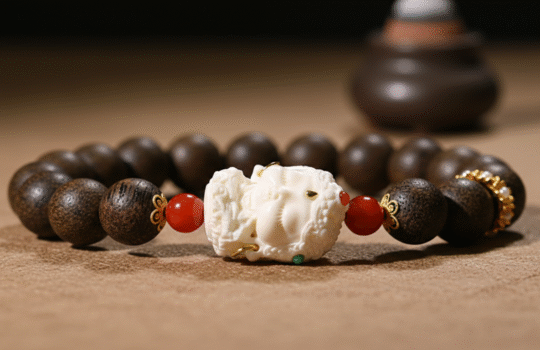
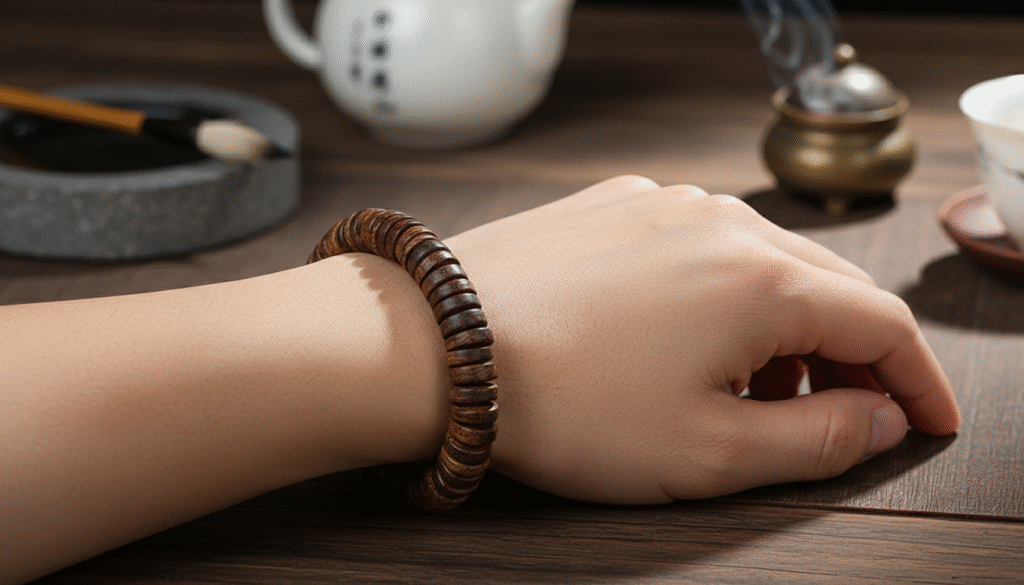
Why was this top-tier material not made into common round beads, but instead into ‘Abacus’ (disc-shaped) beads, a form that is extremely wasteful of raw material? Within this choice lies the great wisdom and ‘willfulness’ of veteran collectors. First, to create uniform abacus beads, the solidity of the raw material must be extremely high; any small hollow will result in a discarded piece. Daring to grind away the edges of Kinam material—which is literally worth more than its weight in gold—to leave only the core disc is a declaration of luxury. Secondly, in terms of wearing aesthetics, abacus beads fit the curve of the wrist perfectly. Tucked inside a sleeve, they are warm and smooth without being bulky. It symbolizes a ‘composed mind’—not flaunting, yet revealing the restrained edge of a scholar and gentleman. This is not just a consideration for comfort, but an aesthetic realm of ‘great ingenuity appearing as simplicity.’
The Soul of Fragrance: A ‘Transcendental’ Experience of Orchid and Milk
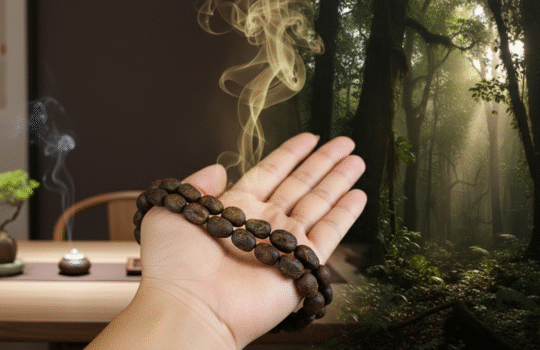
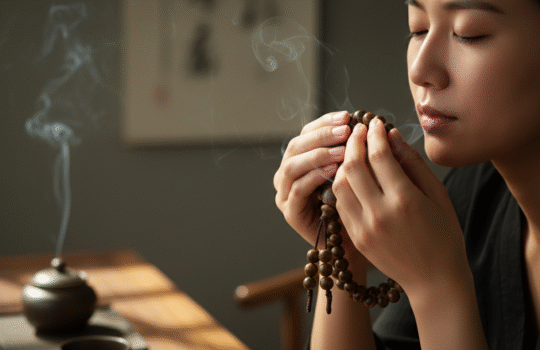
If the appearance is the body, then the scent is the soul of Kinam. The reason Chinese Kinam is revered as the pinnacle of ‘National Fragrance’ lies in its irreplicable penetration. Holding this bracelet, you don’t need to bring it close; a wave of cool air pierces the nostrils, as if you were suddenly transported to a deep mountain valley after rain—this is the signature ‘Cooling Note’ opening of Kinam. As the body temperature warms the beads during wear, the middle note explodes with power—a rich orchid fragrance bursts forth, accompanied by a honey sweetness that is clear and refreshing. When the scent settles, the base note turns into a warm, heavy milky aroma, as mellow as aged wine. This layered transition from cool to sweet to milky is impossible for any synthetic fragrance to simulate. It allows one to instantly find inner peace in a bustling city. This is not just a string of beads, but a portable ‘meditation field.’
Market Insights & Collector’s Note: An Invitation of ‘Fate’
As a practitioner who has stayed at the source for many years, I must honestly tell you a harsh reality: natural, high-quality Chinese Kinam resources are depleting at an alarming rate. Large materials with full resin distribution capable of yielding uniform abacus beads are often intercepted by top collectors the moment they leave the forest, rarely reaching the public market. In the secondary market, these pieces have strong ‘hard currency’ attributes. They are not consumables, but wearable assets. With the scarcity of raw materials, their value appreciation climbs every year. For veteran collectors or elites seeking spiritual solace, acquiring such a ‘graduation-level’ Kinam piece is both an inheritance of traditional incense culture and a steady lock on value. Finally, a word from the heart: connecting with Kinam is about ‘visual fate’ and ‘scent fate.’ If you can feel the tension of this ‘Dark Amber’ through the screen, or simply want to talk about how to identify true Soft Silk, feel free to click the consultation window below. I may not always be online, but when I meet a kindred spirit who understands incense, I will share everything I know. This is not just a consultation; it might be the start of your higher journey in the Way of Incense.
FQAs
Q. How does the micro-climate of Chinese Kinam production areas specifically affect resin formation?
A. The day-night temperature differences at high altitudes and specific fungal environments force the agarwood tree to secrete finer, more active resins to repair injuries. This unique micro-climatic ‘refining’ allows the resin to penetrate deep into the wood fibers (forming Soft Silk), resulting in a highly penetrative scent at room temperature and a honey-like dark amber appearance.
Q. Why is the Abacus (disc) bead shape considered more ‘wasteful’ and precious than round beads?
A. When making round beads, one can use scraps or slightly flawed parts of the raw material. Abacus beads require the raw material to be solid and of uniform thickness across the entire piece, leading to significant loss during grinding. Using Kinam—a material worth more than gold—to make flat beads indicates that the quality of the raw material is exceptionally high and reflects a luxury collection philosophy of ‘quality over quantity.’
Q. What is unique about the scent of this ‘Dark Amber’ bracelet?
A. This bracelet combines the three most charming notes of Chinese Kinam: Cool, Sweet, and Milky. The initial scent is a piercing cool sensation; when heated by body temperature, it explodes with a rich orchid honey sweetness; the base note is a warm, thick milky fragrance. This layering and longevity are characteristics of ‘National Fragrance’ that ordinary agarwood cannot match.
Q. What should I pay attention to when wearing this high-density Kinam bracelet daily?
A. The best maintenance is frequent wearing, as body temperature is the best catalyst for the scent. However, strictly follow the ‘Three Avoids’: avoid water (especially hot water and detergents), avoid high temperatures/direct sunlight, and avoid strong odors (such as perfume or heavy cooking smoke). When not wearing it, it is recommended to place it in a sealed box or porcelain jar to ‘nourish’ the beads and maintain their pure scent.