Collector’s Journal: A Deep Dive into This 95% Sinking Chinese Kinam “Wu Shi Pai” — Why is True “National Fragrance” So Rare?
Having been in this industry for a long time, I’ve handled thousands of top-grade pieces. To be honest, I’ve almost become numb to the term “sinking.” But—whenever I encounter genuine “National Fragrance” (Chinese Agarwood), especially old material with Kinam genetics, my heart still skips a beat. Today, I’m setting aside my identity as an exporter to talk to you as a seasoned hobbyist about this “Kinam Agarwood Wu Shi Pai” that I’m most reluctant to part with lately. It’s not one of those pitch-black, lifeless full-sinking “iron lumps”; it is a perfectly balanced “95% sinking” piece. Trust me, in this state, the interaction between resin and wood structure often hides visual and olfactory secrets more fascinating than those found in full-sinking specimens.
95% Sinking: The Golden Balance Between Resin and Wood
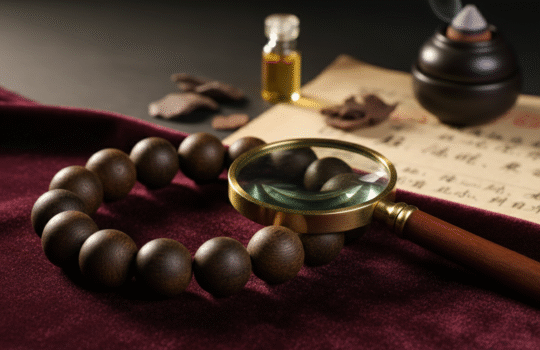
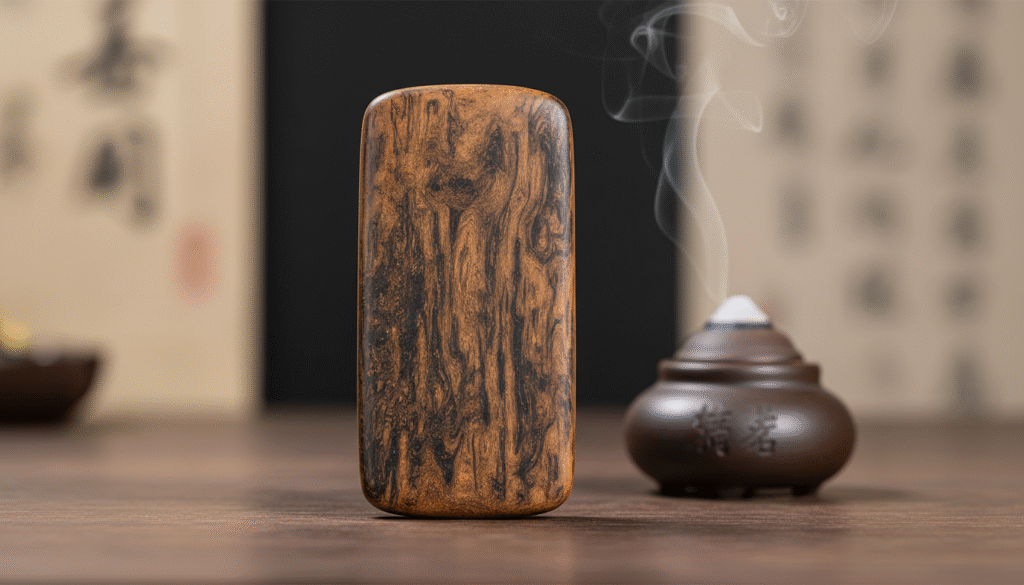
Many newcomers blindly pursue “instant sinking,” believing that sinking immediately in water is the ultimate standard. That is a massive misconception! In the circles of seasoned collectors, we truly appreciate this “95% sinking” state. Look closely at the macro performance of this pendant: the resin lines are dense, penetrating the wood fibers like capillaries, showing a state of high-density entanglement. This is a classic characteristic of Chinese Kinam species—fine, fluid oil lines that move dynamically, unlike the stiff, blocky resin found in some Irian or Malaccan agarwood. This 95% sinking quality means the internal fibers are filled with resin, making it feel heavy in the hand, yet because it retains a hint of “breathability” in the wood, the scent is more diffusive and penetrative than completely carbonized material! When rotated under natural light, you see a restrained, deep glow—a thickness of resin built up over decades or even centuries. This visual impact is something artificial high-pressure oil-injected fakes can never replicate.
Elegance in Simplicity: Why High-Quality Material Shuns the Knife
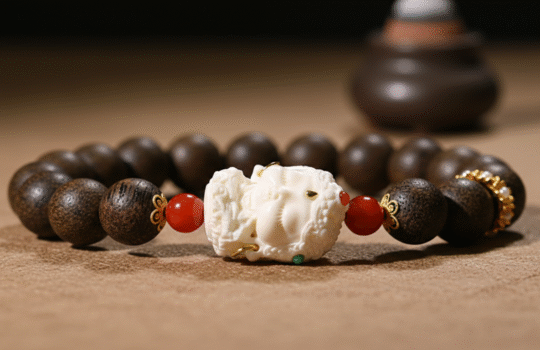
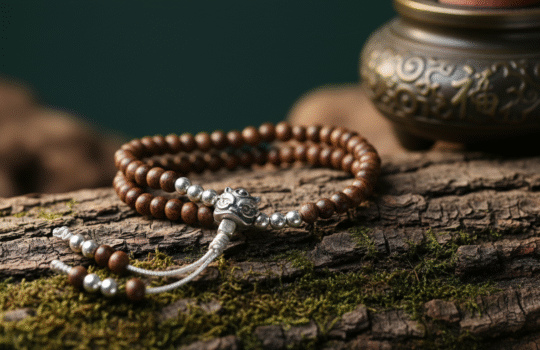
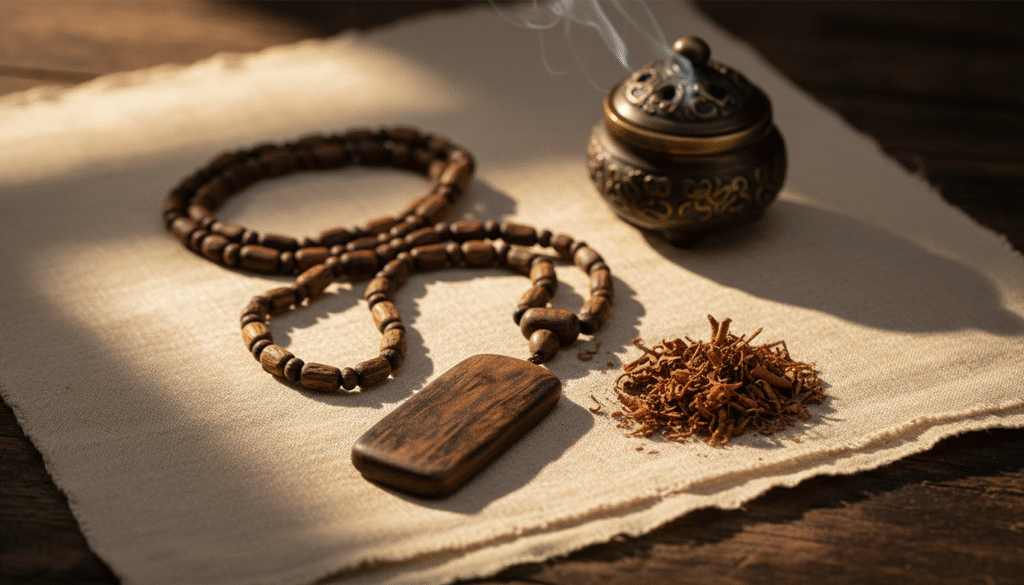
There is a saying in the trade: “Fine material needs no carving.” This Wu Shi Pai adopts a classic minimalist format, with no complex dragons or patterns on the surface, preserving only the natural oil line patterns of the raw material. Why? To put it bluntly: the material is too good to waste! Every cut is a loss of weight, and what is shaved off is literal gold and silver. This “Wu Shi Pai” design (Pendant of No-thingness) reflects the most humble yet luxurious wish in Chinese culture: that life remains peaceful and free of trouble. Furthermore, notice the matching barrel and spacer beads; these are not random fillers but are handcrafted from the same log. Experts know that “same material” beads require sacrificing many precious offcuts! The brilliance of this design lies in its restraint, where the curves of the barrel beads and the straight lines of the pendant complement each other. Wearing it against the skin, you feel a warmth that cold gemstones can never provide.
The Aura of National Fragrance: A Three-Stage Scent Explosion
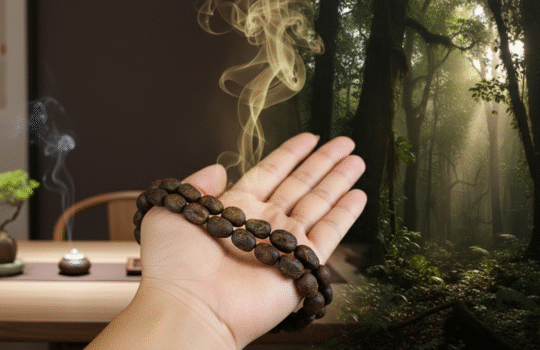
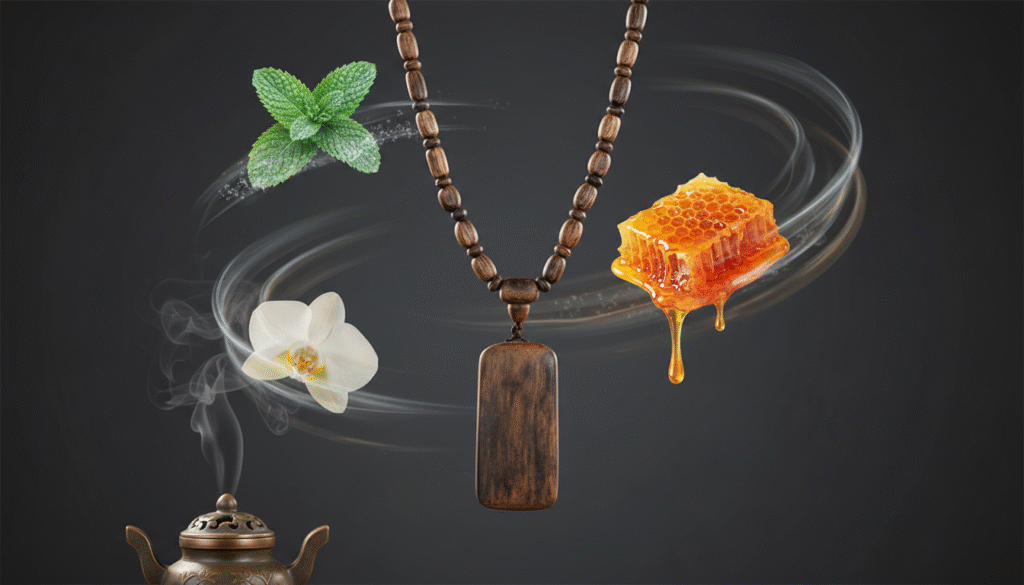
Without scent, agarwood is just a piece of rotten wood. But this pendant earns the title “National Fragrance” solely on its aromatic dominance. When you bring it close to your nose, the initial note is a distinct “coolness,” even carrying a hint of clean medicinal fragrance—this piercing power is a hallmark of Kinam genetics, instantly clearing the mind as if you were in a deep mountain forest at dawn. After wearing it for a while, as it warms with your body temperature, the middle note of rich “honey sweetness” begins to explode—like aged honey dissolved in warm water, thick but not cloying. The most exquisite part is the base note: a faint milky scent mixed with floral tones, highly layered. Unlike the monotonous sweetness of some regions, the scent of Chinese agarwood is alive; it changes with temperature, humidity, and your state of mind. If you are curious about this magical transition from “coolness to sweetness,” or want to see its posture in water, feel free to click for an inquiry and ask me for a high-definition video. Let us meet through the fragrance.
FQAs
Q. What is “95% sinking” and how does it differ from full sinking?
A. Simply put, “95% sinking” means the resin content is extremely high; it mostly sinks in water with only a tiny fraction buoyant. As an expert, I recommend it because its value-for-money is much higher than full-sinking pieces. Because it retains microscopic pores, the diffusion and penetration of the scent are often superior to full-sinking wood where the resin has completely sealed the pores. It is the golden balance for advanced collectors seeking both olfactory pleasure and investment value.
Q. Why is Chinese Kinam-type agarwood called “National Fragrance”?
A. It is due to rarity and scent profile. Agarwood from Chinese regions (like Hainan and Guangdong) has been considered the king of fragrances since ancient times. Material with Kinam genetics is one in ten thousand. Its scent is not single-dimensional but possesses a complex layering of “cool, sweet, milky, and floral” notes. This Zen-like aura is honored as “National Fragrance,” representing the pinnacle of the agarwood pyramid.
Q. How should this Wu Shi Pai be maintained? Will it turn blacker over time?
A. Good fragrance needs to be “nurtured.” Daily wear is easy—just avoid contact with chemical detergents (perfume, soapy water) and prolonged exposure to high heat. The best part is that with long-term wear, your body temperature and natural oils will react with the agarwood, forming a warm “patina.” The pendant will become shinier, the color will deepen, and the scent will become more mellow and dynamic.